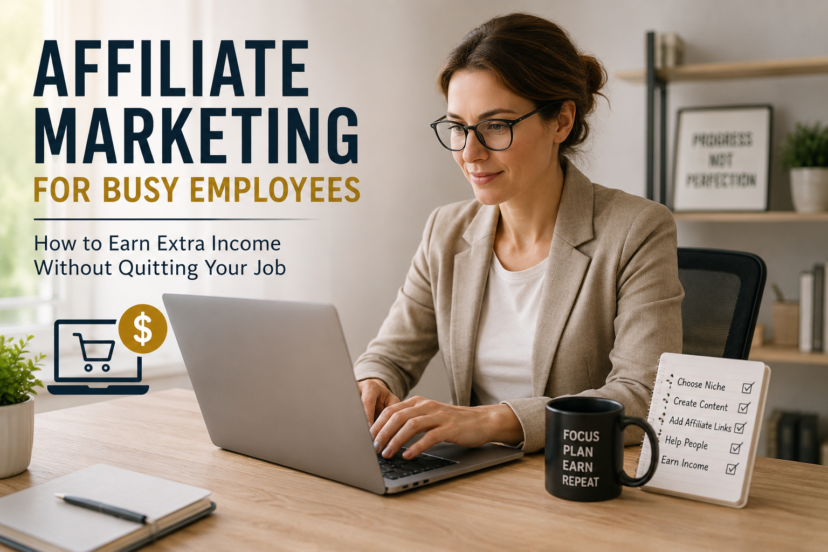
Affiliate Marketing for Busy Employees: The Long-Term Approach That Actually Works
What Most People Get Wrong About Affiliate Marketing
If you’ve spent any time online, you’ve probably seen advertisements promising easy money through affiliate marketing.
But the truth is that affiliate marketing for busy employees looks very different from the flashy promises often seen on social media.
The message usually sounds something like this:
“Sign up for an affiliate program, post some links, and start earning commissions.”
Unfortunately, reality is very different.
Many beginners join affiliate programs on their first day.
They place affiliate links everywhere.
Then they wait.
And wait.
And wait.
A few weeks later, they become frustrated because no commissions appear.
The problem isn’t affiliate marketing.
The problem is the approach.
Affiliate marketing is not about links.
It’s about helping people.
It’s about building trust.
And most importantly, it’s about attracting visitors before trying to sell anything.
Why Affiliate Marketing Is Perfect for Employees
Affiliate marketing is one of the few online business models that fits naturally around a full-time job.
You don’t need:
- inventory
- customer support
- employees
- office space
You can work on your business:
- after work
- on weekends
- during spare time
Even one hour per day can be enough to make meaningful progress.
Unlike a second job, you’re building something that can continue generating results long after the work is done.
Every article, Pinterest Pin, and email subscriber becomes part of an asset you own.
That’s why affiliate marketing is particularly attractive for busy employees.
→ How to Start Affiliate Marketing as a Beginner
The Biggest Myth About Affiliate Marketing
The biggest myth is that affiliate marketing starts with affiliate products.
It doesn’t.
Affiliate marketing starts with an audience.
Imagine opening a shop in the middle of a desert.
You have fantastic products.
Competitive prices.
Great customer service.
But nobody knows your shop exists.
How many sales will you make?
Probably none.
The same principle applies online.
Without visitors, even the best affiliate offers won’t generate income.
That’s why traffic comes first.
Monetization comes later.
→ Best Side Hustles for Busy Employees
The Foundation Comes First
Before worrying about commissions, focus on building a strong foundation.
This foundation consists of four key elements:
A Niche
Choose a topic you can write about consistently.
Examples include:
- side hustles
- personal finance
- fitness
- productivity
- smartwatches
- online business
Content
Create helpful articles that answer questions.
Traffic
Use Google and Pinterest to attract visitors.
Trust
Help people before trying to sell anything.
When these elements are in place, affiliate marketing becomes much easier.
Choosing a Profitable Niche
Your niche is the foundation of everything.
A niche should meet three requirements:
Interest
You should enjoy learning about it.
Demand
People should actively search for information.
Monetization Potential
Products and services should exist that help solve problems in that niche.
The side hustle niche works particularly well because people are actively searching for ways to improve their income.
Why Content Is Your Real Asset
Most beginners underestimate the power of content.
Think of each article as a digital employee working for you.
A single article can:
- rank on Google
- attract Pinterest visitors
- build trust
- generate email subscribers
for years.
The more helpful content you publish, the more opportunities you create.
This is why I recommend focusing heavily on content creation during the early stages.
Building Traffic Before Monetization
Many beginners ask:
“When should I start promoting affiliate products?”
My answer is simple:
Not yet.
First build traffic.
Without traffic, affiliate links are almost worthless.
Instead, focus on:
- publishing articles
- creating Pinterest Pins
- improving SEO
- building your email list
Traffic is the engine that powers affiliate marketing.
The Power of Pinterest Traffic
Pinterest is one of the most overlooked traffic sources online.
Unlike traditional social media platforms, Pinterest functions more like a search engine.
People visit Pinterest looking for solutions.
They search for:
- side hustle ideas
- work-from-home jobs
- online business strategies
- budgeting tips
A well-designed Pin can continue generating traffic for months or even years.
That’s why every article on this website is supported by multiple Pinterest Pins.
The goal is not immediate sales.
The goal is visibility and traffic.
Why Email Marketing Matters
Many experienced marketers say:
“The money is in the list.”
There is a reason this phrase has survived for decades.
An email list allows you to communicate directly with people who are interested in your content.
Instead of relying entirely on Google or Pinterest, you can stay in contact with your audience.
Email subscribers often become:
- loyal readers
- repeat visitors
- future customers
This makes email marketing one of the most important long-term assets you can build.
When Should You Add Affiliate Links?
There is no perfect number.
However, I generally recommend focusing on content and traffic first.
For example:
- 20–30 quality articles
- consistent Pinterest activity
- growing email list
- regular visitors
At this stage, you’ll have enough data to understand what your audience wants.
Then you can introduce affiliate recommendations naturally.
Choosing Affiliate Products Later
Once traffic begins arriving, choosing affiliate products becomes much easier.
You’ll already know:
- what visitors are reading
- which topics are popular
- what problems people want solved
This allows you to recommend products that genuinely fit your audience’s needs.
Helpful recommendations usually outperform aggressive sales tactics.
Realistic Income Expectations
Affiliate marketing is not a get-rich-quick scheme.
Most successful affiliate marketers spend months building content before seeing significant results.
A realistic progression might look like this:
First 3 Months
Learning and content creation.
Months 3–12
First visitors and occasional commissions.
Year 1–3
Growing traffic and increasing income.
The biggest advantage belongs to those who stay consistent.
→ How Much Can You Really Earn with a Side Hustle?
Common Beginner Mistakes
Focusing on Commissions Too Early
Build trust first.
Publishing Too Little Content
Content is your inventory.
Ignoring Pinterest
A huge missed opportunity.
Not Building an Email List
One of the biggest mistakes beginners make.
Quitting Too Soon
Success often comes later than people expect.
→ Why Most People Fail at Side Hustles
My Recommended Strategy
If I were starting today as a busy employee, I would follow this roadmap:
Step 1
Choose a niche.
Step 2
Publish 20–30 helpful articles.
Step 3
Create multiple Pinterest Pins for every article.
Step 4
Build an email list.
Step 5
Grow traffic.
Step 6
Analyze visitor behavior.
Step 7
Add relevant affiliate offers.
Step 8
Scale the system.
This approach takes longer.
But it also creates a much stronger business.
→ How to Start a Side Hustle with No Money
Conclusion
Affiliate marketing is one of the best side hustles for busy employees.
However, success rarely comes from chasing commissions.
It comes from helping people.
Create valuable content.
Build traffic.
Earn trust.
Then introduce affiliate recommendations that genuinely help your audience.
If you follow this approach consistently, affiliate marketing can become a powerful long-term income stream.