
Why Most People Fail at Side Hustles (And How to Avoid It)
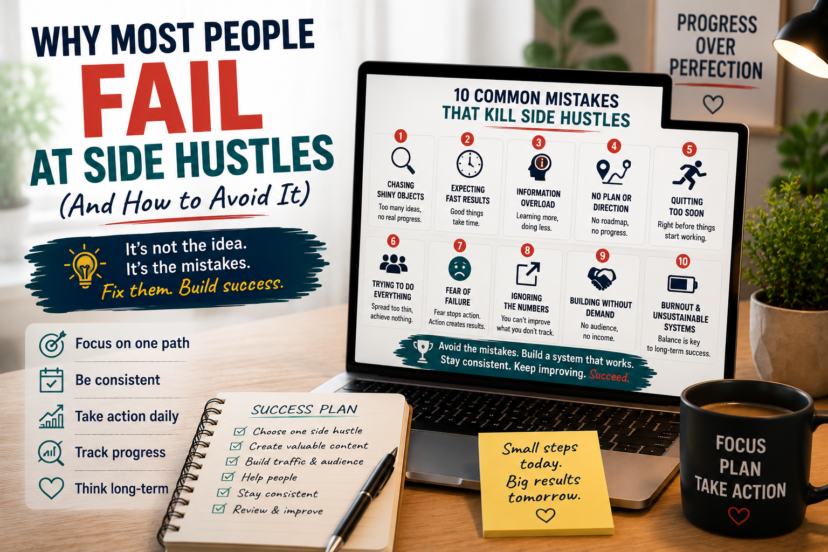
Introduction
Starting a side hustle is exciting.
For a while.
You discover a business idea, watch a few videos, create a plan, and imagine what an additional income could eventually mean for your life.
Then reality arrives.
Your first blog posts receive almost no traffic.
Nobody replies to your freelance offer.
Your Pinterest pins get impressions but few clicks.
Your digital product doesn’t sell.
Or you simply come home after a long day at work and don’t have the energy to spend another three hours building a business.
This is where many side hustles begin to disappear.
But understanding why most people fail at side hustles requires more than saying that people aren’t motivated enough.
Sometimes the business model is wrong.
Sometimes expectations are unrealistic.
Sometimes there isn’t enough demand.
Sometimes people are working hard on tasks that don’t actually move the business forward.
And sometimes a perfectly reasonable side hustle simply doesn’t fit someone’s available time, skills, or personality.
The useful question isn’t:
“Why am I failing?”
It’s:
“What isn’t working yet, and what can I change?”
That’s what we’ll examine in this guide.
If you’re still deciding which model fits you, Best Side Hustles for Beginners in 2026 compares several realistic options and explains the difference between service-based income and longer-term asset building.
First: What Does “Failure” Actually Mean?
This is worth defining.
A side hustle isn’t necessarily a failure because it hasn’t made money after one month.
But it also isn’t automatically successful just because you’ve continued working on it for a year.
Time alone doesn’t determine success.
What matters is whether you’re gradually creating evidence that the model can work.
That evidence might include:
- your first client inquiry
- increasing website impressions
- your first Pinterest clicks
- growing email subscribers
- affiliate link clicks
- your first product sale
- repeat customers
- your first commission
These are signals.
They show that something is beginning to connect.
If you’re working consistently but none of the important numbers are moving, the answer isn’t necessarily:
“Just keep going.”
Sometimes you need to change something.
Persistence matters. But persistence without evaluation can become wasted effort.
Mistake #1: Choosing a Side Hustle for the Wrong Reason
One of the earliest mistakes happens before the work even begins.
People choose a business model because someone else says it’s profitable.
They see:
“Start affiliate marketing.”
“Sell digital products.”
“Become a freelancer.”
“Start a blog.”
And they think:
That must be the answer.
But a business model that works for someone else may be completely unsuitable for you.
Imagine choosing freelance social media management when you dislike client communication.
Or starting a blog when you hate researching and writing.
Or choosing reselling when you don’t enjoy sourcing, photographing, listing, packing, and shipping products.
The theoretical income potential doesn’t matter much if you can’t realistically stick with the work required to produce it.
What to Do Instead
Before choosing a side hustle, consider three things:
Your skills: What can you already do reasonably well?
Your personality: What type of work can you tolerate or even enjoy repeatedly?
Your situation: How much time, energy, and money can you realistically invest?
If you need more ideas before deciding, 7 Realistic Side Income Ideas for Employees gives you several models specifically suited to people building something alongside a regular job.
Mistake #2: Chasing Shiny Objects
This is one of the most common traps in online business.
You start blogging.
Two weeks later, you discover a video explaining why digital products are better.
So you change direction.
Then someone says affiliate marketing is easier.
You switch again.
Then AI automation appears.
Then YouTube.
Then another platform.
Six months later, you’ve learned the basics of six business models but haven’t built one of them properly.
Why Constant Switching Creates Problems
Every model has a learning curve.
A blogger needs to learn content creation, SEO, and traffic.
A freelancer needs to learn positioning, client acquisition, pricing, and delivery.
An affiliate marketer needs content, traffic, trust, and conversion.
A digital-product seller needs a useful product, an offer, and buyers.
If you repeatedly switch before reaching the stage where your efforts can be tested, you keep returning to the beginning.
What to Do Instead
Choose one primary business model.
Then give yourself enough time to collect meaningful data.
That doesn’t mean stubbornly continuing forever.
It means not abandoning a strategy simply because another one looks easier from the outside.
Mistake #3: Expecting Results Too Quickly
This mistake is understandable.
Online business content often focuses on outcomes.
You see:
- revenue screenshots
- traffic charts
- successful product launches
- large email lists
- affiliate commissions
What you don’t always see is everything that happened before those results.
That can create distorted expectations.
A beginner publishes five articles and wonders why Google isn’t sending thousands of visitors.
Someone creates ten Pinterest pins and expects immediate traffic.
Another person sends three freelance proposals and concludes that freelancing doesn’t work.
The problem isn’t necessarily the business.
The sample size is simply too small.
Replace Deadlines With Milestones
Instead of saying:
“I need to earn €500 within 30 days.”
try breaking the process down.
For example:
Freelancing:
Create offer → contact prospects → get responses → first client → repeat client
Blogging:
Publish useful content → gain impressions → receive clicks → build audience → monetize
Affiliate marketing:
Create content → attract relevant visitors → generate affiliate clicks → first conversion
This allows you to see progress before the final income goal arrives.
If €500 is your first target, How to Make Your First €500 Online explains how to turn that number into smaller, measurable steps rather than treating it as an arbitrary deadline.
Mistake #4: Consuming More Than Creating
Learning feels productive.
That’s why this mistake is so easy to make.
You watch another tutorial.
Read another article.
Listen to another podcast.
Download another guide.
Ask another AI tool for another strategy.
At the end of the week, you know more—but your business hasn’t actually changed.
There is a point where more information stops being the bottleneck.
You need to produce something.
That could mean:
- publishing an article
- creating a service offer
- contacting a potential client
- listing a product
- creating a Pinterest pin
- sending an email
- publishing a landing page
Use Just-in-Time Learning
Instead of trying to learn an entire business before starting, learn what you need for your next task.
If your next task is publishing your first article, learn enough WordPress to publish it.
You don’t need to understand every WordPress feature.
If your next task is creating a Pinterest pin, learn enough Canva to create that pin.
Learn.
Apply.
Then learn the next thing.
This prevents months of preparation from replacing actual progress.
Mistake #5: Trying to Do Too Much
This is slightly different from chasing shiny objects.
You may remain committed to one business but try to build every part of it simultaneously.
For example:
You start a blog and immediately decide you need:
- 50 articles
- YouTube
- affiliate marketing
- an email funnel
- three lead magnets
- a digital product
- a newsletter
Suddenly, your “side hustle” requires 30 hours per week.
That’s not a motivation problem.
It’s a planning problem.
Build in Layers
A more realistic content-business sequence might be:
Website → Useful Content → Traffic → Email Audience → Monetization
That doesn’t mean you must finish one stage completely before touching the next.
It means you know what your current priority is.
If traffic is currently your bottleneck, creating five new products probably isn’t the most important task.
If you have traffic but no way to keep in contact with visitors, building your email list may deserve more attention.
The priority should follow the bottleneck.
Mistake #6: Working Without Knowing What the Goal Is
“Work on my side hustle” isn’t a useful task.
Neither is:
“Grow my website.”
What exactly are you trying to achieve?
A good goal connects your actions to a measurable outcome.
Instead of:
“Work on Pinterest.”
try:
“Create three new pins for Article 12.”
Instead of:
“Improve my blog.”
try:
“Update two older articles and add relevant internal links.”
Instead of:
“Start freelancing.”
try:
“Define one service and contact five potential clients.”
Specific tasks are easier to complete.
They also make progress visible.
Mistake #7: Ignoring the Numbers
Persistence becomes much more useful when it’s combined with data.
Suppose you’ve published 40 blog posts and traffic remains very low.
The answer isn’t automatically:
“Publish another 40.”
Investigate.
Are your pages being indexed?
Are you targeting searches that are too competitive?
Are people seeing your pages in search results but not clicking?
Are your Pinterest pins getting impressions but no outbound clicks?
Are visitors clicking affiliate links but not buying?
Different problems require different solutions.
Look for the Bottleneck
For a blog, you might examine:
Impressions → Clicks → Visitors → Subscribers → Revenue
For affiliate marketing:
Visitors → Affiliate Clicks → Conversions → Commission
For freelancing:
Outreach → Replies → Conversations → Clients → Repeat Work
If 100 people receive your freelance offer and nobody replies, you have a different problem than someone who gets ten conversations but no clients.
Data helps you locate the problem.
Then you can work on the right thing.
Mistake #8: Building Something Nobody Wants
This is one of the most important reasons a side hustle can fail—and persistence alone won’t solve it.
You can create an excellent product that nobody needs.
You can write a detailed article about something nobody searches for.
You can offer a service businesses don’t value enough to pay for.
You can create a lead magnet your audience doesn’t want.
Hard work doesn’t automatically create demand.
Look for Evidence of Demand
Before investing heavily, look at what people already do.
What questions are they asking?
What problems appear repeatedly?
What products are they already buying?
What services are businesses already hiring people to perform?
What keywords are people searching?
What content receives engagement?
You don’t need perfect market research.
You need enough evidence to justify the next experiment.
Mistake #9: Trying to Monetize Before Building Trust
This is particularly common in affiliate marketing.
A beginner launches a website and immediately fills every article with affiliate links.
Technically, the monetization system exists.
But why should anyone trust those recommendations?
Good affiliate marketing works much better when the content itself is useful.
Help first.
Explain.
Compare.
Show limitations.
Then recommend something when it genuinely fits.
The same principle applies to email.
If every email is a sales pitch, subscribers quickly learn that opening your messages provides little value unless they’re ready to buy.
If affiliate marketing is part of your strategy, How to Start Affiliate Marketing as a Beginner explains how audience, content, traffic, trust, disclosures, and affiliate programs fit together.
Mistake #10: Building a Side Hustle That Doesn’t Fit Your Life
This one receives surprisingly little attention.
A strategy can be perfectly valid and still be wrong for your current circumstances.
Suppose you have a full-time job, a commute, family responsibilities, and four realistic hours per week.
Then you choose a business model requiring daily customer communication and constant content production.
You’re creating unnecessary friction from day one.
Design Around Your Real Schedule
Don’t ask:
“How much time should I spend on my side hustle?”
Ask:
“How much time do I actually have?”
Then build around that number.
Perhaps it’s:
Tuesday: 45 minutes
Thursday: 45 minutes
Saturday: 2 hours
That’s still three and a half hours per week.
Over a year, those sessions add up.
Our guide How to Earn Extra Money From Home After Work shows how to design a side-income routine around both your available time and your energy after a regular workday.
What About Motivation?
Motivation helps you begin.
But it’s unreliable as a long-term operating system.
Some evenings you’ll feel motivated.
Others you’ll be tired, distracted, or simply uninterested.
That’s normal.
A system reduces the number of decisions you need to make.
Instead of asking every evening:
“Should I work on my side hustle today?”
you already know:
“Thursday is my 45-minute content session.”
And instead of deciding what to do when Thursday arrives, you’ve already chosen the task.
That’s much easier to maintain.
Use a Minimum Viable Week
One useful approach for busy employees is creating a minimum viable week.
Ask yourself:
What is the smallest amount of meaningful work I can realistically complete even during a difficult week?
Perhaps it’s:
- one hour of writing
- two Pinterest pins
- three client proposals
- one newsletter
- one product listing
This isn’t your maximum.
It’s your minimum.
During good weeks, you can do more.
During difficult weeks, the minimum keeps the project moving without requiring you to sacrifice every evening.
Know the Difference Between Persistence and Stubbornness
“Never give up” sounds motivational.
It’s also incomplete business advice.
Persistence means continuing to work toward the goal while learning from feedback.
Stubbornness means repeating the same strategy despite evidence that it isn’t working.
Suppose your Pinterest pins receive impressions but almost no clicks.
Persistence means testing:
- different headlines
- different designs
- stronger relevance between pin and article
- better keyword targeting
Stubbornness means publishing 500 nearly identical pins and hoping something changes.
The same principle applies to almost every side hustle.
Stay committed to the goal, but flexible about the method.
When Should You Consider Changing Direction?
Not every project deserves unlimited time.
Consider reviewing your strategy when:
- you’ve executed it consistently for a meaningful period
- you’ve collected enough data to evaluate it
- you’ve tested reasonable improvements
- there is little evidence of demand
- the economics don’t make sense
- the work doesn’t fit your life
- another direction makes substantially better use of your skills
Changing direction isn’t automatically failure.
Sometimes it’s good business judgment.
The key is making the decision based on evidence rather than impatience.
Why Comparing Yourself to Others Can Be Misleading
You see someone earning €5,000 per month from a blog.
What you don’t see is:
- when they started
- how many hours they work
- how much they invested
- whether they already had an audience
- whether they have employees
- whether the figure is revenue or profit
- how many unsuccessful projects came before it
You’re comparing your beginning with incomplete information about someone else’s business.
A more useful comparison is:
Where was my project three months ago, and where is it now?
Do you have more content?
More impressions?
Better skills?
More subscribers?
More client conversations?
More revenue?
That’s information you can actually use.
Why Small Wins Matter
Your first goal doesn’t need to be replacing your salary.
In fact, that goal may be so distant that it becomes demotivating.
Instead, look for proof.
Your first:
€1 earned online
proves someone is willing to pay.
Your first:
email subscriber
proves someone wants to hear from you again.
Your first:
Pinterest click
proves your content can attract someone from another platform.
Your first:
client inquiry
proves your offer created interest.
Small results aren’t financially transformative.
But strategically, they’re valuable.
They tell you that something worked.
Then you can ask:
How do I make it happen again?
A Better Side-Hustle Framework
Instead of relying on motivation and hoping for results, use a simple cycle.
1. Choose
Pick one realistic business model.
2. Build
Create the minimum required to test it.
3. Publish or Offer
Put your work in front of real people.
4. Measure
Watch what happens.
5. Diagnose
Identify the bottleneck.
6. Improve
Change one meaningful thing.
7. Repeat
Run the cycle again.
This turns your side hustle into a series of experiments rather than one giant pass-or-fail decision.
What Successful Side Hustlers Tend to Do Differently
There isn’t one personality type that guarantees success.
However, sustainable side-hustle builders often develop several useful habits.
They focus on a manageable number of priorities.
They understand that learning and execution need to happen together.
They pay attention to feedback rather than relying only on motivation.
They keep costs under control while testing ideas.
They develop skills gradually.
And perhaps most importantly, they learn to distinguish between slow progress and no progress.
Slow progress can be perfectly acceptable.
No progress requires investigation.
Build a System, Not a Second Full-Time Job
A side hustle should fit into your life—not consume it.
If your strategy requires you to work until midnight every evening, the problem may not be your discipline.
The system may simply be unsustainable.
This is especially important for employees.
Your regular job already consumes a large part of your working week.
The goal is therefore not to maximize every available hour.
It’s to use a smaller number of hours effectively.
For more practical options that can fit around employment, 10 Easy Side Hustles You Can Start After Work explores several models with different levels of time commitment and scalability.
Final Thoughts
Understanding why most people fail at side hustles isn’t about blaming beginners for lacking discipline.
Side hustles can fail for many reasons.
People choose models that don’t fit them.
They switch direction constantly.
They expect results before they’ve done enough work to produce meaningful data.
They spend more time learning than creating.
They try to build too many things simultaneously.
They ignore numbers.
They create products or content without enough demand.
And sometimes they simply build a business that doesn’t fit around the rest of their life.
Consistency matters.
But consistency works best when it’s combined with focus, feedback, and adjustment.
Choose one realistic direction.
Give it enough effort to produce useful information.
Measure what happens.
Find the bottleneck.
Improve it.
And if the evidence eventually tells you the strategy needs to change, change it.
The goal isn’t to prove that your first idea was perfect.
The goal is to build an additional income stream that actually works for you.
Turn Your Side Hustle Into a Real Plan
If your biggest problem is knowing what to work on next, download the free:
Use it to choose a realistic first goal, break it into manageable steps, and create a side-income plan you can work on alongside your regular job.
And if you’re still at the beginning, How to Start a Side Income While Working a Full-Time Job will help you choose your business model and create a manageable starting routine.
FAQ
Why do most side hustles fail?
There isn’t one reason. Common problems include unrealistic expectations, switching strategies too often, insufficient demand, lack of focus, poor planning, limited traffic, weak offers, and choosing a business model that doesn’t fit the person’s available time or skills.
How long should I try a side hustle before giving up?
There is no universal timeframe. Instead of using time alone, look at whether you’ve executed the strategy consistently, collected meaningful data, tested improvements, and found evidence of demand.
Should I stick with one side hustle?
Beginners generally benefit from having one primary business model rather than repeatedly switching between unrelated opportunities. However, sticking with one model doesn’t mean refusing to adjust a strategy that evidence shows isn’t working.
How can I stay consistent with a side hustle while working full-time?
Set a realistic weekly schedule, define specific tasks in advance, and create a minimum amount of work you can maintain even during busy weeks. Three focused hours can be more useful than an ambitious schedule you abandon after two weeks.
Is it okay to change my side hustle?
Yes. Changing direction after evaluating real evidence is different from chasing every new opportunity. Sometimes adapting, repositioning, or abandoning an unworkable idea is the sensible business decision.
What should I focus on first?
Choose one business model, identify the first thing required to test it, and create something real. Avoid trying to build content, traffic, email, products, and multiple social platforms simultaneously.


