Before You Buy a “Done-for-You” Online Business: Build Something You Actually Own
Introduction
Done-for-you business vs building your own: if you’ve been searching for ways to make money online, this is one of the most important differences to understand before you invest your money.
You have probably seen these promises before.
Someone has already built the business for you.
The website is ready.
The sales funnel is ready.
The emails are ready.
The products are ready.
The traffic system is ready.
All you supposedly need to do is buy the system, follow a few simple instructions, click a few buttons—and watch the money arrive.
It is an incredibly attractive idea.
Especially if you have a full-time job, limited technical knowledge, little experience with online marketing, or simply want to improve your financial situation without spending years learning how an online business works.
And that is precisely why the promise can be so powerful.
But there is one principle I want you to understand before you spend hundreds or even thousands on a ready-made income opportunity:
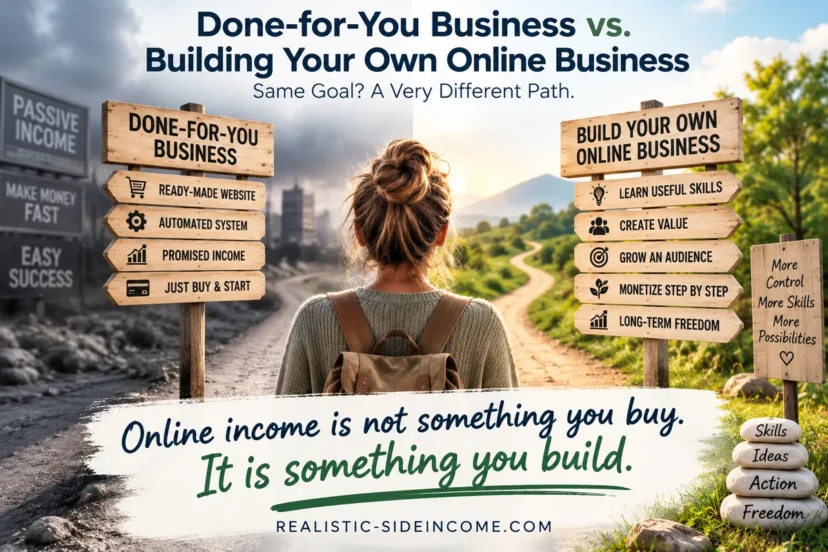
Online Income is not something you buy. It is something you build.
You can buy a website, software, templates, training, advertising, automation, or professional help.
What you cannot simply buy is a sustainable business with real customers, genuine demand, trust, and a reliable reason for people to spend money.
Those things have to be developed.
People may spend hundreds or thousands on “done-for-you” business opportunities, automated income systems, traffic packages, courses, funnels, software stacks, memberships, upgrades, and additional tools because they believe they are buying the difficult part of entrepreneurship.
Sometimes the initial purchase is only the beginning.
There is another upgrade.
Then a traffic package, a premium membership, another tool that is supposedly necessary to make the previous system work.
Eventually, some people reach a painful conclusion:
They have spent a substantial amount of money, but they still do not have a business that reliably attracts real customers.
Worse, they may conclude that making money online requires having a lot of money to begin with.
That is exactly the idea I want to challenge on Realistic Side Income.
You do not need to buy an expensive “business in a box” before you can begin.
What you need is something much less exciting—but potentially much more valuable:
A real problem you can help solve, useful skills you can develop, an audience you understand, and an asset you gradually build yourself.
This guide will help you understand the difference between buying a ready-made income system and building an online business of your own—and show you what to look for before risking your money on promises of traffic, automation, or passive income.
Done-for-You Business vs Building Your Own: What’s the Real Difference?
The basic sales message behind many done-for-you systems is extremely compelling:
Why build everything yourself when somebody has already done it for you?
On the surface, that is not an unreasonable question.
Businesses legitimately outsource work every day.
You can hire someone to design a website, create graphics, edit videos, configure software, or help write sales pages.
There is nothing inherently wrong with buying tools, training, templates, professional services, or automation.
The real difference between a done-for-you business vs building your own is not whether you use outside help. It is whether you understand and control the value, audience, assets, and business model behind what you are building.
The problem begins when outsourcing work is confused with outsourcing the business itself.
A website is not a business.
A funnel is not a business.
An autoresponder is not a business.
A collection of affiliate links is not a business.
And 10,000 visitors are not necessarily an audience.
A real business ultimately needs people who have a reason to care about what it provides.
That cannot be installed with one click.
The Question Nobody Wants You to Ask
When you encounter an online income opportunity, ask one simple question:
Where does the money actually come from?
Not:
“How much can I earn?”
Not:
“How automated is it?”
Not:
“How quickly can I start?”
Ask:
Who is the real customer, and why would that person willingly spend money?
Imagine you create a useful website about gardening.
The business model is understandable.
People search for gardening information.
You help them.
Some readers buy products you recommend.
Perhaps others buy your gardening guide.
Companies may eventually pay to advertise to that audience.
There is a clear chain of value:
Problem → Useful Content → Audience → Trust → Offer → Customer → Revenue
Now examine an online income system using the same logic.
Who receives value?
Why does a customer outside the system want the product?
Would anyone still want what is being offered if the income opportunity disappeared?
If the answers are difficult to identify, that is worth investigating before you spend money.
Traffic Is Not the Same as an Audience
This distinction is particularly important because many online income systems revolve around traffic.
The numbers can sound impressive:
1,000 visitors.
10,000 hits.
Hundreds of ad views.
Guaranteed exposure.
Traffic exchanges and advertising platforms can provide visits or impressions according to their particular systems. Some models encourage users to view advertisements or websites in exchange for credits, exposure, or other benefits.
But a visit is not automatically valuable simply because analytics recorded it.
Consider two visitors.
The first person is browsing websites primarily because doing so earns credits that allow their own advertisement to be displayed.
The second person searches:
“How can I start a side income while working full-time?”
They discover an article that answers exactly that question.
Technically, both can become website visits.
Commercially, they are very different.
The second person has intent.
They came because they wanted something your content could provide.
That is the kind of traffic we are trying to build at Realistic Side Income.
Not just:
How do I get more visitors?
But:
How do I become useful enough that the right people have a reason to visit?
Once you have something useful to offer, traffic channels can help the right people discover it. For example, How Pinterest Works in 2026 explains how useful website content can become discoverable through Pinterest search, recommendations, related ideas, and visual discovery.
10,000 Visitors Can Be Worth Less Than 100
This is one of the most important lessons for anyone building an online business.
Traffic volume alone tells you very little.
Imagine Website A receives 10,000 visits from people who have little interest in its subject.
Website B receives only 100 visits, but those people are actively searching for the exact problem the website solves.
Which audience would you rather have?
For most business models, the smaller relevant audience can be far more valuable.
This is why buying traffic cannot automatically solve a weak business model.
If people do not want what you offer, sending more people to it simply allows more people to ignore it.
Traffic does not create value.
Traffic helps people discover value that already exists.
The Dangerous Appeal of Automation
Another word appears constantly in online-income marketing:
Automation.
And automation really can be valuable.
I use automation.
Businesses use automation.
Email sequences, scheduled content, payment processing, analytics, customer onboarding, and countless repetitive tasks can be automated.
But automation has an important limitation:
It can automate a process. It cannot make a bad process valuable.
Imagine a restaurant where nobody likes the food.
Installing an automated ordering system does not solve the problem.
It merely allows people to order disappointing food more efficiently.
The same principle applies online.
You can automate:
Content Distribution → Email → Offer → Checkout
But somewhere underneath that system there still needs to be something people actually want.
Automation should make a working process more efficient.
It should not be confused with the reason the business works.
Be Careful With “Passive Income”
Passive income is another phrase that deserves more careful thinking.
Online assets can absolutely continue working after the initial effort.
An article you wrote months ago can attract a visitor today.
An email sequence can run automatically.
A digital product can be delivered without you manually sending a file each time.
An affiliate link can generate a commission while you are away from your computer.
But affiliate marketing works best when the recommendation is connected to useful content and a real audience—not when affiliate links are simply placed in front of as many people as possible. What Is Affiliate Marketing and How Does It Work? explains how the model actually works and where the value comes from.
Those are genuine advantages of an online business.
But look at what came first:
Someone researched the subject.
Created the article.
Built the website.
Found the audience.
Created or evaluated the offer.
Set up the systems.
Tested what worked.
Improved what did not.
The automation came after work had created something worth automating.
Passive elements can exist inside an online business.
That is very different from a passive business requiring no thought, skill, experimentation, or maintenance.
Why People Keep Buying the Next System
There is also a psychological trap here.
Suppose you spend €500 on an online business system.
It does not produce the results you expected.
You now have two possible explanations.
The first is uncomfortable:
Maybe the system was never the shortcut I thought it was.
The second is easier to accept:
Maybe I am missing one more piece.
So you buy the additional traffic package.
Then the advanced training, another software tool, a different business opportunity.
Each purchase restores hope.
For a while.
Eventually, you can end up spending far more time and money shopping for an online business than building one.
That is the cycle I want you to escape.
You Don’t Need Another Opportunity—You Need to Understand Yourself
Before looking for the next business system, close the sales page for a moment.
Take out a notebook.
And ask yourself some different questions.
What am I already good at?
Maybe you are good at Excel.
Organizing information.
Cooking inexpensive meals.
Repairing bicycles.
Writing.
Teaching.
Photography.
Gardening.
Accounting.
Dog training.
Design.
Working with children.
Using particular software.
Finding travel deals.
Explaining complicated subjects simply.
Then ask:
What have I learned through my work and life that somebody else might find useful?
You do not need to be the world’s leading expert.
You need to identify problems you understand well enough to help someone take the next step.
If you need help turning those thoughts into a realistic direction, the Side Hustle Roadmap walks you through the process of choosing a path, building a foundation, attracting an audience, and eventually monetizing what you create.
Your Experience Is More Valuable Than You Think
People often dismiss their own knowledge because it feels ordinary to them.
If you have used Excel every working day for ten years, creating a simple spreadsheet may feel trivial.
To someone who has never used formulas, it may solve an important problem.
If you successfully grow vegetables on a small balcony, that knowledge may feel like a hobby.
To someone searching for:
“how to grow tomatoes on an apartment balcony”
it is exactly the information they need.
If you have spent years organizing business travel, dealing with particular software, teaching children, managing household finances, caring for animals, or working in a specialized industry, you already possess experiences that other people may not have.
This does not automatically mean every skill can become a profitable business.
But it gives you a much better place to begin than:
“Which ready-made system promises the most money?”
Start With a Problem, Not a Product
A realistic online business often begins with a simple question:
Who can I help, and with what?
Then:
Where do those people look for help?
Then:
What could I create that genuinely helps them?
Perhaps that becomes a blog.
A freelance service.
A newsletter.
A digital guide.
Templates.
Online tutoring.
A small course.
Affiliate content.
Printables.
Consulting.
A YouTube channel.
Or something you have not thought of yet.
The format comes later.
First comes the value.
That reverses the logic of many done-for-you systems.
Instead of:
Buy Product → Find Traffic → Hope Someone Buys
you begin with:
Understand People → Identify Problem → Create Value → Attract Audience → Build Trust → Monetize
That is slower.
It also gives you something much more important:
a reason for the business to exist.
If you’re not yet sure which direction fits your skills, available time, and goals, 7 Realistic Side Income Ideas for Employees can help you explore several practical options before committing to one.
Build Assets You Control
This is one of the central principles behind Realistic Side Income.
Whenever possible, put your effort into building assets that continue to belong to you.
Your website, articles, a domain, skills, email list, brand, knowledge and a relationship with your readers.
Your understanding of your market.
Even if one traffic source changes, those assets still have value.
Contrast that with spending months earning credits inside a system that stops benefiting you the moment you stop participating.
Ask:
What will I still own after six months of work?
That question can completely change how you evaluate an online opportunity.
A blog is one example of this approach because every useful article can become part of a growing content library that you control. If that idea appeals to you, our Blogging Hub will take you through the process from choosing a niche and planning content to SEO, traffic, and monetization.
Spend Money to Solve Problems—Not to Buy Hope
I am not suggesting that you should never spend money on an online business.
Real businesses have expenses.
You might reasonably pay for:
- a domain and hosting
- email marketing software
- useful design or research tools
- professional services you genuinely need
- education that teaches a specific skill
- software that saves meaningful time
The difference is why you are spending the money.
There is a huge difference between:
“I understand my business and this €100 tool solves a specific problem.”
and:
“I don’t understand how this business makes money, but the €3,000 package promises everything will be done for me.”
The first is a business decision.
The second is a leap of faith.
Starting with a limited budget can actually encourage you to focus on what matters first: understanding your audience, developing useful skills, testing an idea, and creating something people genuinely need. How to Start a Side Hustle With No Money shows how you can begin building and testing a side-income idea without assuming that a large upfront investment is necessary.
Before buying something expensive, you should be able to explain exactly what it does, why you need it, and how it contributes to a business model you understand.
A Simple Test Before You Buy Any Online Business System
Before paying hundreds or thousands for an opportunity, ask yourself:
What exactly am I buying?
Can you describe it without using the seller’s marketing language?
Who is the customer?
Who ultimately provides the revenue?
What value does that customer receive?
Would people want it without the income opportunity attached?
Where will the traffic come from?
“Traffic included” is not enough. What kind of traffic is it, and why should those visitors care?
What additional costs will I need?
Hosting? Advertising? Upgrades? Software? Memberships? Traffic packages?
What do I own if I stop paying?
The domain? Content? Customer list? Products? Data?
What skills will I learn?
Or will I remain dependent on the system?
Can I test the underlying idea more cheaply?
Often, you can.
And perhaps the most important question:
If the income claims disappeared from the sales page, would I still think this was a good business?
If not, do more research before reaching for your credit card.
What Realistic Side Income Means
This brings us to the reason this website exists.
Realistic Side Income is not about finding a machine that spits out money.
It is about building something useful alongside the life you already have.
You may have a job.
A family.
Limited time.
A limited budget.
You may be starting with little technical knowledge.
That is okay.
You do not need to become an entrepreneur overnight.
Start smaller.
Learn one skill.
Publish one useful article.
Create one service.
Help one customer.
Understand one traffic source.
Collect your first email subscriber.
Earn your first honest commission.
Then learn from it.
The process looks much more like:
Learn → Create → Publish → Measure → Improve → Repeat
than:
Buy → Click → Profit
Your Brain Is Part of the Business Model
There is something deeply valuable about building your own project that no done-for-you package can sell you.
Along the way, you begin to understand what people actually need and develop the judgment to distinguish promising ideas from distractions. Mistakes become useful because you can see what went wrong, adjust your approach, and make better decisions the next time.
You also develop practical skills. Building a website teaches you how online content works. Writing helps you communicate ideas more clearly. Marketing shows you what attracts attention, what builds trust, and why some offers connect with an audience while others do not. Over time, you become better at deciding which tools genuinely help and which ones simply add another expense.
Perhaps most importantly, you become less dependent on the next person promising to reveal the secret.
The knowledge and judgment you gain belong to you. They can be applied to your current project, adapted when circumstances change, and carried into whatever you decide to build next.
Even if your first project never becomes a major source of income, the experience does not automatically become worthless. You have learned how to research, create, test, evaluate, and improve an idea rather than simply following somebody else’s system.
That is an asset no ready-made business package can give you.
Das gefällt mir sogar besser als die ursprüngliche Version. Vor allem der Schluss bringt unsere Botschaft zurück auf den Punkt: Das eigentliche Investment ist nicht nur die Website oder das Projekt – sondern auch das Wissen und die Urteilskraft, die man beim eigenen Aufbau entwickelt.
Don’t Ask, “Which System Will Make Me Money?”
Instead of looking for the next system, start with a better question:
What can I build that could genuinely help someone?
Think about what you already know, the skills and experience you have gained through work or everyday life, and the subjects you would be willing to learn more about. Pay attention to problems people repeatedly encounter and consider whether you could create something that makes one of those problems easier to solve.
Then bring the idea back to reality.
Could you test it on a small scale without risking a large amount of money? Could you create a useful article, offer a simple service, build a small resource, or help your first potential customer before investing heavily in tools and automation?
And rather than asking how to generate the largest possible amount of traffic, think about where the people who genuinely need what you offer might already be looking for help.
These questions are less exciting than:
“Earn €500 a day while you sleep!”
They do not offer an instant shortcut or a guaranteed outcome.
But they encourage something much more valuable: independent thinking.
You stop asking someone else to hand you the right system and begin learning how to recognize opportunities, test ideas, solve real problems, and make your own decisions.
That is where real independence begins.
You Are Allowed to Start Small
Perhaps one of the biggest misconceptions about online business is that your first move needs to be big.
It doesn’t.
You don’t need a website with 100 articles, an email list with 10,000 subscribers, or a product generating thousands of euros before your work begins to matter. A first freelance client does not have to replace your salary either.
At the beginning, a much better goal is proof.
Create something useful and see whether one person wants to read it. Offer a simple service and find out whether somebody is willing to pay for your help. Publish an article and learn whether it can attract relevant visitors. Recommend a product only when it genuinely fits the reader’s problem and see whether that recommendation leads to your first commission.
These may look like small results, but they answer important questions.
Can I create something people value? Is there genuine interest? Can I reach the right people? Can this idea eventually generate revenue?
You do not need all of those answers on day one. Each small experiment gives you information you can use for the next decision.
That is far more valuable than investing heavily before you know whether the underlying idea works.
Your first genuine euro online may not change your financial situation. But it can prove something that a sales page never can:
Someone valued what you created, offered, or recommended enough for money to change hands.
At that point, you are no longer buying somebody else’s promise.
You are beginning to understand how value becomes income.
The Goal Is Not Easy Money. It Is Leverage.
One of the most interesting things about building an online asset is the possibility of creating leverage.
An article you write once can help many readers. A digital product can be purchased more than once without being recreated for every customer. An email can reach an entire subscriber list, while a Pinterest Pin can introduce new people to content you have already published.
Over time, a useful website can develop many different entry points through which people discover your work.
That is part of what makes an online business so interesting: the effort you put in today does not always have to produce value only once.
But leverage is not magic, and it should not be confused with effortless income.
It can only amplify something that already has value.
That might be your knowledge, useful content, a product that solves a real problem, an audience that trusts you, or a process you have tested and improved.
This is why trying to automate everything at the beginning often puts the priorities in the wrong order. Before thinking about scale, build something worth scaling. Before automating a process, make sure the process serves a useful purpose.
Create the value first. Build the system around it second.
Then automation and scale have something worthwhile to amplify.
Final Thoughts
If you have already spent money on online income systems that did not work out, you do not have to conclude that making money online is impossible—or that the solution is to spend even more on the next opportunity.
There is a more useful lesson to take from the experience:
Understand the business before you buy the business.
Look beyond impressive traffic numbers and ask where those visitors come from and why they would care about the offer. Treat automation as a tool rather than a substitute for value. And remember that even the most expensive package cannot remove the need to understand your customers, your marketing, your offer, and the way genuinely interested people discover it.
Most importantly, do not underestimate what you can build yourself.
Your existing experience can become a starting point. New skills can be learned as you need them. Curiosity can lead you toward problems worth solving, while every article, service, resource, product, or relationship with a reader can become part of something you actually own.
You do not need to build everything at once, and you do not need to spend a fortune before you begin. Start small, spend carefully, pay attention to what people need, and use what you learn to make the next decision better than the last.
Over time, the goal is to create something that has value even after the sales webinar ends, the advertisement disappears, or the latest online opportunity has been replaced by another one.
That is the difference between buying access to somebody else’s promise and gradually building an asset of your own.
Sustainable online income is rarely something another person can simply hand to you in a box.
You build it by becoming useful.
And that is exactly what we are going to do throughout Realistic Side Income.
Ready to Build Something of Your Own?
You don’t need to have the perfect business idea today. Start by looking at your skills, interests, available time, and the problems you could realistically help other people solve.
The Side Hustle Roadmap will help you take that next step—from choosing a realistic direction and building your foundation to attracting an audience and eventually monetizing what you create.
Or, if you’re still exploring your options, Start Here to find the RSI guides that best match where you are today.
FAQ
1. Are all done-for-you online business systems scams?
No. “Done for you” simply means that some work has been completed on your behalf, and legitimate businesses sell services, templates, websites, funnels, and other pre-built assets. The important question is whether you understand what you are buying, what additional work and costs are required, who the customers are, and why the underlying business should create value.
2. Do I need a lot of money to start making money online?
Not necessarily. Different business models have different costs, but many can be tested on a relatively small scale before making major investments. Starting small allows you to learn whether an idea has potential before committing significant savings.
3. Is buying website traffic a good way to make money?
Traffic itself does not guarantee revenue. What matters is whether visitors are genuinely interested in the problem, content, product, or service you offer. A smaller relevant audience can be far more valuable than a large number of uninterested visits.
4. What should I invest in when starting an online business?
Prioritize expenses that solve a clearly understood problem: essential infrastructure, useful tools, specific skills, or services that save meaningful time. Be cautious about expensive purchases whose main appeal is an income promise rather than a clearly defined business function.
5. What is the best way to start building a realistic side income?
Start by looking at your skills, experience, interests, available time, and the problems you could realistically help other people solve. Choose a small idea you can test without risking large amounts of money, create something useful, learn how to reach the right audience, measure what happens, and improve from there.


