
Pinterest vs Google Traffic: Which One Is Better for Bloggers?
Introduction
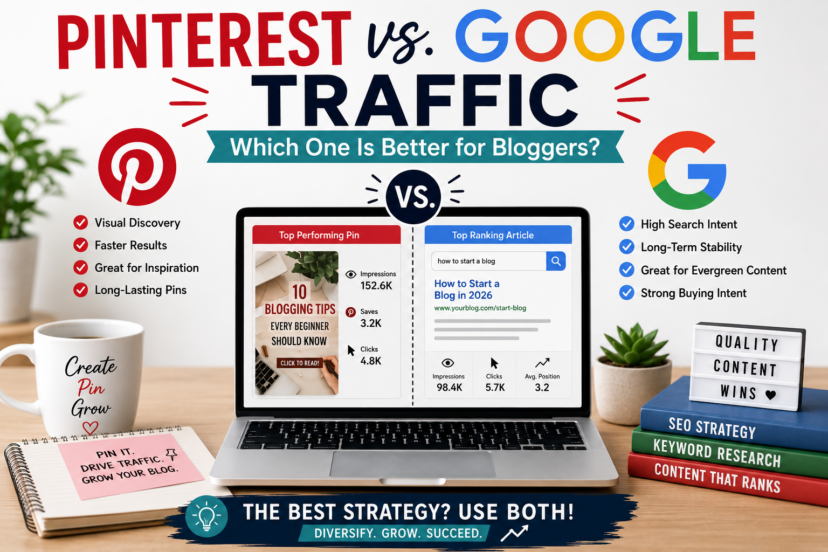
When new bloggers start thinking about traffic, they usually hear the same advice: “You need Google traffic.” However, many content creators also discover that Pinterest can drive thousands of visitors to a website. Naturally, this raises an important question: Pinterest vs Google traffic—which one is actually better?
The truth is that there is no universal answer. Both platforms can send highly valuable visitors to your blog, but they work in completely different ways. On the one hand, Google is the world’s largest search engine. On the other hand, Pinterest combines visual inspiration with search functionality.
Because of these differences, bloggers often experience very different results depending on their niche, content strategy, and goals.
In this guide, we’ll compare Pinterest and Google traffic in detail. You’ll learn how each platform works, how long it takes to see results, and why many successful bloggers use both at the same time.
Understanding the Fundamental Difference
Before comparing Pinterest and Google, it is important to understand one thing: users behave differently on each platform.
People usually visit Google because they already know exactly what they need.
For example, they search for:
- “how to start a blog”
- “best email marketing tools”
- “Pinterest keyword research”
- “how to make money online”
They have a problem and actively want a solution.
Pinterest users behave differently. In many cases, they are still exploring ideas. They browse, save inspiration, and discover opportunities they had not considered before.
For example, they may search for:
- blogging tips
- side hustle ideas
- home office inspiration
- online business ideas
As a result, Pinterest often creates demand, while Google mainly captures existing demand.
If you’re new to the platform, our guide How Pinterest Works in 2026 explains why Pinterest functions more like a visual search engine than a traditional social network.
How Google Traffic Works
Google traffic comes from search engine optimization (SEO).
In simple terms, Google analyzes billions of pages and tries to show users the most relevant content.
To rank well on Google, bloggers usually focus on:
- keyword research
- search intent
- article quality
- backlinks
- technical SEO
- website speed
- user experience
Google’s algorithm evaluates many different signals. Therefore, ranking on the first page often requires patience and consistency.
At first, this process may seem intimidating. Nevertheless, Google traffic has one major advantage: people who search on Google are often highly motivated.
If someone types “best blogging platform for beginners,” there is a good chance that they are ready to take action.
How Pinterest Traffic Works
Pinterest works differently.
Instead of ranking articles directly, Pinterest primarily ranks pins. Those pins then lead users to your website.
Consequently, Pinterest success depends on factors such as:
- attractive pin designs
- strong headlines
- relevant keywords
- user engagement
- consistency
Moreover, Pinterest is highly visual. Even the best blog article may receive very little traffic if the pin itself fails to capture attention.
Unlike Google, Pinterest users often discover content they were not actively looking for.
This makes Pinterest particularly effective for:
- inspiration
- lifestyle topics
- personal finance
- side hustles
- recipes
- blogging
- productivity
To create pins that attract clicks, read How to Create Click-Worthy Pins, where we explain the design principles that work best for beginners.
Which Platform Brings Traffic Faster?
This is one of the biggest questions for new bloggers.
The honest answer is: it depends.
Generally speaking, Pinterest traffic often arrives faster than Google traffic. Some creators begin receiving impressions and clicks after a few weeks.
Google, by contrast, usually requires more patience. New websites often need several months before they start ranking consistently.
However, this does not mean that Pinterest always wins.
Pinterest traffic may grow more quickly in the beginning, while Google traffic often becomes more stable over time.
A realistic timeline looks something like this:
| Timeframe | ||
|---|---|---|
| First month | Low to moderate traffic | Usually very little traffic |
| Three months | Traffic often increases | Rankings slowly develop |
| Six months | Consistent growth possible | Stronger SEO performance |
| One year and beyond | Depends on consistency | Often highly stable |
Therefore, bloggers should avoid focusing only on short-term results.
If you’re wondering when Pinterest results typically appear, our article How Long Does Pinterest Traffic Take? offers a realistic timeline for beginners.
The Quality of Visitors
Traffic volume matters. Nevertheless, visitor quality matters even more.
Google visitors usually have strong intent. They are actively searching for answers, products, or solutions.
For example:
- Someone searching for “best hosting provider” may be ready to buy immediately.
- Someone searching for “how to start affiliate marketing” may be looking for a step-by-step guide.
Pinterest visitors, meanwhile, are often in discovery mode.
As a result, they may:
- save your content for later
- browse multiple ideas
- compare different options
- return weeks later
Neither type of traffic is inherently better. Instead, they serve different purposes.
Google tends to convert well because users already know what they want.
Pinterest excels at introducing your content to people who might never have found it otherwise.
The Lifespan of Content
One of the most interesting differences between Pinterest and Google involves content lifespan.
Google articles can rank for years. Once an article reaches the first page, it may generate steady traffic with relatively little maintenance.
Pinterest pins can also last a long time. However, their performance often fluctuates more dramatically.
For example:
- A Google article may receive 300 visitors every month for three years.
- A Pinterest pin may go viral, slow down, and then suddenly gain momentum again months later.
Consequently, Pinterest traffic can feel less predictable.
That said, both platforms reward evergreen content.
Topics such as:
- blogging
- personal finance
- productivity
- affiliate marketing
- online business
can continue attracting visitors for years.
Content Creation: Which Platform Is More Demanding?
Many beginners underestimate the amount of work involved.
With Google, your main investment is writing.
You need:
- high-quality articles
- good SEO
- internal links
- technical optimization
Pinterest requires additional work because every article needs visual assets.
Besides writing, you must create:
- pins
- graphics
- headlines
- descriptions
- boards
Therefore, Pinterest often requires more creative effort.
On the other hand, some bloggers enjoy designing pins and prefer Pinterest’s visual nature.
If you’re still building your content strategy, read How to Plan Blog Content to learn how successful bloggers organize their articles into topic clusters.
Competition on Pinterest and Google
Competition exists everywhere online.
However, competition looks different on each platform.
Google competition is usually intense because:
- large companies dominate many keywords
- older websites have more authority
- backlinks influence rankings
For beginners, ranking for highly competitive keywords can be difficult.
Pinterest competition, meanwhile, depends more on:
- design quality
- keyword optimization
- consistency
- engagement
As a result, newer bloggers sometimes gain visibility on Pinterest faster than on Google.
Nevertheless, both platforms reward persistence.
Monetization Potential
Ultimately, most bloggers care about one question:
Which platform makes more money?
Again, the answer depends on your niche and business model.
Google often performs extremely well for:
- affiliate marketing
- software reviews
- product comparisons
- tutorials
- buying guides
Pinterest performs particularly well for:
- digital products
- courses
- printable products
- blogging resources
- lifestyle brands
That said, the strongest businesses rarely rely on a single traffic source.
Instead, they combine:
- Google SEO
- Pinterest marketing
- email marketing
- social media
- direct visitors
Diversification creates stability.
Why Depending on Only One Traffic Source Is Risky
Algorithms change constantly.
Google updates its ranking system.
Pinterest modifies its recommendations.
Consequently, relying on only one source can become dangerous.
Imagine these scenarios:
- Your Google rankings suddenly decline.
- Pinterest changes how it distributes pins.
- A new competitor enters your niche.
If all your traffic comes from one platform, your business becomes vulnerable.
Therefore, many experienced bloggers build multiple traffic channels from the very beginning.
The Power of Combining Pinterest and Google
The smartest strategy is often not choosing between Pinterest and Google.
Instead, it is combining both.
Here’s how they can work together:
- You write an SEO-optimized article.
- Google gradually indexes the content.
- You create several Pinterest pins.
- Pinterest sends early traffic.
- Google rankings improve over time.
- Your email list grows.
- The article continues attracting visitors for years.
As a result, each platform strengthens the other.
Pinterest can provide momentum in the early stages, while Google creates long-term stability.
Keyword optimization plays a crucial role on Pinterest. In Pinterest Keyword Research, you’ll learn how to find the search terms that help users discover your content.
Common Beginner Mistakes
When comparing Pinterest and Google, beginners often make the same mistakes.
For example, many people:
- expect instant results
- give up too early
- ignore keywords
- publish inconsistently
- focus on traffic instead of quality
- rely on a single platform
Fortunately, all of these mistakes can be avoided.
Success on both Pinterest and Google requires patience, experimentation, and continuous improvement.
If you want to avoid the most common problems, read Common Pinterest Mistakes (And How Beginners Can Avoid Them) for practical tips and realistic expectations.
Which Platform Should Beginners Focus On?
If you are just starting your blog, the answer depends on your goals.
You may want to prioritize Pinterest if:
- you enjoy visual content
- your niche performs well on Pinterest
- you want traffic sooner
- you like graphic design
You may want to prioritize Google if:
- you enjoy writing
- you prefer long-term stability
- your niche depends on search intent
- you are willing to invest in SEO
However, if possible, learning both platforms will give you the greatest advantage.
Even modest success on Pinterest and Google can create a powerful combination.
Want to master Pinterest step by step? Visit our Pinterest Hub, where you’ll find practical guides on keyword research, pin design, analytics, traffic growth, and beginner-friendly strategies.
Final Thoughts
The debate between Pinterest and Google traffic does not have a clear winner.
Pinterest often delivers traffic more quickly and helps people discover new ideas. Google, meanwhile, tends to provide highly targeted visitors who are actively searching for solutions.
Most importantly, both platforms reward creators who consistently publish valuable content.
Instead of asking which platform is better, a more useful question might be:
How can Pinterest and Google work together to grow your blog?
Over time, bloggers who diversify their traffic sources build stronger, more resilient businesses. Therefore, rather than choosing one platform over the other, consider using both to create sustainable growth.
FAQ
1. Is Pinterest traffic better than Google traffic?
Neither platform is universally better. Pinterest often brings traffic faster, while Google usually provides more stable long-term traffic.
2. Does Pinterest traffic convert well?
Yes, especially in niches such as blogging, personal finance, lifestyle, and digital products.
3. Can beginners get traffic from Pinterest faster than from Google?
In many cases, yes. Pinterest may generate impressions and clicks within weeks, while Google rankings often take several months.
4. Should bloggers focus on Pinterest or Google?
Ideally, bloggers should use both platforms because they complement each other.
5. Can one article rank on Google and perform well on Pinterest?
Absolutely. Many successful bloggers create SEO-optimized articles and promote them with multiple Pinterest pins.