
How to Plan Blog Content: A Simple Strategy for Beginners
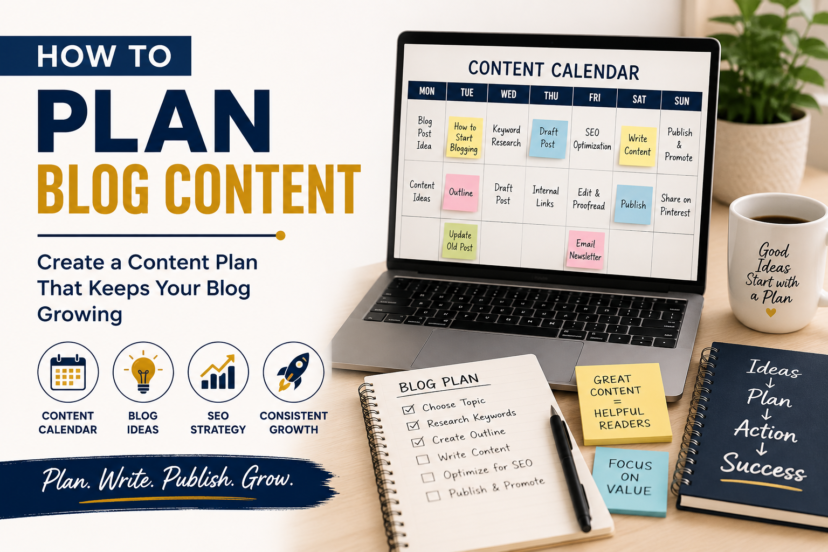
Learning how to plan blog content is one of the most useful skills you can develop as a blogger.
Without a plan, blogging can quickly become frustrating.
You publish one article because you had an idea.
A week later, you write about something completely different.
Then you spend an hour staring at a blank screen wondering:
“What should I write about next?”
After a few months, you may have ten or twenty articles—but they do not necessarily work together.
A good content plan solves that problem.
It helps you decide:
- what your audience needs
- which topics belong on your website
- what to publish first
- which articles should link to one another
- where keywords and search intent fit
- how often you can realistically publish
- which older articles need updating
You do not need complicated software or a 12-month editorial calendar.
You need a simple system that turns individual blog posts into a connected library of useful content.
Let’s build one.
Why Blog Content Planning Matters
A successful blog is more than a collection of articles.
Each article should contribute to the larger purpose of the website.
Imagine a beginner arrives at your blog because they want to start affiliate marketing.
They first read:
What Is Affiliate Marketing and How Does It Work?
Then they might naturally want to know:
How Do I Choose a Niche?
Then:
Where Do I Find Affiliate Programs?
Then:
How Do I Write Affiliate Content?
And eventually:
How Do Affiliate Commissions Work?
Those articles form a journey.
The reader does not have to return to Google after every question because your website already provides the next useful answer.
That is one of the biggest benefits of planning content before publishing it.
Start With Your Niche
Before planning articles, you need to understand what your blog is actually about.
Your niche determines:
Who you help + What problems you solve + Which topics belong on the website
If your niche is unclear, your content plan will probably become unclear too.
For example, if your website is about realistic online side income for busy employees, articles about blogging, affiliate marketing, Pinterest, and email marketing can all make sense because they support the same larger goal.
An unrelated article about gardening probably does not.
If you have not yet established this foundation, start with How to Choose a Blog Niche before building your content calendar.
Step 1: Understand Your Audience’s Problems
Do not begin your content plan with keywords.
Begin with people.
Ask:
- Who am I helping?
- What are they trying to accomplish?
- What prevents them from doing it?
- What do they not understand yet?
- What decisions do they need to make?
- What questions appear at each stage?
Suppose your audience consists of employees who want to build an online side income.
Their questions might include:
Which side hustle should I choose?
Can I start with no money?
How do I start a blog?
How long does blogging take?
How do I get traffic?
What is affiliate marketing?
Do I need an email list?
When should I start monetizing?
You already have the beginnings of a content plan.
Each problem can become an article—or lead to an entire group of related articles.
If you are still exploring the larger journey your readers might follow, the Beginner Side Hustles learning path can help you see how beginner questions develop from choosing an idea to building something more substantial.
Step 2: Create Your Main Topic Clusters
Once you understand the audience’s problems, group related questions together.
These groups become topic clusters.
For example, Realistic Side Income can organize content around several connected areas.
Blogging
Possible topics include:
- choosing a blog niche
- planning blog content
- writing blog posts
- keyword research
- SEO
- internal linking
- blogging consistency
Affiliate Marketing
Possible topics include:
- affiliate marketing basics
- choosing a niche
- finding programs
- affiliate content
- disclosures
- commissions
Pinterest Marketing
Possible topics include:
- Pinterest SEO
- keyword research
- Pin design
- Pinterest analytics
- Pinning frequency
- traffic growth
Email Marketing
Possible topics include:
- building an email list
- lead magnets
- signup forms
- email sequences
- newsletters
- email tools
Notice what is happening.
We are no longer planning 40 random blog posts.
We are building four connected content libraries.
That makes future planning much easier.
Step 3: Find the Big Questions First
Within each cluster, identify the broad questions a beginner needs answered.
These often become your foundational articles.
For example, within a blogging cluster:
How to Choose a Blog Niche
could be a foundational article.
So could:
SEO for Beginner Bloggers
and:
Keyword Research for Beginners
Smaller supporting articles can then explore narrower questions.
This creates a useful structure:
Main Topic → Important Question → Supporting Questions
Instead of starting with hundreds of tiny keyword ideas, build the main structure first.
You can fill in the details later.
Step 4: Research Search Intent and Keywords
Now keyword research becomes useful.
You already know which problems you want to cover.
The next question is:
“How are people actually searching for these answers?”
Search intent describes what someone wants when they enter a query.
For example, someone searching:
“how to choose a blog niche”
probably wants instructions.
Someone searching:
“best blogging platforms”
is probably comparing options.
Someone searching:
“WordPress vs Wix”
has an even more specific comparison intent.
The article should match what the searcher is trying to accomplish.
This is more important than repeating an exact keyword a certain number of times.
A single article may naturally answer several closely related searches if they share the same intent.
For example:
- how to plan blog content
- blog content planning
- how to create a blog content plan
- content planning for bloggers
do not necessarily require four different articles.
Creating separate pages for every small keyword variation can lead to repetitive content.
Think in problems and intent first, keywords second.
Step 5: Build a Content Idea Bank
Once you begin researching, you will discover more ideas than you can publish immediately.
Do not lose them.
Create a simple content idea bank.
A spreadsheet works perfectly.
Useful columns might include:
| Article Idea | Topic Cluster | Search Intent | Priority | Status |
|---|---|---|---|---|
| How to Choose a Blog Niche | Blogging | Informational | High | Published |
| How to Plan Blog Content | Blogging | Informational | High | In Progress |
| SEO for Beginner Bloggers | Blogging | Informational | High | Planned |
| How Long Does Blogging Take? | Blogging | Informational | Medium | Planned |
You can add more columns later.
For example:
- focus keyphrase
- URL
- publish date
- update date
- internal links
- Pinterest Pins
- lead magnet
- affiliate opportunity
But start simple.
A planning system that you actually use is better than an elaborate spreadsheet you stop opening after two weeks.
Step 6: Prioritize Articles Instead of Publishing Randomly
Once you have 30 ideas, you face a new problem:
Which one should you write first?
A useful beginner prioritization system considers four things.
1. Audience Importance
How important is this problem to your target reader?
2. Foundational Value
Will other articles need to link to this article?
3. Search Opportunity
Are people actively looking for this information?
4. Strategic Value
Does the article support an important part of your website, email list, product strategy, or monetization plan?
You do not need a complicated scoring formula.
Simply label ideas:
High / Medium / Low
Then work primarily from the high-priority group.
This prevents a common problem: continually choosing the easiest article rather than the article your website actually needs.
Step 7: Plan Internal Links Before You Write
Internal linking should not be something you remember five minutes before publishing.
It can be part of your content strategy from the beginning.
Suppose you are planning:
How to Plan Blog Content
You already know that readers may benefit from:
How to Choose a Blog Niche
before it.
Later, they may benefit from:
Keyword Research for Beginners
or:
Internal Linking Explained
after it.
You can therefore think of your articles as a connected path:
Choose Niche → Plan Content → Research Keywords → Write Articles → Optimize SEO → Build Internal Links
This helps readers move through your website naturally.
It also makes updating older articles easier because you already know which newer pages should eventually be linked.
Step 8: Balance Foundational and Supporting Content
Not every article needs to be a huge beginner guide.
Your content plan should contain different levels of depth.
Foundational Content
These articles explain important subjects comprehensively.
Examples:
How to Choose a Blog Niche
SEO for Beginner Bloggers
Pinterest SEO for Beginners
Supporting Content
These answer narrower questions connected to those larger topics.
Examples might include:
How Often Should You Publish?
How Long Does Blogging Take to Make Money?
How Many Articles Do You Need?
Supporting content helps fill gaps and creates opportunities for natural internal links.
Together, foundational and supporting articles create a more complete resource.
Step 9: Include Different Stages of the Reader Journey
Not every visitor is at the same stage.
Some are complete beginners.
Others already understand the basics and need help solving a specific problem.
Others may be comparing tools or considering a purchase.
Your content plan can serve all of them.
Early Stage
“What is affiliate marketing?”
Learning Stage
“How do I find affiliate programs?”
Implementation Stage
“How do I write affiliate content?”
Decision Stage
“Which tool should I use?”
A healthy content strategy does not publish only highly commercial articles.
Informational content builds traffic and trust.
Commercial content can help readers make decisions.
Both have a role.
This is also the philosophy behind Content Marketing for Beginners: valuable content attracts people by answering questions rather than constantly trying to sell something.
Step 10: Create a Realistic Publishing Schedule
Now we can finally create the calendar.
But there is no universal ideal publishing frequency.
Some bloggers can publish three articles per week.
Someone building a website alongside a full-time job may only have enough time for one strong article per week—or less.
That is fine.
A realistic calendar might look like this:
| Week | Article | Cluster | Status |
|---|---|---|---|
| 1 | How to Choose a Blog Niche | Blogging | Published |
| 2 | How to Plan Blog Content | Blogging | Published |
| 3 | How to Write Blog Posts Faster | Blogging | Planned |
| 4 | SEO for Beginner Bloggers | Blogging | Planned |
The purpose of the calendar is not to pressure you.
It is to make the next action obvious.
If you are worried that you need to publish enormous quantities of content to succeed, How Many Articles Do You Need? explains why there is no magic article count.
How Far Ahead Should You Plan?
For most beginners, planning the next four to twelve weeks can provide enough structure without becoming restrictive.
You might have:
Next 4 articles: clearly scheduled.
Next 10–20 articles: prioritized.
Everything else: stored in your idea bank.
That gives you both structure and flexibility.
If you discover an important new question, you can adjust the plan.
A content calendar should guide you.
It should not become a prison.
Don’t Plan 100 Articles in Detail Before Publishing
Planning is useful.
Overplanning is another form of procrastination.
You do not know exactly what your audience will respond to until people start visiting your website.
After publishing, you may discover that:
- one topic gets far more impressions
- a Pinterest Pin unexpectedly performs well
- readers search for a question you had overlooked
- one cluster receives no traction
- an article creates several obvious follow-up questions
Your plan should evolve based on what you learn.
This is why planning your next few months usually makes more sense than deciding exactly what Article #83 will be before Article #3 exists.
Step 11: Plan Content Promotion Too
Publishing is not the end of the process.
Ask how people will discover each article.
Depending on your strategy, that could involve:
- Google search
- internal links from existing articles
- social platforms
For Realistic Side Income, for example, an article can become more than a blog post.
It can also generate:
- a featured image
- multiple Pinterest Pins
- an email topic
- internal links
- future supporting articles
One piece of well-planned content can therefore support several parts of your traffic system.
Once your publishing plan is established, How to Get Your First 100 Website Visitors explains how to begin turning that content library into actual traffic.
Step 12: Include Content Updates in Your Plan
A content plan should not contain only new articles.
Older content also needs attention.
As your website grows, some articles may contain:
- outdated screenshots
- old statistics
- broken links
- outdated product information
- weak internal links
- sections that are too short
- old SEO practices
- missing FAQs
- information that no longer reflects what you have learned
That means your calendar might eventually contain:
Week 1: New article
Week 2: New article
Week 3: Update important older article
Week 4: New article
Refreshing valuable existing content can sometimes be more useful than publishing another article simply to increase your post count.
Common Blog Content Planning Mistakes
A good plan also helps you avoid several common problems.
Mistake 1: Writing Whatever Comes to Mind
Inspiration is useful, but it should not determine your entire strategy.
Keep spontaneous ideas in your idea bank and evaluate where they fit.
Mistake 2: Chasing Every Keyword
A keyword does not automatically deserve an article.
Ask whether it serves your audience and fits your existing topic clusters.
Mistake 3: Creating Multiple Articles for the Same Intent
Closely related keywords may belong together.
Otherwise, you can end up with several weak articles competing to answer essentially the same question.
Mistake 4: Ignoring Internal Links
Articles should support one another rather than exist in isolation.
Mistake 5: Publishing Only Commercial Content
If every article recommends products, your website may struggle to become a genuinely useful resource.
Balance information and monetization.
Mistake 6: Creating an Unrealistic Schedule
Publishing five articles per week sounds impressive until you stop after three weeks.
Choose a pace you can maintain.
Mistake 7: Never Updating the Plan
Your content strategy should change as you collect real traffic and performance data.
A Simple Blog Content Planning System
You do not need to remember everything in this guide every time you plan an article.
Use this simple sequence:
1. Audience
Who am I helping?
↓
2. Problem
What do they need to solve?
↓
3. Cluster
Which larger topic does this belong to?
↓
4. Search Intent
What does the reader actually want?
↓
5. Article
What is the best piece of content to answer it?
↓
6. Internal Links
What should they read before and after?
↓
7. Promotion
How will people discover the article?
↓
8. Review
What does the performance tell me to create or improve next?
That is a content strategy.
It is much more useful than simply maintaining a list of titles and publishing dates.
What Comes After Content Planning?
Once your content plan exists, the next challenge is execution.
You need to turn those planned ideas into useful articles without spending endless hours writing each one.
That means developing:
- a repeatable writing process
- article outlines
- research habits
- formatting standards
- editing routines
- templates where appropriate
Your goal is not to write as quickly as possible.
It is to remove unnecessary friction from the writing process so that publishing consistently becomes realistic.
You can explore the complete sequence of blogging topics in the Blogging learning hub.
Conclusion
Learning how to plan blog content can make blogging significantly easier.
Instead of asking:
“What should I write this week?”
you begin working from a clear strategy.
Start with your audience.
Identify their problems.
Group those problems into topic clusters.
Research search intent and keywords.
Prioritize the most useful articles.
Plan internal links.
Choose a realistic publishing schedule.
Promote what you publish.
Then use real performance data to improve your plan.
You do not need 100 perfectly planned articles.
You need enough direction to know what you are creating next—and why.
Plan enough to stay focused. Publish enough to learn. Improve as your audience grows.
That is a much more sustainable way to build a useful blog.
FAQs
1. How far ahead should I plan blog content?
For many beginner bloggers, planning four to twelve weeks ahead provides a useful balance between structure and flexibility. You can schedule your next few articles in detail while keeping additional ideas in a larger content bank.
2. Do I need a content calendar for my blog?
No, but a simple content calendar can make consistent publishing much easier. It helps you track what you are writing, when it should be published, which topic cluster it belongs to, and what should come next.
3. Should every blog post target one keyword?
Not necessarily. Each article should primarily satisfy a clear search intent or solve a specific problem. Several closely related keywords with the same intent can often be covered naturally within one comprehensive article rather than creating separate posts for every variation.
4. How many blog posts should I publish each month?
There is no universal number. Choose a publishing frequency that allows you to produce genuinely useful content consistently. For someone building a blog alongside other responsibilities, even one strong article per week—or a slower sustainable schedule—can be more realistic than trying to publish every day.
5. What is a blog topic cluster?
A topic cluster is a group of closely related articles covering different aspects of a broader subject. For example, a blogging cluster might contain articles about niche selection, content planning, keyword research, SEO, internal linking, and writing. Topic clusters help readers explore related questions and create a more organized website.