
How Long Does Pinterest Traffic Take? (A Realistic Timeline for Beginners)
Introduction
One of the first questions new creators ask is: “How long does Pinterest traffic take?” After creating a Pinterest account, designing beautiful pins, and publishing their first content, many beginners expect visitors to arrive almost immediately.
Unfortunately, Pinterest rarely works that way.
Some pins start gaining traction within a few weeks, while others may take several months before they generate meaningful traffic. The process can feel frustrating, especially when you see screenshots from creators claiming to receive thousands of monthly visitors.
The good news is that slow growth is completely normal.
Pinterest is a long-term platform. Unlike Instagram or TikTok, where posts often disappear after a few days, Pinterest content can continue driving traffic for months or even years.
In this guide, you’ll learn how long Pinterest traffic typically takes, which factors influence your results, and what you can do to speed up your progress.
Why Pinterest Traffic Takes Time
Many beginners assume that Pinterest works like social media.
However, Pinterest behaves much more like a search engine.
Before your pins can generate traffic, Pinterest needs time to:
- understand your content
- analyze your keywords
- identify your audience
- test your pins
- measure engagement
- decide where your content belongs
This process does not happen overnight.
When you publish a new pin, Pinterest collects data and gradually learns whether users find your content helpful.
That is why patience is one of the most important skills for Pinterest success.
If you’re still learning how the platform works, read How Pinterest Works in 2026 to understand why Pinterest behaves more like a visual search engine than a traditional social network.
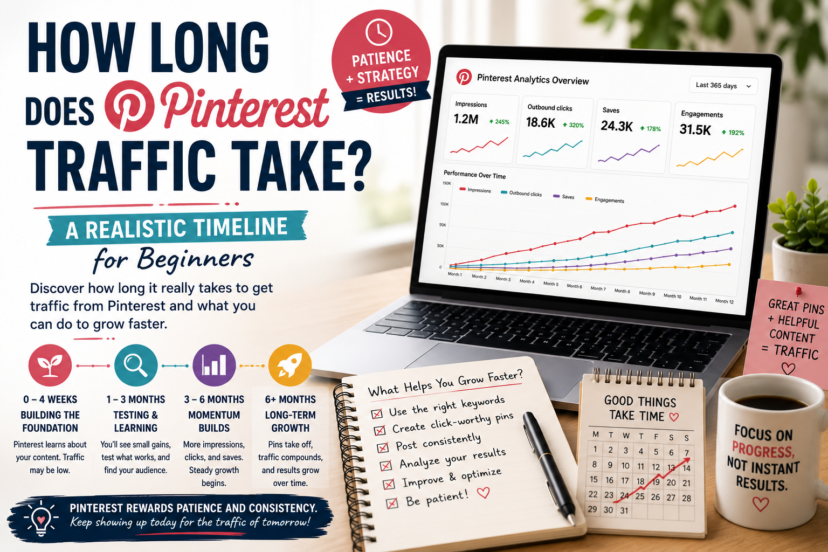
The First Few Weeks: Building the Foundation
During your first weeks on Pinterest, your account is still new.
At this stage, Pinterest knows very little about:
- your niche
- your audience
- your website
- your content strategy
As a result, many beginners experience:
- low impressions
- very few clicks
- inconsistent traffic
- slow growth
This phase can feel discouraging.
However, a lack of early traffic does not mean your strategy is failing.
Instead, Pinterest is simply gathering information.
During this period, focus on:
- publishing consistently
- optimizing your keywords
- creating attractive pins
- improving your profile
Your goal is to build a strong foundation.
Months One to Three: Testing and Learning
For most creators, the first real signs of progress appear between one and three months.
You may begin to notice:
- increasing impressions
- occasional saves
- your first outbound clicks
- certain pins performing better than others
At this stage, Pinterest starts testing your content with larger audiences.
Not every pin will succeed.
In fact, some pins may perform poorly while others unexpectedly gain traction.
This is normal.
Rather than obsessing over individual pins, focus on identifying patterns.
Ask yourself:
- Which topics generate clicks?
- Which designs attract attention?
- Which headlines perform best?
The creators who learn from this data usually improve much faster.
Pinterest data becomes much easier to understand once you know which metrics matter. In Pinterest Analytics Explained, you’ll learn how to interpret impressions, saves, clicks, and engagement.
Months Three to Six: Momentum Builds
For many beginner bloggers, Pinterest starts becoming more interesting after three to six months.
By now, you may have:
- dozens of published pins
- several blog articles
- clearer keyword strategies
- more analytics data
Pinterest has also had time to better understand your account.
At this stage, you may notice:
- growing monthly impressions
- more outbound clicks
- stronger engagement
- better-performing pins
This is often the point where creators realize that Pinterest rewards patience.
Growth is rarely linear.
Some months may feel slow, while others bring noticeable improvements.
Six Months and Beyond: Long-Term Growth
Pinterest’s greatest strength is longevity.
Unlike social media posts that disappear after a few days, pins can continue generating traffic for years.
After six months or longer, many creators shift their focus toward:
- updating older pins
- creating fresh designs
- improving keywords
- expanding successful topics
- optimizing top-performing articles
At this point, Pinterest becomes less about experimentation and more about refinement.
The content you created months earlier may suddenly begin attracting significant traffic.
That delayed growth surprises many beginners.
Why Some Creators Grow Faster Than Others
Not every Pinterest account grows at the same speed.
Several factors influence your results.
Your Niche Matters
Some niches perform particularly well on Pinterest.
Popular topics include:
- recipes
- home decor
- fashion
- fitness
- personal finance
- blogging
- side hustles
- marketing
These niches already have active audiences searching for ideas.
However, less popular niches can still succeed if they provide helpful content.
Your Keyword Strategy Matters
Pinterest relies heavily on keywords.
Without strong keywords, Pinterest struggles to understand:
- your pins
- your boards
- your website
Good keyword research improves:
- discoverability
- relevance
- traffic potential
Many beginners underestimate how important keywords really are.
If keyword research still feels confusing, our guide Pinterest Keyword Research explains how to find search terms that help Pinterest connect your content with the right audience.
Your Pin Quality Matters
Pinterest wants to recommend content that users find helpful and engaging.
Strong pins usually include:
- clear headlines
- attractive images
- readable fonts
- compelling benefits
- consistent branding
Even excellent blog posts struggle if the pin design fails to capture attention.
Design plays a major role in Pinterest success. In How to Create Click-Worthy Pins, you’ll learn how to create pins that encourage users to visit your website.
Consistency Matters More Than Volume
Many beginners believe they need to publish dozens of pins every day.
Fortunately, that is rarely necessary.
Pinterest generally rewards:
- consistency
- relevance
- quality
Publishing three excellent pins every week often works better than posting fifty low-quality pins in a short burst.
The creators who succeed are usually those who build systems they can maintain.
If you’re wondering how many pins are realistic, read How Many Pins Should You Create? for a beginner-friendly strategy that balances quality and consistency.
Common Expectations vs. Reality
Pinterest success stories can create unrealistic expectations.
Let’s compare common assumptions with reality.
| Expectation | Reality |
|---|---|
| Traffic arrives within days | Growth often takes months |
| Every pin will perform well | Most creators have many weak pins |
| Followers determine success | Keywords matter more |
| More pins always mean more traffic | Quality matters more than quantity |
| Pinterest is quick money | Pinterest rewards patience |
Understanding these realities helps beginners stay motivated.
Mistakes That Slow Down Pinterest Growth
Sometimes traffic grows slowly because of avoidable mistakes.
Common problems include:
- ignoring keywords
- publishing inconsistently
- creating weak headlines
- neglecting analytics
- expecting instant success
- giving up too early
Many creators quit just before their account begins gaining momentum.
That is why persistence matters.
To avoid the most common beginner errors, read Common Pinterest Mistakes, where we explain the habits that often prevent creators from growing their traffic.
What You Should Focus on Instead of Traffic
Checking your Pinterest statistics every day can become frustrating.
Instead of obsessing over traffic, focus on actions you can control.
For example:
- create one new pin
- improve an older design
- test a new keyword
- publish another article
- analyze your best-performing content
These small actions compound over time.
Pinterest growth is often invisible in the beginning.
The work you do today may produce results months later.
How to Stay Motivated While Waiting for Results
Waiting for traffic can be difficult.
Many bloggers lose motivation because they focus only on short-term numbers.
Try shifting your perspective.
Instead of asking:
“Why am I not getting traffic yet?”
ask:
“Am I building a system that can succeed over the next year?”
The creators who succeed on Pinterest usually:
- publish consistently
- learn from analytics
- improve their designs
- experiment with keywords
- think long-term
Patience is not exciting, but it is often the deciding factor.
Long-term growth requires discipline. In How to Stay Consistent as a Blogger, you’ll discover practical strategies that help you keep publishing even when motivation fades.
Want to build a sustainable Pinterest strategy from the ground up? Visit our Pinterest Hub, where you’ll find beginner-friendly guides on Pinterest SEO, keyword research, pin design, analytics, and long-term traffic growth.
Final Thoughts
Pinterest traffic takes longer than many beginners expect.
For some creators, meaningful results appear after a few weeks. For others, it may take several months.
The important thing to remember is that Pinterest is not designed for instant success. It rewards creators who publish helpful content, optimize their keywords, analyze their results, and remain consistent over time.
If you focus on improving your skills instead of chasing quick wins, Pinterest can become one of the most reliable traffic sources for your blog.
Growth may feel slow in the beginning—but every pin you create becomes another opportunity to attract visitors in the future.
FAQ
1. How long does Pinterest traffic take?
Most beginners need several weeks or months before seeing meaningful traffic from Pinterest.
2. Why are my Pinterest pins not getting views?
Common reasons include weak keywords, inconsistent posting, poor design, or simply not giving Pinterest enough time.
3. Can a pin go viral months later?
Yes. Pinterest pins often gain traction long after they are published.
4. How often should I post on Pinterest?
Consistency matters more than volume. Many beginners succeed with three to five quality pins per week.
5. Is Pinterest traffic faster than Google traffic?
It depends on your niche and strategy. Some creators see Pinterest results sooner, while others grow faster through SEO.