Best Side Hustles for Beginners in 2026: 7 Realistic Ideas
Introduction
Finding the best side hustles for beginners in 2026 can be surprisingly difficult.
It’s certainly not because there aren’t enough options.
The problem is almost the opposite.
There are too many.
Search online and you’ll find endless videos, articles, courses, and social media posts promising the next great way to make money. One person recommends affiliate marketing. Another says blogging is dead. Someone else tells you to create digital products with AI, start freelancing, open an online shop, or build an audience on the latest platform.
For a beginner, all that information can quickly become overwhelming.
Meanwhile, the basic reason many people want a side income hasn’t changed: an additional source of income can create more financial flexibility and reduce your dependence on a single paycheck.
But that doesn’t mean you need to build the next million-euro startup.
For someone working full-time, an additional €200, €500, or eventually €1,000 per month could already make a meaningful difference.
The challenge is choosing a side hustle that fits your available time, existing skills, financial goals, and willingness to learn.
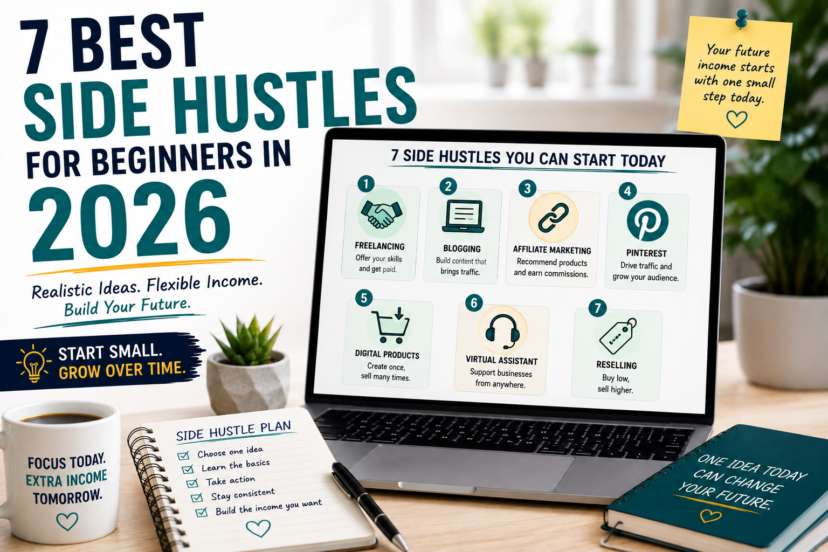
In this guide, we’ll look at seven realistic options and compare what makes each one interesting for beginners in 2026.
If you’re completely new to online income, begin with How to Start a Side Income While Working a Full-Time Job. That guide explains how to choose a model and fit it into your existing schedule before you start worrying about traffic, monetization, or scaling.
What Makes a Good Beginner Side Hustle in 2026?
A good side hustle doesn’t need to be trendy.
In fact, chasing whatever happens to be popular this month can make starting more difficult.
Instead, look for a few fundamental characteristics.
A beginner-friendly side hustle should ideally have:
- relatively low startup costs
- a business model you can understand
- flexible working hours
- skills you can learn gradually
- genuine customer or audience demand
- room to improve or grow over time
It should also fit your actual life.
If you have a full-time job and only four hours per week available, a business requiring daily client meetings probably isn’t a good match.
Likewise, if you need additional income relatively soon, starting a blog and waiting for traffic may not be your best first move.
The best side hustle isn’t the one with the biggest theoretical income potential. It’s the one you can realistically start and continue.
One Important Change in 2026: AI Is a Tool, Not the Business
It’s difficult to talk about online work in 2026 without mentioning AI.
AI tools can help with research, brainstorming, organization, outlines, data analysis, repetitive tasks, and many other parts of an online business.
But there’s an important distinction:
Using AI isn’t a business model by itself.
You still need to create value for someone.
A freelance writer still needs to produce useful writing.
A blogger still needs to understand what readers are looking for.
A virtual assistant still needs to solve problems for clients.
A digital product still needs to be useful enough for someone to buy it.
The barrier to creating generic content has become lower. That makes judgment, experience, trust, usefulness, and originality more—not less—important.
So instead of asking:
“How can AI make money for me?”
A better question is:
“How can I use available tools to do useful work more efficiently?”
That mindset will remain valuable even as individual tools change.
1. Freelancing
For many beginners, freelancing deserves to be near the top of the list because it offers one of the shortest paths between doing useful work and potentially getting paid.
You don’t need to build an audience first.
Instead, you sell a service directly to a client.
Beginner-accessible services might include:
- blog writing
- virtual assistance
- Pinterest support
- simple Canva graphics
- social media support
- online research
- spreadsheet or administrative work
- content formatting
The important word is useful.
Businesses don’t pay you because you want a side income. They pay because you solve a problem they don’t have the time, skills, or desire to handle themselves.
Why Freelancing Works Well for Beginners
You can start small.
You don’t necessarily need a complete website or sophisticated brand. A few good work samples and a clearly defined service may be enough to begin approaching potential clients.
Freelancing also teaches valuable business skills quickly:
- communicating with clients
- understanding requirements
- pricing work
- meeting deadlines
- improving based on feedback
The disadvantage is scalability.
If you’re paid primarily for your time, there are only so many hours you can sell alongside a full-time job.
But that doesn’t make freelancing a bad model.
In fact, it can be an excellent first-stage side hustle that generates money while you gradually build something more scalable.
2. Blogging
Blogging remains an interesting long-term side hustle in 2026, but beginners should understand what they’re signing up for.
A blog isn’t simply an online diary.
A useful niche website answers questions, solves problems, explains topics, and helps readers make decisions.
Over time, traffic may come from:
- search engines
- referrals
- other content platforms
And that audience can potentially support several income streams, including:
- affiliate marketing
- advertising
- digital products
- services
- partnerships
Why Blogging Is Still Attractive
The biggest advantage is ownership.
You’re building content on a website you control rather than relying entirely on an account hosted on someone else’s social platform.
An article can also remain useful long after you publish it.
However, that doesn’t mean every article will attract traffic for years.
Some will perform well.
Others won’t.
Some will need updating.
And building meaningful traffic can take considerable time.
That’s why blogging is much better suited to someone who thinks in years rather than weeks.
If this route interests you, our Blogging Hub takes you through niche selection, content planning, SEO, keyword research, internal linking, consistency, and realistic blogging timelines.
3. Affiliate Marketing
Affiliate marketing works particularly well alongside content.
The concept is straightforward.
You recommend a relevant product or service, and if someone makes a qualifying purchase through your affiliate link, you may receive a commission.
You don’t need to manufacture the product, store inventory, or handle shipping.
But there is something beginners often underestimate:
Affiliate links need people to click them.
That means affiliate marketing generally requires:
- useful content
- relevant traffic
- trust
- appropriate products
- clear disclosures
Simply joining ten affiliate programs doesn’t create an income stream.
What Good Affiliate Marketing Looks Like
Imagine you’re helping beginners start a blog.
Instead of writing:
“Buy this hosting.”
you might publish an article explaining what website hosting is, what beginners actually need, which features matter, and which options may suit different situations.
Now the affiliate recommendation is part of genuinely useful content.
That’s a much stronger long-term model.
Our Affiliate Marketing Hub explains how programs, commissions, content, disclosures, links, and reader trust fit together.
4. Virtual Assistance
Virtual assistance is another practical option for beginners because many people already have useful administrative skills from their regular jobs.
A virtual assistant might help a business with:
- email organization
- scheduling
- research
- spreadsheets
- customer communication
- uploading website content
- social media administration
- document preparation
You don’t necessarily need a specialized qualification to start.
Reliability can be extremely valuable.
If a client gives you a task, can they trust you to understand it, ask sensible questions when necessary, and complete it on time?
That’s a marketable skill.
Specialization Can Come Later
At first, you might provide general administrative support.
Over time, you could specialize as a:
- Pinterest VA
- WordPress VA
- email marketing VA
- content VA
That allows you to develop deeper skills and potentially offer more valuable services.
Virtual assistance also works well alongside a full-time job if you choose clients whose deadlines and communication expectations fit your available hours.
5. Selling Digital Products
Digital products are appealing because the same product can potentially be sold repeatedly without physical inventory.
Examples include:
- templates
- planners
- spreadsheets
- checklists
- ebooks
- worksheets
- mini guides
- digital resources
This makes the model potentially scalable.
However, beginners often start in the wrong place.
They ask:
“What digital product can I make?”
A better question is:
“What problem can I help someone solve?”
That’s where useful products come from.
Start With a Small Problem
Suppose your audience consists of employees trying to build a side hustle.
Instead of creating a huge 200-page course, you might begin with a simple weekly side-hustle planner.
The product has one job:
Help someone organize limited time.
That’s easier to create, explain, test, and improve.
And while digital products can eventually generate sales without you personally fulfilling every order, they aren’t automatically passive.
You still need demand, traffic, marketing, customer support, and updates.
6. Pinterest Content and Services
Pinterest is slightly different from the other ideas on this list because there are two ways to use it.
Pinterest as a Traffic Source
If you own a blog or content-based business, Pinterest can help people discover your content.
A simple system might look like:
Pinterest Pin → Blog Article → Email Signup → Future Monetization
Pinterest can therefore become part of a larger business rather than the business itself.
Pinterest as a Service
Alternatively, once you develop Pinterest skills, you could offer those skills to other bloggers or businesses.
For example, you might help with:
- pin design
- keyword research
- pin scheduling
- account organization
- analytics
Now Pinterest becomes a freelance service.
That’s an important distinction.
One route uses Pinterest to grow your own asset.
The other uses your Pinterest knowledge to generate service income from clients.
If you want to understand the platform in depth, our Pinterest Hub covers Pinterest SEO, keyword research, pin design, publishing frequency, analytics, common mistakes, traffic timelines, and more.
7. Reselling and Flipping
Not every good side hustle needs to involve content, algorithms, or digital marketing.
Reselling is one of the simplest business models to understand:
Acquire something for less than you can sell it for.
Beginners can even start with items they already own.
Look around your home for things you no longer need:
- clothing
- books
- electronics
- furniture
- collectibles
- household items
Listing those products teaches you the basics without requiring you to invest heavily in inventory.
You’ll learn about:
- pricing
- product descriptions
- photographs
- buyer communication
- marketplace fees
- shipping
- profit margins
Revenue Isn’t Profit
This distinction matters.
If you buy an item for €40 and sell it for €70, you haven’t necessarily made €30.
You may also have:
- selling fees
- payment fees
- packaging
- shipping
- transportation costs
Calculate the actual profit.
That habit is useful no matter which business you eventually build.
Which Side Hustle Has the Fastest Path to Income?
For beginners, this is one of the most useful distinctions to understand.
Generally, services have a shorter path to potential income than audience-based businesses.
If you offer freelance writing, virtual assistance, or Pinterest services, you need to find someone willing to hire you.
Once you do, you can potentially get paid for completing the work.
Blogging and affiliate marketing work differently.
First, you usually need:
Content → Traffic → Audience → Monetization
That can take considerably longer.
Digital products fall somewhere in between. If you already have access to potential buyers, sales may happen sooner. If you need to build an audience from scratch, the process can take much longer.
There is no universally “fastest” side hustle.
But understanding the business model helps you set realistic expectations.
Which Side Hustle Has the Best Long-Term Potential?
Now the answer changes.
If you’re willing to build gradually, asset-based businesses become more interesting.
A freelancer usually earns when completing client work.
A blogger can potentially create an article once and receive visitors from it repeatedly.
A digital product can potentially be sold more than once.
An email list allows you to communicate with subscribers repeatedly.
That creates scalability.
For this reason, some people eventually combine the two approaches.
For example:
Freelancing → first side income → build website → create content → grow audience → add affiliate marketing or digital products
The service provides potential income earlier.
The assets create longer-term opportunities.
You don’t have to choose between them forever.
You simply need to know which one you’re building first.
How to Choose the Right Side Hustle for Your Personality
Income potential isn’t the only consideration.
Your personality matters too.
If you dislike writing, building a blog with 100 articles may become miserable.
If you hate communicating with clients, freelancing may not suit you.
If you enjoy organizing systems, virtual assistance could be a natural fit.
If you enjoy finding bargains and negotiating, reselling may be more enjoyable.
Ask yourself:
Do I enjoy creating or serving clients?
Do I prefer writing, organizing, designing, or selling?
Do I want potential income sooner or am I comfortable building slowly?
How many hours can I realistically invest each week?
Do I want to work with clients or build something of my own?
The answers will narrow your options considerably.
The Biggest Beginner Mistake: Starting Everything
You’ve probably experienced this while researching side hustles.
One article convinces you to start blogging.
Then a video tells you digital products are better.
Next you discover affiliate marketing.
Then freelancing.
Then a new AI opportunity.
Suddenly, you’re trying to build five businesses.
Don’t.
Choose one primary income model.
You can add other components when they make sense.
For example, blogging naturally connects with:
Blog → Pinterest → Email → Affiliate Marketing → Digital Products
Those aren’t necessarily five separate businesses.
They can eventually become parts of one ecosystem.
But you don’t need to build the entire ecosystem in your first month.
What I Would Focus on If Starting From Zero in 2026
If I were designing a beginner strategy from scratch, I would keep the framework simple:
1. Choose One Income Model
Decide whether you’re primarily building a service or an asset.
2. Learn One Useful Skill
Writing, design, SEO, Pinterest, organization, sales, or another skill relevant to your chosen model.
3. Create Something Real
A service offer, an article, a product, or a listing.
4. Put It in Front of Real People
Potential clients, readers, searchers, or buyers.
5. Watch What Happens
Don’t guess forever.
Look at the response.
6. Improve
Do more of what shows potential and change what clearly isn’t working.
That simple cycle is more useful than constantly searching for the “best new side hustle.”
How Long Does It Take to Make Money?
There is no responsible universal answer.
A freelancer might find a client relatively quickly.
Another freelancer may send dozens of proposals before getting one.
A blogger might need many months before seeing meaningful traffic.
A digital product might sell soon after launch—or receive no sales until the offer or marketing improves.
This is why I wouldn’t use a fixed timeline.
Instead, track progress you can control:
- proposals sent
- articles published
- products created
- pins published
- email subscribers
- client conversations
- sales
- commissions
Then look for evidence of what works.
If your first goal is financial rather than simply building an audience, How to Make Your First €500 Online explains how to break that goal into smaller milestones and choose between a potentially faster service route and a slower asset-building route.
What About Side Hustles With No Experience?
You don’t need to arrive with years of expertise.
But no experience doesn’t mean no learning.
A beginner can learn:
- Canva
- WordPress
- basic SEO
- writing
- client communication
- spreadsheets
- email marketing
one step at a time.
That’s a much healthier expectation than believing there is a business requiring no skill whatsoever.
Our guide 10 Side Hustles With No Experience explores this distinction in more detail and gives you additional options if you’re worried that you don’t have anything to offer yet.
How Much Time Do You Really Need?
You don’t need to work on your side hustle every day.
Suppose you can consistently find four hours per week.
That’s more than 200 hours over a year.
What could you learn or create in 200 focused hours?
Quite a lot.
The key word is focused.
Instead of sitting down on Tuesday evening with the vague goal of “working on my business,” choose one specific task.
For example:
Research one article.
Create two Pinterest pins.
Contact three potential clients.
Finish one product template.
Specific actions make limited time far more useful.
For more ideas designed specifically around employment, 10 Easy Side Hustles You Can Start After Work explores options that can fit into short weekly work sessions.
Don’t Ignore Email If You’re Building an Audience
If you choose blogging, affiliate marketing, or digital products, traffic is only part of the equation.
Eventually, you’ll want some way to maintain contact with people who find your content.
That’s where an email list becomes useful.
Instead of relying entirely on Google, Pinterest, or another platform to bring the same visitor back, you can invite interested readers to subscribe.
Over time, email can help you:
- build trust
- bring readers back to useful content
- understand audience interests
- recommend relevant resources
- introduce future products
Our Email Marketing Hub covers this entire stage, from lead magnets and welcome sequences to email frequency, opt-in rates, trust, and eventual monetization.
A Simple Decision Guide
If you’re still unsure which of the seven ideas to choose, simplify the decision.
If you want a potentially shorter path to your first income:
Consider freelancing or virtual assistance.
If you want to build a long-term content asset:
Consider blogging.
If you enjoy recommending useful products and are prepared to build traffic:
Consider affiliate marketing.
If you enjoy creating useful resources:
Consider digital products.
If you’re interested in visual search and content promotion:
Learn Pinterest and either use it for your own business or eventually offer it as a service.
If you prefer buying, selling, and practical activity rather than creating online content:
Consider reselling.
You don’t need the perfect answer.
You need a reasonable first choice.
Final Thoughts
The best side hustles for beginners in 2026 aren’t necessarily new.
In fact, many of the strongest models are based on very old principles:
Solve a problem.
Provide a useful service.
Create something people value.
Help people make decisions.
Buy something for less than you sell it for.
Technology changes how we do those things, but the underlying economics remain surprisingly familiar.
Freelancing and virtual assistance can offer a relatively direct path to potential income.
Blogging and affiliate marketing can help you build longer-term assets.
Digital products offer scalability when they solve genuine problems.
Pinterest can support content businesses or become a marketable skill.
Reselling provides a practical alternative that doesn’t require building an audience at all.
You don’t need to choose all seven.
Choose one.
Learn what it requires.
Create something real.
Test it with real people.
Then improve.
That’s a far more realistic way to build a side income in 2026 than chasing whichever opportunity happens to be trending this week.
If you want to see how all the pieces fit together, continue with the Side Hustle Roadmap, where choosing your business model, creating content, building traffic, growing an audience, and eventually monetizing are organized into a clear path.
Start With a Realistic €500 Goal
Once you’ve chosen a side hustle, you need a practical first milestone.
Instead of aiming immediately for financial freedom or replacing your salary, use it to define your first manageable goal, organize your weekly actions, and start building evidence that your chosen model can work.
FAQ
What are the best side hustles for beginners in 2026?
Freelancing, blogging, affiliate marketing, virtual assistance, digital products, Pinterest-related services, and reselling can all be realistic options. The best choice depends on your skills, available time, and whether you prefer faster service income or longer-term asset building.
What is the easiest side hustle to start in 2026?
There isn’t one easiest option for everyone. Reselling can have a low barrier to entry if you already own items you can sell, while freelancing may be accessible if you already have a useful workplace skill.
Which side hustle can make money the fastest?
Service-based models such as freelancing and virtual assistance generally offer a shorter path to potential income because you don’t need to build an audience first. However, no specific earning timeline is guaranteed.
Are blogging and affiliate marketing still worth starting in 2026?
They can be worthwhile for people prepared to build for the long term. Both depend heavily on useful content, relevant traffic, trust, and adapting as search and discovery platforms change.
Do I need AI skills to start a side hustle in 2026?
Not necessarily. AI tools can make certain tasks more efficient, but the fundamental requirement remains creating useful value for clients, customers, or an audience.


