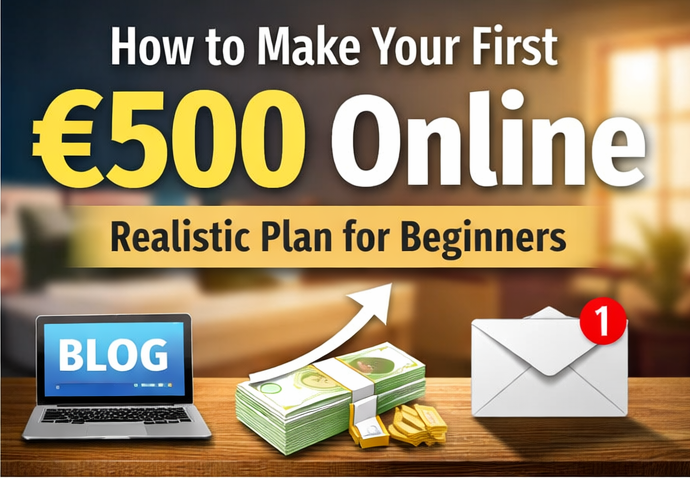
How to Make Your First €500 Online (Realistic Plan for Beginners)
Introduction
Learning how to make your first €500 online can feel much harder than it should.
Not necessarily because earning money online is impossibly complicated, but because so much advice starts with unrealistic expectations.
You’ve probably seen promises such as:
- “Make €10,000 in your first month.”
- “Build passive income without working.”
- “Quit your job with this simple online business.”
- “Make money while you sleep.”
Those claims can make a beginner feel as though earning €500 should happen almost automatically.
Usually, it doesn’t.
Your first €500 online will probably require learning new skills, trying things that don’t work, making adjustments, and consistently taking action.
But that’s exactly why €500 is such a useful first goal.
It’s large enough to make a meaningful difference, yet small enough to break into manageable milestones.
You don’t need to build a huge company.
You don’t need thousands of followers.
And you certainly don’t need to quit your job.
What you need is one realistic income model, a simple plan, and enough time to learn what works.
If you’re completely new to online income, start with How to Start a Side Income While Working a Full-Time Job. It explains how to choose a business model and fit the work around your existing schedule.
Then come back here, because we’re going to turn that idea into a concrete first target:
€500.
Why Your First €500 Matters More Than €10,000
It may sound strange, but your first €500 can teach you more than reading another hundred articles about making money online.
Why?
Because it proves that something you created has real value to another person.
Your first €500 might come from:
- ten €50 freelance projects
- five €100 clients
- digital product sales
- affiliate commissions
- a combination of smaller income sources
The exact path isn’t important.
What matters is that you’ve moved from:
“Could this work?”
to:
“Something worked. Now how can I improve it?”
That’s an enormous psychological and practical shift.
Your first €500 isn’t financial freedom.
It’s proof of concept.
Step 1: Choose One Realistic Income Model
The first step is also where many beginners go wrong.
They start blogging on Monday.
On Wednesday, they discover dropshipping.
By Friday, they’re researching print on demand.
The following week, they’re trying affiliate marketing.
A month later, they have six unfinished projects and no clear idea which one deserves their attention.
Instead, choose one primary method.
Some realistic possibilities include:
- freelancing
- virtual assistance
- affiliate marketing
- blogging
- digital products
- online tutoring
- content creation
The right choice depends heavily on how quickly you want the possibility of earning money.
Faster Income vs. Long-Term Income
This distinction is extremely important.
If your main goal is reaching your first €500 as quickly as reasonably possible, selling a service may give you a shorter path.
For example:
Service-based models:
- freelance writing
- virtual assistance
- social media management
- tutoring
- graphic design
With these models, you can potentially earn money as soon as you find someone willing to pay for your service.
You don’t need thousands of website visitors first.
However, the income is generally tied directly to the work you perform.
By contrast, models such as:
- blogging
- affiliate marketing
- digital products
- content creation
can take considerably longer because you may need to build traffic or an audience first.
However, they also have more potential to become scalable over time.
Neither approach is automatically better.
Choose based on your situation.
If you want to compare your options before deciding, 5 Beginner-Friendly Online Side Hustles You Can Start Today explains the differences between several accessible models.
Step 2: Turn €500 Into Smaller Milestones
€500 can feel like a big target when you’ve never made money online.
So don’t start by focusing on €500.
Start with:
€10.
Then:
€50.
Then:
€100.
Then:
€250.
Finally:
€500.
Each stage teaches you something.
For example, your first €10 tells you that someone was willing to pay for something you created, recommended, or provided.
Your first €100 begins showing whether the result can be repeated.
By €500, you may have enough information to identify what is actually producing results.
This makes the process much less intimidating.
Step 3: Create One Simple Offer or Asset
Beginners often believe they need an entire business before they can earn anything.
They think they need:
- a perfect website
- professional branding
- expensive software
- dozens of products
- thousands of social media followers
Usually, you don’t.
You need something useful that another person can discover, use, or purchase.
What that looks like depends on your business model.
If You’re Freelancing
Create one clear service.
For example:
“I write beginner-friendly SEO blog posts for small businesses.”
That’s much easier to understand than:
“I provide digital business solutions.”
If You’re Blogging
Publish genuinely useful articles that answer specific questions people are searching for.
If You’re Selling Digital Products
Start with one focused product rather than an enormous course.
For example:
Weekly Side Hustle Planner
If You’re Doing Affiliate Marketing
Create helpful content around problems where a relevant product genuinely helps the reader.
The goal isn’t to build everything.
The goal is to create one thing that can produce a result.
Step 4: Get Your First Real People to See It
Nothing happens until people discover what you’ve created.
If you’re freelancing, this means finding potential clients.
You might:
- use freelance platforms
- contact relevant small businesses
- network professionally
- ask existing contacts for referrals
If you’re building a blog, you need traffic.
That may eventually come from:
- email marketing
- other relevant platforms
If you’re selling digital products on a marketplace, you need to understand how buyers search for products there.
The traffic strategy should match the business model.
This is why the old advice of simply saying “Use Pinterest” isn’t enough.
Pinterest can be extremely useful for certain businesses, especially content-based websites. However, it isn’t automatically the fastest traffic source for every side hustle.
Step 5: Use Pinterest Strategically If You Have a Blog
If you’ve chosen blogging, Pinterest can become part of your traffic strategy.
Instead of treating Pinterest as another social media account that needs constant attention, think of it as a discovery platform.
A basic system might look like this:
Create helpful article → Create relevant pin → Pinterest user clicks → Visitor reads article
From there, the visitor might:
- read another article
- join your email list
- click an affiliate link
- return later
This is much more useful than simply chasing followers.
However, Pinterest traffic takes time to develop and results vary significantly between niches and accounts.
There is no reliable rule saying you’ll receive clicks within a certain number of days.
If this is the route you’ve chosen, our Pinterest Hub explains everything from Pinterest SEO and keyword research to pin design, analytics, mistakes, and realistic traffic timelines.
Step 6: Focus on One Traffic Source at First
Beginners often try to be everywhere.
They create:
- a blog
- YouTube
- TikTok
Then they discover that maintaining six platforms leaves almost no time to build the actual business.
Start smaller.
Choose the traffic source that makes the most sense for your model.
For a blogger, that might be Pinterest while gradually learning SEO.
For a freelancer, it might be direct outreach or a freelance platform.
For an Etsy seller, marketplace search may be the priority.
You can expand later.
At the beginning, concentration makes it easier to understand where your results are coming from.
Step 7: Don’t Wait for Passive Income
One of the biggest traps for beginners is focusing too early on passive income.
Passive income sounds attractive because the idea is that you can earn money without continuously exchanging hours for payment.
However, most so-called passive income requires substantial work first.
A blog requires articles.
Affiliate marketing requires traffic.
A digital product needs to be created and marketed.
An email list needs subscribers.
Therefore, don’t reject a side hustle simply because it requires active work.
Your first €500 might come from a service.
That income could then help finance the tools or time required to build something more scalable.
For example:
Freelancing → first income → invest in website → build content → grow audience → add affiliate income
Side income doesn’t need to begin passive.
It can become more scalable over time.
Step 8: Learn Only What You Need Next
It’s easy to spend months preparing.
You watch courses about SEO before publishing your first article.
You learn advanced email automation before getting your first subscriber.
You study conversion optimization before anyone visits your website.
This feels productive, but it can become procrastination.
Instead, ask:
What skill do I need for my next step?
If you need to publish an article, learn enough WordPress to publish it.
If you need a Pinterest pin, learn enough design to create one.
If you need clients, learn how to write a simple outreach message.
Then take action.
You can improve later.
Step 9: Track Where Your First Money Comes From
Once you start earning even small amounts, pay attention.
Suppose you earn:
- €15 from affiliate commissions
- €80 from freelance writing
- €0 from a digital product
That doesn’t necessarily mean you should immediately abandon affiliate marketing or digital products.
However, the numbers give you information.
Ask:
- What produced the result?
- Can I repeat it?
- How much time did it require?
- Is there enough demand?
- Did I enjoy doing it?
- Could this scale?
Successful side hustles are often built by doing more of what already shows signs of working.
Step 10: Reinvest Carefully
When your first income arrives, you may be tempted to immediately buy more tools.
Be careful.
You don’t need a collection of subscriptions simply because your side hustle made €50.
Reinvest when the expense solves a real problem.
For example, paying for a useful tool may make sense if it:
- saves significant time
- improves your website
- helps you serve clients
- increases your ability to create content
- removes an actual bottleneck
Don’t buy tools because successful creators use them.
Buy them because you need them.
Step 11: Build an Email List as Your Traffic Grows
If you’re building a content-based business, don’t think only about getting visitors.
Think about what happens after they arrive.
A visitor might read one article and never return.
An email subscriber gives you an opportunity to continue the relationship.
That’s why email marketing becomes increasingly valuable as your website grows.
You can offer a useful free resource and invite readers to subscribe.
Then, instead of depending entirely on Google, Pinterest, or social media to bring that same person back, you can communicate directly through email.
Our Email Marketing Hub explains how lead magnets, welcome sequences, opt-in forms, regular emails, and trust-building fit together.
Step 12: Give Yourself Enough Time to Learn
There is no responsible answer to:
“How long will it take me to make €500 online?”
Someone offering a service may reach the target relatively quickly.
Someone building a new blog may need considerably longer.
Another person may try one business model, discover it doesn’t suit them, and change direction.
That’s normal.
Instead of setting a deadline based on someone else’s results, measure your progress by actions you can control.
For example:
- number of client proposals sent
- useful articles published
- Pinterest pins created
- products tested
- subscribers gained
- skills learned
Income matters.
But at the beginning, consistent useful activity is what eventually creates the possibility of income.
A Realistic Example: The Service Route to €500
Suppose you decide to offer freelance writing.
You might set a simple target:
5 projects × €100 = €500
That doesn’t mean you’ll immediately find five clients willing to pay €100.
But now your goal becomes concrete.
You know what needs to happen:
- Create writing samples.
- Define your service.
- Find potential clients.
- Send proposals.
- Complete good work.
- Ask satisfied clients about additional projects.
Compare that with simply saying:
“I want to make money online.”
One is vague.
The other gives you actions.
Another Example: The Long-Term Content Route
Now imagine you choose blogging and affiliate marketing.
Your €500 path might be much less predictable.
You need to:
- Choose a niche.
- Build your website.
- Publish useful content.
- Learn basic SEO.
- Develop traffic.
- Join relevant affiliate programs.
- Create helpful recommendations.
- Build an email list.
- Continue improving your content.
The path is slower and harder to predict.
However, you’re also building assets that can continue working after the initial creation.
If you’re interested in this route, our Blogging Hub provides the step-by-step foundation.
What If You Have No Experience?
That’s not a reason to stop.
It simply means your first milestone is learning.
Our guide 10 Side Hustles With No Experience covers options that allow beginners to start without an existing specialist background.
Remember:
You don’t need experience to begin learning.
You need experience to become good.
And the only way to gain that experience is to start doing the work.
Avoid These Common €500 Mistakes
Several mistakes can make your first income unnecessarily difficult.
Trying Too Many Business Models
Choose one primary direction.
Buying Too Many Tools
Start with what you actually need.
Expecting Passive Income Immediately
Build value first.
Waiting for Everything to Be Perfect
Your first version is allowed to be simple.
Comparing Your Results With Other People
Their starting point, experience, budget, and available time may be completely different.
Giving Up Before You Have Enough Data
One unsuccessful article, product, or proposal tells you very little.
Test, learn, and improve.
Your First €500 Is the Beginning, Not the Finish Line
Once you reach €500, resist the urge to immediately chase €5,000.
First ask:
How did I make the €500?
Perhaps one service performed particularly well.
Perhaps one article generated most of your affiliate clicks.
Perhaps one product sold much better than the others.
That’s valuable information.
Your next goal could simply be:
Can I repeat this?
If you can repeatedly generate €500, you have something much more valuable than a one-time success.
You have the beginning of a system.
Final Thoughts
Learning how to make your first €500 online isn’t about discovering a secret shortcut.
It’s about simplifying the process.
Choose one realistic income model.
Create something useful.
Put it in front of real people.
Learn from their response.
Earn your first small amount.
Then repeat what works.
Your first milestone might be €10.
Then €50.
Then €100.
Eventually, €500 becomes less of an abstract dream and more of a measurable business goal.
There is no guarantee about how quickly you’ll get there.
And that’s okay.
The purpose of building a realistic side income isn’t to win an online race.
It’s to gradually create another source of income that fits your life and can potentially become more valuable over time.
If you’re still unsure which direction is right for you, 7 Realistic Side Income Ideas for Employees can help you compare several models before committing to one.
Ready to Build Your Own €500 Plan?
This article explains the strategy.
The next step is turning it into your own action plan.
Use it to choose your business model, define your first milestones, organize your weekly actions, and start working toward your first €500 without relying on unrealistic income promises.
You can also visit our Side Hustle Roadmap if you want to see how the complete journey—from choosing an idea to traffic, email marketing, and monetization—fits together.
FAQ
1. Is it realistic to make €500 online as a beginner?
It can be a realistic first goal, but there is no guarantee that every beginner will reach it or do so within a specific timeframe. Your results depend on your business model, skills, available time, demand, and consistency.
2. What is the fastest way to make your first €500 online?
Selling a useful service can offer a shorter route than building an audience from scratch because you can earn directly from clients. Freelancing, virtual assistance, tutoring, and similar services are examples.
3. Can I make €500 online with affiliate marketing?
It’s possible, but affiliate marketing generally requires relevant traffic and people who trust your recommendations. Beginners should not expect immediate commissions simply from adding affiliate links.
4. Do I need a website to make my first €500?
Not necessarily. Service-based side hustles can often be started without a website. However, a website can become valuable if you’re building a blog, affiliate business, audience, or long-term online brand.
5. How long does it take to make the first €500 online?
There is no reliable universal timeline. Some service businesses may reach the target relatively quickly, while blogs and audience-based businesses can take much longer. Focus on building a repeatable process rather than reaching €500 by an arbitrary deadline.