
How to Start Affiliate Marketing as a Beginner (2026 Guide)
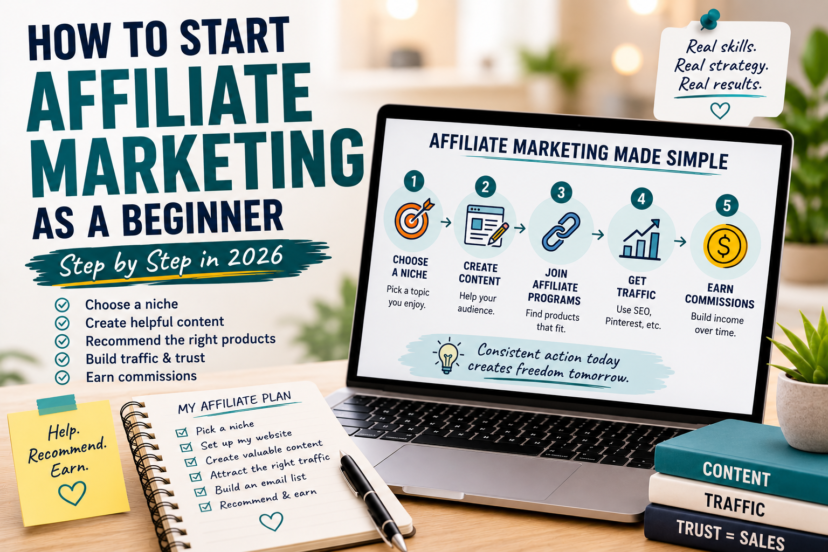
Introduction
If you’re researching ways to build an online side income, you’ve probably come across affiliate marketing.
The basic idea sounds almost too simple:
Recommend a product or service, someone purchases through your affiliate link, and you receive a commission.
But if you’re trying to understand how to start affiliate marketing as a beginner, the real process involves much more than finding products and posting links.
You need to decide who you want to help, create useful content, attract the right visitors, choose relevant affiliate programs, earn trust, and understand which recommendations actually produce results.
That takes time.
However, affiliate marketing has several characteristics that make it interesting for beginners.
You don’t have to create your own product. You don’t need traditional inventory or shipping. And you can build it gradually alongside a full-time job.
In this guide, we’ll go through the process step by step—from choosing your niche to creating content, attracting traffic, building an email audience, and eventually earning your first affiliate commission.
What Is Affiliate Marketing?
Affiliate marketing is a performance-based marketing model.
A company provides you with a unique tracking link. You use that link when recommending an eligible product or service.
If someone follows your link and completes the action required by the affiliate program—usually a purchase—you may earn a commission.
A simple affiliate journey might look like this:
Reader searches for information → finds your article → reads your recommendation → clicks your affiliate link → makes a qualifying purchase → you receive a commission
However, the commission isn’t the most important part of that process.
The reader’s problem is.
If your content doesn’t help the reader, there’s little reason for them to trust your recommendation in the first place.
That’s why good affiliate marketing starts with useful content rather than affiliate links.
Why Affiliate Marketing Can Work Well as a Side Hustle
Affiliate marketing has relatively few barriers to entry compared with many traditional businesses.
You generally don’t need to:
- manufacture products
- maintain physical inventory
- package orders
- ship products
- build a customer-service department
The merchant usually handles those parts of the transaction.
Your role is different.
You help the right person discover and understand a product that may solve their problem.
This also makes affiliate marketing flexible.
You can research an article on Tuesday evening, write on Thursday, and publish on the weekend.
That makes it particularly interesting for employees building something alongside their regular job.
If you’re comparing affiliate marketing with other possibilities, Best Side Hustles for Beginners in 2026 explains how it differs from freelancing, blogging, digital products, virtual assistance, and other beginner-friendly models.
What Affiliate Marketing Is Not
Before starting, it’s worth clearing up a common misconception.
Affiliate marketing isn’t simply:
Get link → post link → make money.
A link has no value if nobody sees it.
Traffic has limited value if the visitors aren’t interested in the topic.
And even relevant traffic doesn’t automatically produce sales if people don’t trust your recommendation.
A more realistic model is:
Useful content → Relevant traffic → Trust → Recommendation → Click → Possible conversion
That process explains why affiliate marketing can take time.
You’re not just building links.
You’re building an audience and a content system around problems people want solved.
Do You Need to Be an Expert?
No—but the old advice that you only need to be “one step ahead” of your reader can be misleading.
You don’t need to be the world’s leading authority on a subject.
But you should understand what you’re talking about.
If you’re reviewing a tool you’ve never used, be transparent about that.
If you’re explaining a financial, medical, legal, or other high-stakes topic, expertise and accuracy become particularly important.
For ordinary affiliate content, focus on researching carefully, checking your claims, understanding the products you recommend whenever possible, and being clear about limitations.
Trust is difficult to build and very easy to lose.
Step 1: Choose a Focused Niche
A niche is the main subject around which you build your content.
Examples might include:
- side income
- blogging
- home organization
- photography
- travel
- gardening
- fitness
- technology
- hobbies
The purpose of choosing a niche isn’t to trap yourself inside one tiny subject forever.
It’s to give your website direction.
Imagine arriving on a website where one article is about gardening, the next is about gaming laptops, the next explains dog food, and another recommends accounting software.
It’s difficult to understand who that website is designed to help.
A focused niche makes that much clearer.
How to Choose an Affiliate Niche
Don’t choose a niche based only on commission rates.
Instead, look for an intersection between three things:
1. Something You Can Work With for a Long Time
You don’t necessarily need a lifelong passion.
But you should be willing to research and create content about the topic repeatedly.
2. Problems People Actually Want Solved
Good affiliate niches contain questions, decisions, comparisons, and problems.
3. Relevant Products or Services
There should be legitimate products that naturally fit those problems.
For example, a blogging niche might naturally connect with hosting, WordPress tools, email platforms, design tools, or educational resources.
The product follows the problem.
Don’t build the problem around the commission.
Step 2: Understand Your Reader Before Choosing Products
This step is often skipped.
Before joining ten affiliate programs, ask:
Who am I trying to help?
Suppose your audience is:
Employees who want to build a realistic online side income with limited time.
Now your content decisions become much easier.
You know that your reader probably cares about:
- low startup costs
- flexible schedules
- beginner-friendly tools
- realistic expectations
- simple systems
- avoiding unnecessary expenses
That should influence which products you recommend.
An expensive professional tool designed for a large marketing agency may be excellent software, but still completely wrong for your beginner audience.
Affiliate marketing works best when you match:
Reader → Problem → Content → Solution
Step 3: Build a Simple Website
You don’t technically need a website for every form of affiliate marketing.
Some affiliate programs allow promotion through other channels.
However, for the strategy we’re discussing here, a website provides a useful home base.
It’s a place where you can:
- publish detailed content
- organize resources
- build search visibility
- collect email subscribers
- create comparison pages
- update recommendations
- develop a recognizable brand
And unlike an account on a social platform, you have significantly more control over your own website.
If you’re building your affiliate business alongside employment, How to Earn Extra Money From Home After Work explains how a website-based business can fit into a realistic weekly schedule.
What Does a Beginner Affiliate Website Need?
Don’t overbuild it.
At the beginning, focus on the essentials.
You may need pages such as:
- Home
- Blog
- About
- Contact
- Resources
- Privacy Policy
- Affiliate Disclosure
Depending on your location and audience, additional legal pages or disclosures may also be required.
The exact legal requirements vary, so don’t simply copy another website’s legal pages and assume you’re covered.
Step 4: Add a Clear Affiliate Disclosure
This deserves its own section because it’s too important to hide inside a list of beginner mistakes.
Readers should be able to understand when your content contains affiliate links.
Don’t try to disguise the commercial relationship.
A disclosure should be clear and easy to notice rather than buried somewhere nobody will see it.
Individual affiliate programs may also have their own requirements concerning how their relationship must be disclosed.
Transparency isn’t just a compliance issue.
It supports trust.
You’re effectively telling the reader:
“I may receive compensation if you purchase through certain links.”
Then they can evaluate your recommendation with that information.
Step 5: Join Relevant Affiliate Programs
Once you understand your audience and have begun creating your website, you can research affiliate programs that fit your niche.
Programs can be offered:
- directly by companies
- through affiliate networks
- through software marketplaces
- through specialized partner platforms
Examples of affiliate networks and platforms include CJ, Impact, PartnerStack, and others.
But don’t assume a program is good simply because it exists on a large network.
Evaluate the individual merchant and offer.
What Makes a Good Affiliate Program?
Commission percentage matters, but it isn’t the only factor.
Consider:
- Is the product genuinely useful?
- Does it fit your audience?
- Is the company reputable?
- Would you feel comfortable recommending it without a commission?
- How long is the tracking window?
- What actions qualify for a commission?
- Are there minimum payout requirements?
- What promotion methods are allowed?
- Are there restrictions on paid ads, email, or branded keywords?
- Can commissions be reversed after refunds?
Read the terms.
Affiliate programs can change their commission structures, rules, and even close entirely.
That means your business shouldn’t depend completely on one program.
Step 6: Create Helpful Content Before Chasing Commissions
Content is where your affiliate strategy becomes useful to real people.
You aren’t publishing simply to have more pages.
Each article should have a purpose.
Useful affiliate content can include:
- beginner guides
- tutorials
- product comparisons
- reviews
- alternatives
- resource pages
- problem-solving articles
But not every article needs affiliate links.
That’s important.
Some articles should simply help readers understand the topic.
Those informational articles can attract visitors who aren’t yet ready to buy anything.
Later, internal links can guide them toward more specific content when appropriate.
Understand Search Intent
One of the biggest improvements a beginner can make is learning to recognize why someone is searching.
Compare these searches:
What is email marketing?
and:
Best email marketing platform for beginner bloggers
The first person is learning.
The second may be much closer to choosing a product.
Both searches can be valuable.
But the content should be different.
A strong affiliate website often contains a mixture of:
Informational content that teaches.
and
Commercial content that helps people compare and choose.
This creates a much more natural website than publishing nothing but reviews.
Step 7: Recommend Products Naturally
Don’t force an affiliate product into every paragraph.
Imagine you’re writing:
How to Start an Email List as a Beginner
You first explain:
- why an email list matters
- how subscribers join
- what a lead magnet is
- how welcome emails work
When the reader reaches the point where they need an email platform, a relevant recommendation makes sense.
The product appears because the process requires a solution.
That’s very different from beginning with:
“How can I get people to click my affiliate link?”
Start with the reader.
Then decide whether a product belongs in the answer.
Step 8: Get Relevant Traffic
Once you have useful content, people need to discover it.
For the type of content business we’re building, two important traffic sources are Google and Pinterest.
They work differently and should be treated differently.
Google and SEO
Search traffic can be valuable because people actively look for answers to specific questions.
But publishing a helpful article doesn’t guarantee a top Google ranking.
Search results are competitive.
Your chances depend on many factors, including:
- how well your content satisfies the query
- competition
- website authority
- topical relevance
- technical quality
- internal linking
- user experience
SEO is therefore a long-term strategy rather than a guaranteed traffic source.
Our Blogging Hub covers keyword research, SEO, content planning, internal linking, and other foundations in more depth.
Pinterest Traffic
Pinterest can also help people discover content, particularly in niches that perform well on the platform.
You create pins around relevant topics and connect them with useful pages on your website.
However, Pinterest isn’t instant traffic.
New accounts and new content can take time to gain distribution, and results vary widely.
The right approach is to think of Pinterest as another discovery system rather than a guaranteed source of visitors.
Our Pinterest Hub covers Pinterest SEO, keyword research, click-worthy pins, publishing frequency, analytics, common mistakes, and realistic traffic timelines.
Step 9: Build an Email List
Traffic is useful.
But a visitor may read one article and never return.
An email list gives interested readers a way to stay connected.
You might offer a useful free resource such as:
- checklist
- template
- short guide
- planner
- worksheet
in exchange for an email subscription.
Then you can continue providing useful information after the reader leaves your website.
This matters in affiliate marketing because trust often develops over multiple interactions rather than one page view.
Don’t Turn Every Email Into a Sales Email
The goal isn’t to collect subscribers and immediately bombard them with affiliate links.
Use email to help.
Share:
- useful tips
- relevant articles
- lessons you’ve learned
- resources
- occasional recommendations
When you do recommend an affiliate product, the same principle applies:
It should make sense for the reader.
Our Email Marketing Hub explains lead magnets, welcome sequences, email frequency, subscriber trust, open rates, mistakes, and when monetization becomes appropriate.
Step 10: Track What Actually Happens
Affiliate marketing becomes much easier to improve when you stop guessing.
Most affiliate dashboards provide at least some basic information such as:
- clicks
- conversions
- commissions
- refunds or reversals
Your website analytics can tell you which pages attract visitors.
Together, those numbers help answer useful questions.
For example:
Article A: 2,000 visitors, 5 affiliate clicks.
Article B: 300 visitors, 40 affiliate clicks.
Article A has more traffic.
But Article B may be much more commercially relevant.
That doesn’t mean Article A is useless. It may be excellent for introducing people to your website.
The point is that traffic alone isn’t the complete picture.
Learn the Basic Affiliate Funnel
A simple affiliate funnel might look like this:
Traffic → Article → Affiliate Link → Merchant → Conversion
Or:
Traffic → Article → Email Signup → Helpful Emails → Affiliate Recommendation → Merchant
Every stage can be measured and improved.
If people don’t reach your website, you have a traffic problem.
If they arrive but don’t click, the recommendation may be irrelevant, poorly placed, or unconvincing.
If people click but don’t purchase, the merchant’s offer may not fit the audience—or they may simply not be ready to buy.
This is much more useful than assuming:
“Affiliate marketing doesn’t work.”
Find out where the process is breaking down.
How Long Does It Take to Earn Your First Affiliate Commission?
There is no reliable answer.
The old version of this article said some people earn a commission within weeks while others take several months.
That’s possible, but it doesn’t help you predict your own result.
Someone with an established audience may earn a commission almost immediately.
Someone starting a brand-new website may spend months building content before receiving meaningful traffic.
Instead of measuring only time, measure progress.
For example:
- articles published
- impressions
- visitors
- affiliate clicks
- email subscribers
- conversions
Those numbers tell you whether your system is beginning to work.
How Much Can Beginners Earn?
Again, there is no useful universal number.
One beginner may earn nothing for a long time.
Another may earn a small first commission.
Someone with established traffic and strong commercial content may earn considerably more.
Commission rates also vary dramatically.
A physical product might offer a relatively small percentage.
A software company may offer a larger commission or recurring payments.
What matters initially isn’t whether you can earn €5,000 per month.
It’s whether you can build the first functioning sequence:
Visitor → Useful content → Recommendation → Click → Conversion
Once that happens, you have something you can analyze and improve.
Common Affiliate Marketing Mistakes
Several mistakes repeatedly slow beginners down.
Choosing Products Before Understanding the Audience
Start with problems, not commissions.
Promoting Too Many Products
More links don’t automatically mean more income.
Publishing Only Commercial Content
Build a useful website, not a catalogue of affiliate offers.
Hiding Affiliate Relationships
Be transparent.
Recommending Products You Don’t Trust
A commission isn’t worth damaging reader trust.
Ignoring Affiliate Terms
Programs have rules. Read them.
Depending on One Traffic Source
Google, Pinterest, email, and other sources can change. Diversification becomes valuable over time.
Depending on One Affiliate Program
Commission structures and program terms can change.
Obsessing Over Traffic Instead of Intent
One hundred highly relevant visitors can sometimes be more useful than thousands of people who aren’t interested in the product.
Quitting Because the First Articles Don’t Perform
Early results provide information—not a final verdict on the business.
How Much Does It Cost to Start?
Affiliate marketing can be relatively inexpensive, but it isn’t necessarily free.
For a website-based strategy, potential expenses include:
- domain
- hosting
- email marketing software
- optional design or SEO tools
You don’t need every premium tool from day one.
Start with what you genuinely need.
Upgrade when a limitation becomes a real business problem rather than because someone else’s setup contains more software.
This keeps your financial risk low while you’re still learning.
Can You Start Affiliate Marketing While Working Full-Time?
Yes, and the model can fit particularly well around employment because much of the work is asynchronous.
You can research, write, create pins, analyze results, or prepare emails when your schedule allows.
You don’t need to work every evening.
A realistic week might involve:
Tuesday: keyword and topic research
Thursday: write part of an article
Saturday: finish and publish
Sunday: create Pinterest content or review analytics
Even a few focused hours each week can move the project forward.
The trade-off is speed.
If you have limited time, growth may take longer.
That’s not a failure.
It’s simply the reality of building a business alongside another job.
For more on this approach, continue with Affiliate Marketing for Busy Employees: The Long-Term Approach That Actually Works.
How Affiliate Marketing Fits Into a Larger Side-Income System
Affiliate marketing becomes particularly interesting when you stop viewing it as an isolated tactic.
Consider this system:
Helpful Blog Content
↓
Google + Pinterest Traffic
↓
Email Subscribers
↓
Trust and Repeat Visitors
↓
Relevant Affiliate Recommendations
↓
Potential Commissions
Now each component supports the others.
Your blog gives Pinterest somewhere useful to send visitors.
Pinterest helps people discover the blog.
The blog helps grow the email list.
Email brings some readers back.
Affiliate marketing provides one way to monetize that audience.
Later, digital products or other income streams could be added.
That’s how a simple affiliate project can gradually become a more diversified online business.
A Realistic Beginner Action Plan
If you’re starting from zero, don’t try to build the entire system this weekend.
Start with these stages.
Month/Stage 1: Foundation
Choose your niche and understand your target reader.
Set up the essential website structure.
Research the questions your audience asks.
Stage 2: Content
Create genuinely useful articles.
Build informational content before obsessing over affiliate links.
Stage 3: Relevant Programs
Research reputable affiliate programs that fit your existing content and audience.
Read the terms.
Add appropriate disclosures.
Stage 4: Traffic
Develop one primary traffic strategy.
Learn SEO and/or Pinterest gradually.
Stage 5: Email
Create a useful lead magnet and begin building a subscriber relationship.
Stage 6: Optimization
Track traffic, clicks, and conversions.
Improve what shows potential.
This isn’t a promise that each stage takes a specific number of weeks.
Think of them as development stages rather than deadlines.
Final Thoughts
Learning how to start affiliate marketing as a beginner isn’t primarily about learning how to create affiliate links.
That’s the easy part.
The real work is learning how to:
- understand an audience
- identify useful problems
- create valuable content
- attract relevant visitors
- recommend appropriate products
- build trust
- track results
- improve over time
Affiliate marketing can be an attractive side-income model because you don’t need your own product and can build it gradually around a full-time job.
But it isn’t effortless income.
You need content.
You need traffic.
You need trust.
And you need patience.
Start with one niche and one audience.
Help them solve real problems.
Introduce affiliate products only when those products genuinely fit the solution.
Then measure what happens.
That’s a much stronger foundation than chasing high commission percentages or looking for shortcuts.
And once you’ve understood these fundamentals, continue with Affiliate Marketing for Busy Employees: The Long-Term Approach That Actually Works to see how to turn the basic model into a sustainable strategy when you only have limited time each week.
Start Building Your First Online Income Stream
If affiliate marketing is the model you want to explore, you don’t need to build everything at once.
Use it to define your first goal, organize your weekly actions, and begin building a realistic side-income project step by step.
You can also visit our Affiliate Marketing Hub for the complete collection of guides on affiliate programs, content, traffic, conversions, disclosures, and long-term strategy.
FAQ
Is affiliate marketing good for beginners in 2026?
It can be. Startup costs can be relatively low, you don’t need your own product, and the work can be done flexibly. However, meaningful results usually require useful content, relevant traffic, trust, and consistent work.
Do I need a website for affiliate marketing?
Not every affiliate strategy requires a website, and individual programs have different rules. However, a website provides a useful long-term home for detailed content, SEO, email-list building, and affiliate recommendations.
How long does it take to make money with affiliate marketing?
There is no standard timeline. Results depend on your existing audience, niche, content, traffic, products, and execution. A brand-new website may require considerable time before receiving enough relevant traffic to generate commissions.
Can I do affiliate marketing without followers?
Yes. An existing social following isn’t mandatory. Search engines, Pinterest, email, and other discovery channels can bring people to your content, although building traffic through any channel takes work.
How many affiliate programs should a beginner join?
There is no ideal number. Start with a small number of relevant, reputable programs that genuinely fit your audience and content rather than joining as many programs as possible.
Can affiliate marketing become passive income?
Some affiliate content can continue generating clicks and commissions after publication, but maintaining a successful affiliate business still requires updates, traffic development, tracking, compliance, and adapting when products or affiliate programs change.


