
How to Earn Extra Money From Home After Work: A Realistic Guide
Introduction
If you want to earn extra money from home after work, one of the biggest challenges isn’t finding ideas.
It’s finding an idea you can realistically fit into your life.
After a full workday, your time and energy are limited. You may have a commute, household responsibilities, family commitments, appointments, or simply need some time to switch off.
The last thing most employees need is a side hustle that feels like a second full-time job.
Fortunately, building an additional income stream doesn’t necessarily require working every evening or investing large amounts of money.
There are ways to start from home with a laptop, an internet connection, a few useful skills, and several focused hours each week.
Some can potentially generate income relatively quickly because you provide a service directly to clients. Others take longer because you’re building content, traffic, products, or an audience.
The important part is understanding the difference.
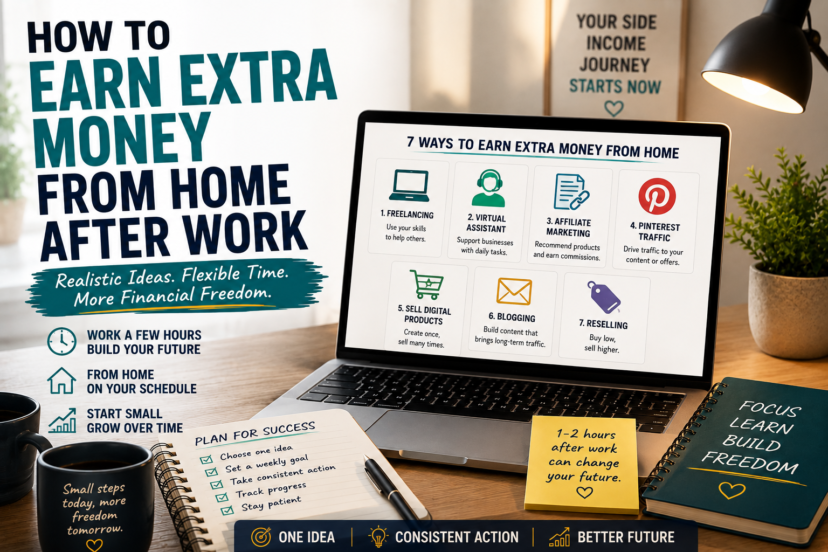
In this guide, we’ll look at seven realistic ways to earn extra money from home, how to choose between them, how much time you actually need, and how to create an after-work routine you can maintain.
If you’re completely new to side income, start with How to Start a Side Income While Working a Full-Time Job. It explains the basic process of choosing a model and fitting it around regular employment.
Why Working From Home Changes the Side-Hustle Equation
Traditional second jobs often come with a hidden cost: more commuting, fixed shifts, and less control over your schedule.
A home-based side hustle can remove some of those barriers.
You might be able to work for 45 minutes on Tuesday evening, skip Wednesday completely, and continue for two hours on Saturday morning.
That flexibility is valuable when you already have a job.
However, working from home creates a different challenge.
Nobody tells you when to begin.
Nobody gives you a task list.
And nobody stops you from spending two hours researching side hustles instead of actually building one.
That means a home-based side income requires something beyond motivation:
a simple system.
We’ll come back to that shortly.
First, let’s look at the different ways you could actually earn money.
Two Ways to Earn Extra Money From Home
Most of the ideas in this article fall into two broad categories.
Understanding them makes choosing much easier.
1. Sell Your Time or Skills
You provide a service and someone pays you for the work.
Examples include:
- freelancing
- virtual assistance
- design services
- writing
- social media support
This can provide a relatively short path to potential income because you don’t need to build a large audience first.
The disadvantage is that your available hours can limit your income.
2. Build an Asset
Instead of selling individual hours, you create something that may continue producing value.
Examples include:
- a blog
- affiliate content
- digital products
- an email list
These models can become more scalable, but they generally require more patience.
Neither approach is inherently better.
The right one depends on what you need now.
1. Freelancing From Home
Freelancing is one of the most practical starting points for employees who already have useful skills.
You provide a specific service to a client and receive payment for completing the work.
Possible services include:
- writing
- proofreading
- research
- spreadsheet work
- Canva graphics
- Pinterest support
- website administration
- social media assistance
You may already have skills from your regular job that can be transferred into freelance work.
For example, someone who regularly works with spreadsheets doesn’t need to become a programmer before offering basic spreadsheet assistance.
Someone who writes reports at work may already have a foundation for business writing.
Why Freelancing Can Work After Work
You can often choose projects that fit around your schedule.
More importantly, you don’t need thousands of website visitors before you can potentially earn money.
You need a client with a problem you can solve.
The trade-off is that client work creates deadlines.
If your regular job is unpredictable, choose your commitments carefully and avoid promising turnaround times you can’t realistically maintain.
2. Virtual Assistance
Virtual assistance is closely related to freelancing but deserves its own category because the work can be particularly accessible to organized beginners.
Businesses may need help with:
- email management
- scheduling
- document organization
- customer communication
- website updates
- research
- spreadsheets
- content uploads
- social media administration
You don’t need to know everything before you begin.
You could start with general administrative support and specialize later.
For example, as your skills develop, you might become a:
- Pinterest VA
- WordPress VA
- content VA
- email marketing VA
Specialization can help you become more useful to a particular type of client.
The important part is reliability.
For many small businesses, someone who communicates clearly, follows instructions, and delivers work on time can be extremely valuable.
3. Blogging
Blogging is a very different kind of home-based side hustle.
Instead of working for clients, you’re building an asset of your own.
You choose a topic, create useful articles, and gradually build a library of content that people can discover online.
Traffic might eventually come from:
- search engines
- referrals
- other platforms
That audience can potentially support income through affiliate marketing, advertising, digital products, or services.
Why Blogging Fits Around a Full-Time Job
Blogging is highly flexible.
You can research an article one evening, write part of it another evening, and finish it during the weekend.
There is usually no client waiting for you at a specific hour.
But flexibility doesn’t mean fast results.
A new blog can take considerable time to attract meaningful traffic.
That’s why blogging is better suited to someone who wants to build gradually for the long term rather than someone who needs extra money immediately.
Our Blogging Hub covers this entire process, from niche selection and content planning to SEO, keyword research, internal linking, consistency, and realistic income timelines.
4. Affiliate Marketing
Affiliate marketing can become part of a blog, website, newsletter, or other content business.
The model is simple:
You recommend a relevant product or service and may receive a commission when someone makes a qualifying purchase through your affiliate link.
However, the simple business model can hide an important reality:
You need people to see your recommendations.
That usually means you need traffic, an audience, or both.
This is why affiliate marketing shouldn’t be viewed as simply signing up for affiliate programs and adding links.
Successful affiliate content should help someone solve a problem or make a better decision.
For example, a useful comparison explaining which type of email marketing tool suits different beginners is much more valuable than simply saying:
“Buy this tool.”
Affiliate marketing works best when the recommendation naturally follows the useful information.
If this model interests you, our Affiliate Marketing Hub explains programs, commissions, disclosures, content strategy, links, and the importance of reader trust.
5. Selling Digital Products
Digital products are particularly attractive for home-based businesses because you don’t need physical inventory or traditional shipping.
Examples include:
- planners
- templates
- checklists
- spreadsheets
- worksheets
- ebooks
- mini guides
The same digital file can potentially be sold more than once.
That’s what gives the model scalability.
However, creating a file doesn’t automatically create demand.
A digital product still needs to solve a problem someone cares about.
Start With One Small Problem
Instead of asking:
“What can I create?”
ask:
“What does my audience need help with?”
Suppose your audience consists of employees trying to build a side hustle.
A simple weekly side-hustle planner might solve a clearer problem than a huge generic ebook about making money online.
Start small.
Test the idea.
Learn from real users.
Then improve or expand.
6. Pinterest as a Traffic Source or Service
Pinterest can play two different roles in a home-based side business.
First, it can help people discover your own content.
For example:
Pinterest → Blog → Email List → Monetization
You create pins that lead to useful articles on your website.
Pinterest therefore supports your business rather than necessarily being the business itself.
Second, Pinterest knowledge can become a service.
Once you understand pin design, keywords, scheduling, and analytics, you could potentially help bloggers or businesses manage their Pinterest presence.
Now you’re selling your Pinterest skills directly.
That distinction matters because the income models are different.
Using Pinterest for your own blog is usually a longer-term traffic strategy.
Providing Pinterest services can offer a more direct path to client income.
Our Pinterest Hub explains the platform in depth, including Pinterest SEO, keywords, pin creation, analytics, common mistakes, and realistic traffic timelines.
7. Online Reselling
You don’t necessarily need to build a website or learn digital marketing to earn extra money from home.
Reselling offers a more practical alternative.
The model is straightforward:
Sell something for more than it cost you.
You can even begin with items you already own and no longer use.
For example:
- clothing
- books
- electronics
- furniture
- collectibles
- household items
This gives you a low-risk way to learn how online marketplaces work.
You’ll gain experience with pricing, photographs, product descriptions, buyer communication, shipping, and fees.
Pay Attention to Profit
If you later begin buying items specifically for resale, calculate your real profit.
A €60 sale isn’t €60 of income if you paid €35 for the item and another €10 in fees, packaging, or transport.
Basic bookkeeping matters even for a small side hustle.
Which Option Is Best If You Need Money Sooner?
If your primary goal is generating additional income relatively soon, start by looking at services.
Freelancing and virtual assistance don’t require you to build a large audience first.
Your basic path is:
Skill → Offer → Potential Client → Paid Work
That’s much shorter than:
Blog → Content → Traffic → Audience → Monetization
This doesn’t mean service income is easy or guaranteed.
Finding clients can take time.
But the business model has fewer steps between your work and potential payment.
Reselling can also offer a relatively direct route, particularly if you begin with items you already own.
Which Option Is Better for Long-Term Growth?
If immediate income isn’t your main priority, building assets becomes more interesting.
Blogging, affiliate marketing, digital products, and email marketing can work together.
For example:
Blog Article → Pinterest or Google Traffic → Email Subscriber → Relationship → Affiliate Recommendation or Product
This type of system takes considerably longer to build.
However, each part can strengthen the others.
An article can attract subscribers.
Subscribers can return to new articles.
Those readers can discover relevant products.
Eventually, several income streams can grow around the same audience.
This is fundamentally different from completing one freelance project and getting paid once.
Don’t Try to Build Everything at the Same Time
Seeing that system can create another beginner mistake.
You think:
“Great. I need a blog, Pinterest, affiliate marketing, an email list, five digital products, Instagram, YouTube…”
No.
That’s the finished ecosystem.
It isn’t your first week’s task list.
Start with the foundation.
If you’re building a blog:
First: create useful content.
Then add a traffic strategy.
Then begin building your email audience.
Then develop monetization when it makes sense.
Each stage should support the previous one.
How Much Time Do You Really Need After Work?
One of the biggest myths about side hustles is that you need to work on them every day.
You don’t.
In fact, telling a full-time employee to spend two additional hours every evening means asking them to work another ten hours per week.
That may be completely unrealistic.
Instead, look at your actual schedule.
Perhaps you can manage:
Tuesday: 45 minutes
Thursday: 45 minutes
Saturday: 2 hours
That’s three and a half focused hours per week.
Over a year, that adds up to more than 180 hours.
You can learn and create a surprising amount in that time.
The important part isn’t working every day.
It’s using the time you do have deliberately.
Match Your Side Hustle to Your Energy
Time isn’t the only limited resource after work.
Energy matters too.
Suppose you work at a computer all day.
Writing another 1,500 words in the evening may be difficult even if you technically have two free hours.
A different task—such as photographing items for resale or creating simple graphics—might feel much easier.
Someone with a physically demanding job may experience the opposite.
Sitting down with a laptop to write or organize content could be quite comfortable.
When choosing your side hustle, don’t ask only:
“Do I have time?”
Ask:
“Will I usually have enough energy for this type of work?”
That’s a much more realistic test.
Create an After-Work Routine You Can Maintain
Motivation is unreliable after a long day.
A routine works better.
You don’t need an elaborate productivity system.
Try something simple.
Choose Your Workdays
Decide in advance which evenings or weekend periods are available.
Decide the Task Beforehand
Don’t sit down with:
“Work on side hustle.”
Instead:
“Write the introduction to Article 10.”
or:
“Send three client proposals.”
or:
“Create two Pinterest pins.”
Keep Sessions Manageable
A focused 45-minute session can be enough.
Stop When Planned
Your side hustle shouldn’t consume every free evening simply because you could continue working.
A sustainable system is more useful than a heroic first month followed by burnout.
Build Around Weekly Goals, Not Daily Pressure
This can be especially useful for employees.
Instead of saying:
“I must work on my business every day.”
set one weekly goal.
For example:
This week I will publish one article.
Then break it into smaller tasks:
Monday: keyword research
Tuesday: outline
Thursday: write
Saturday: edit and publish
If Wednesday becomes unexpectedly busy, nothing has failed.
You still have a weekly objective.
That flexibility makes side hustles much easier to combine with normal life.
What If You Have No Experience?
You don’t need to arrive with professional online-business experience.
But you should expect to learn.
That’s an important distinction.
You can learn:
- WordPress
- Canva
- basic SEO
- freelance writing
- spreadsheets
- client communication
- email marketing
gradually.
Don’t try to learn everything first.
Learn what your next action requires.
If you’re worried that you don’t have marketable skills yet, 10 Side Hustles With No Experience explores beginner-friendly models and explains how to start while developing skills along the way.
How Long Does It Take to Earn Your First Money?
There is no reliable universal timeline.
It depends heavily on what you choose.
Someone selling unused items online may make a first sale relatively quickly.
A freelancer may find a client early—or spend weeks sending proposals.
A blogger may work for months before meaningful traffic develops.
An affiliate marketer needs people to discover and trust their recommendations before commissions become possible.
Instead of asking:
“How many weeks until I make money?”
ask:
“What needs to happen before this business can make money?”
For freelancing:
Find client → provide service → get paid
For blogging:
Create content → attract traffic → monetize
Once you understand those steps, you can focus on moving the process forward.
If your first concrete goal is €500, How to Make Your First €500 Online breaks that target into smaller milestones and compares the faster service route with slower asset-based models.
Keep Your Startup Costs Low
Another advantage of many home-based side hustles is that you can test them relatively cheaply.
Don’t turn that advantage into an expensive collection of software subscriptions.
At the beginning, ask before every purchase:
Do I actually need this to take my next step?
If not, wait.
You don’t need the premium version of every tool.
You don’t need five courses.
You don’t need professional branding before your first client.
And you don’t need an elaborate home office.
Start lean.
Let real problems tell you what you eventually need to buy.
Don’t Forget the Business Side
Once money begins coming in, treat your side hustle like a real activity.
Keep records of:
- income
- expenses
- subscriptions
- marketplace fees
- invoices
- relevant receipts
You should also check the tax, registration, and employment rules that apply where you live.
If you have a regular employer, review any rules concerning secondary employment, conflicts of interest, confidential information, and use of company equipment.
Build your side income on your own time and your own resources.
That creates a much cleaner separation between your job and your business.
When Should You Start Building an Email List?
If your business depends on an audience, email becomes increasingly useful once people begin visiting your content.
Imagine someone discovers your website through Pinterest.
They read an article and leave.
You may never see them again.
Now imagine they download a useful free resource and subscribe.
You have an opportunity to continue the relationship.
Over time, email can help you:
- bring readers back
- share useful content
- learn what your audience needs
- build trust
- introduce relevant products or services
This is why email becomes such an important part of a content-based business.
Our Email Marketing Hub takes you through lead magnets, welcome emails, email frequency, opt-in rates, trust building, metrics, and eventually monetization.
A Simple Roadmap for Starting From Home
If all of this still feels like a lot, simplify it into six stages.
Step 1: Choose One Model
Service or asset?
Step 2: Set a Weekly Time Budget
Use the schedule you actually have.
Step 3: Learn the First Necessary Skill
Not twenty skills.
One.
Step 4: Create Something Real
An offer, article, product, or listing.
Step 5: Put It in Front of People
Clients, readers, searchers, or buyers.
Step 6: Learn From the Response
Improve what works.
Change what doesn’t.
Then repeat.
That’s how a small after-work project begins becoming a business.
How the Different Side Hustles Compare
For someone who wants potential income sooner, freelancing, virtual assistance, and reselling are worth considering first.
For someone who wants to build a long-term online asset, blogging may be a better match.
If you already have content and traffic, affiliate marketing can add monetization without requiring your own product.
If you understand a specific audience problem, digital products can create another scalable income stream.
And if you enjoy Pinterest, you can either use it to attract traffic to your own website or develop the skill into a client service.
There isn’t one correct answer.
The goal is to choose the model whose disadvantages you’re willing to accept—not just the one whose advantages sound exciting.
Final Thoughts
Learning how to earn extra money from home after work doesn’t require turning every evening into another work shift.
It requires choosing a model that fits your life.
If you want a potentially shorter path to income, consider selling a useful service or reselling items.
If you’re willing to build for the long term, blogging, affiliate marketing, digital products, Pinterest, and email can gradually become parts of a larger online business.
Start with one piece.
Give yourself a realistic weekly schedule.
Learn only what you need for the next step.
Create something real.
Then see how people respond.
Some experiments won’t work.
Others may surprise you.
That’s part of building any business.
The goal isn’t to find a magical side hustle that produces effortless income.
It’s to gradually create another source of income that you understand, control, and can improve over time.
For more options, Best Side Hustles for Beginners in 2026 compares seven beginner-friendly models and helps you decide whether service income or long-term asset building is the better starting point for you.
Ready to Start From Home?
You don’t need to build everything at once.
Start with your first realistic milestone.
Use it to choose your direction, organize your limited weekly time, and turn a broad idea into concrete next steps toward your first side-income goal.
And when you’re ready to see the complete journey, continue with our Side Hustle Roadmap, where the stages from choosing an idea through traffic, audience building, and monetization come together.
FAQ
1. What is the easiest way to earn extra money from home after work?
There isn’t one easiest option for everyone. Freelancing, virtual assistance, and reselling can offer relatively direct paths to potential income, while blogging and digital products may suit people who prefer building something of their own.
2. Can I start earning extra money from home with no experience?
Yes, but expect to learn new skills. Beginner-friendly doesn’t mean skill-free. Start with a simple model and learn only what you need for the next step.
3. How many hours per week do I need for a side hustle?
There is no fixed minimum. Even three to five focused hours per week can be enough to begin learning and building. A sustainable schedule matters more than working every evening.
4. Which home-based side hustle has the best long-term potential?
Blogging, affiliate marketing, digital products, and audience-based businesses can have strong long-term potential because they allow you to build reusable assets. However, they generally require more patience than service work.
5. How quickly can I make money from home?
There is no guaranteed timeline. Services and reselling may provide a shorter path to potential income, while blogging, affiliate marketing, and other audience-based models usually take longer to develop.


