
Affiliate Marketing Mistakes Beginners Make: 10 Mistakes to Avoid
Affiliate marketing can look surprisingly simple from the outside.
You join an affiliate program, receive a tracking link, recommend a product, and earn a commission when someone buys.
Technically, that is how the model works. But building an affiliate marketing business that consistently generates income is much more involved.
Many beginners discover this only after spending weeks creating content, adding affiliate links, and checking their dashboards without seeing meaningful results.
The problem is often not affiliate marketing itself. The problem is starting with unrealistic expectations or focusing on the wrong things.
Understanding the most common affiliate marketing mistakes beginners make can help you avoid wasted time and build a much stronger foundation from the beginning.
Affiliate marketing works best when you stop thinking primarily about links and commissions and start thinking about audience, problems, useful content, traffic, and trust.
Here are ten mistakes worth avoiding.
Why Do So Many Beginners Struggle With Affiliate Marketing?
The basic affiliate marketing process is easy to understand:
You create content.
Someone discovers that content.
They trust your recommendation.
They click your affiliate link.
They purchase the product.
You may earn a commission.
The difficult part is everything that happens before the click.
You need people to find your content. You need to understand what they are trying to accomplish. Your recommendation needs to be relevant, and your content needs to give readers a reason to trust what you say.
If you’re still learning the fundamentals, start with What Is Affiliate Marketing and How Does It Work?. It explains the complete process before you begin worrying about individual programs and commissions.
Once you understand that affiliate marketing is essentially a content-and-trust business, many of the mistakes below become much easier to avoid.
Mistake #1: Choosing a Niche Only Because It Looks Profitable
It is easy to find lists of supposedly profitable affiliate niches.
Finance. Software. Health. Hosting. Online business. Technology.
But a high-value niche does not automatically make it the right niche for you.
Remember that you may need to create dozens of articles about your subject before your website develops meaningful traffic and authority.
Ask yourself:
- Can I realistically write about this topic for several years?
- Do I understand the problems people in this niche face?
- Are people actively searching for solutions?
- Are there products I would genuinely feel comfortable recommending?
- Can I bring something useful to the topic?
A niche needs commercial potential, but it also needs enough depth to support long-term content creation.
That is why How to Choose a Profitable Affiliate Marketing Niche focuses on the intersection of interest, demand, problems, and products rather than simply chasing the niche with the highest commissions.
Mistake #2: Trying to Monetize Before Building an Audience
This is one of the easiest traps to fall into.
You create your website, publish your first few articles, join an affiliate program, add some links—and start waiting for commissions.
But affiliate links cannot compensate for a lack of visitors.
A website receiving ten visitors per month has very few opportunities to generate affiliate sales, regardless of how attractive the commission structure might be.
That does not mean you have to wait until you have thousands of visitors before adding any affiliate links. A useful recommendation can be included whenever it genuinely helps the reader.
The important point is that traffic growth should remain the priority during the early stages.
If your website is still new, How to Get Your First 100 Website Visitors provides a realistic starting strategy using content, SEO, Pinterest, and consistency.
And if you’re wondering whether there is a magic traffic number at which monetization suddenly makes sense, read How Much Traffic Do You Need Before Monetizing?. The answer depends much more on traffic quality, search intent, and audience engagement than on one arbitrary number.
Mistake #3: Focusing on Products Instead of Problems
Beginners often ask:
“What products should I promote?”
A better question is:
“What problems does my audience need help solving?”
That small change in perspective can completely change the quality of your affiliate content.
Someone researching email marketing software probably does not wake up thinking, “I really want another monthly software subscription.”
They may actually want to:
- collect email subscribers
- automatically deliver a lead magnet
- send newsletters
- create a welcome sequence
- stay connected with website visitors
The software is simply a tool for achieving those goals.
The same principle applies to almost every niche.
Start with the reader’s problem. Explain the available solutions. Then introduce a product when it genuinely fits into that solution.
That makes the recommendation useful rather than intrusive.
Mistake #4: Publishing Thin Content Just to Add Affiliate Links
Affiliate marketing needs content, but simply publishing more pages is not enough.
An article should have a reason to exist beyond containing affiliate links.
Useful affiliate content might:
- answer an important question
- explain a complicated process
- compare different solutions
- show someone how to use a tool
- identify advantages and disadvantages
- help a reader make a buying decision
- prevent a costly mistake
This is why Content Marketing for Beginners is closely connected to affiliate marketing.
Helpful content can attract visitors through search engines and Pinterest while simultaneously building credibility.
Instead of asking, “Where can I put another affiliate link?”, ask:
“How can I make this article more useful?”
That is a much better long-term question.
Mistake #5: Expecting Results Too Quickly
Affiliate marketing is frequently presented as passive income.
That description can be misleading for beginners.
Content may eventually continue generating traffic and commissions after it has been published, but creating that system usually requires substantial work first.
A new website may need time to:
- build a useful content library
- become visible in search engines
- gain Pinterest exposure
- attract returning readers
- build an email list
- learn which topics generate interest
- identify which recommendations actually convert
This is why the first few months can feel frustrating.
You may be doing many things correctly without seeing much visible progress yet.
Instead of judging your website only by affiliate income, watch for smaller signs of growth: impressions, clicks, visitors, email subscribers, better rankings, returning readers, and affiliate-link clicks.
Those are signs that the system is beginning to work.
Mistake #6: Joining Too Many Affiliate Programs
Finding your first affiliate programs can be exciting.
Suddenly you discover hundreds of companies willing to pay commissions.
The temptation is to join as many as possible.
Usually, that creates more work rather than more income.
Every additional program means another dashboard, another set of terms, another tracking system, and another product you need to understand.
A better approach is to choose a small number of highly relevant programs.
Look for products that:
- match your niche
- solve real audience problems
- come from trustworthy companies
- have reasonable affiliate terms
- fit naturally into your existing content
The Best Affiliate Programs for Beginners explains why relevance and product quality are generally more important than simply finding the highest commission percentage.
Mistake #7: Promoting Products You Barely Understand
Trust can take months to build and minutes to damage.
That is why careless recommendations are particularly dangerous in affiliate marketing.
Whenever possible, recommend products you have actually used.
Personal experience allows you to explain details that generic promotional content cannot:
- what you liked
- what you disliked
- what was easy
- what was confusing
- who the product is suitable for
- who probably does not need it
Of course, personally testing every product is not always possible. In that case, research it carefully and be transparent about the basis of your recommendation.
Never pretend to have personal experience you do not have.
A balanced recommendation is usually more convincing than claiming every product is “amazing.”
Mistake #8: Writing Affiliate Content That Sounds Like an Advertisement
Readers can usually tell when an article exists primarily to sell them something.
Excessive calls to action, exaggerated claims, endless praise, and affiliate links in every paragraph quickly reduce credibility.
Good affiliate content should still be useful even if the reader never clicks your affiliate link.
This is the principle behind How to Write Affiliate Content That Converts:
Help first. Recommend second.
Explain the problem.
Provide useful information.
Discuss possible solutions.
Mention disadvantages where relevant.
Then recommend a product when it makes sense.
Ironically, reducing the sales pressure can make affiliate content more persuasive because the recommendation feels earned.
Mistake #9: Ignoring Your Email List
A visitor may discover one of your articles through Google or Pinterest, read it, and leave.
You may never see that person again.
An email list changes that.
Instead of relying on the reader to remember your website, you can continue the relationship by sending helpful information, new articles, resources, and relevant recommendations.
That makes email particularly valuable for affiliate marketers because not every visitor is ready to make a decision during their first visit.
A useful lead magnet can turn some of those visitors into subscribers.
If you have not started yet, Building an Email List as a Beginner explains the basic process, while How to Create a Lead Magnet That People Actually Download shows how to give visitors a compelling reason to subscribe.
Your website brings people in.
Your email list gives you another opportunity to help them later.
Mistake #10: Constantly Changing Strategy
One week it is SEO.
The next week it is Pinterest.
Then someone says short-form video is the answer.
A few days later you discover another affiliate network, another niche, another AI tool, or another “secret” traffic strategy.
This constant switching can become a serious problem.
Every strategy needs time to generate useful data.
If you repeatedly start over, you never learn whether the previous strategy could have worked.
For a busy employee especially, simplicity matters.
A manageable system might be:
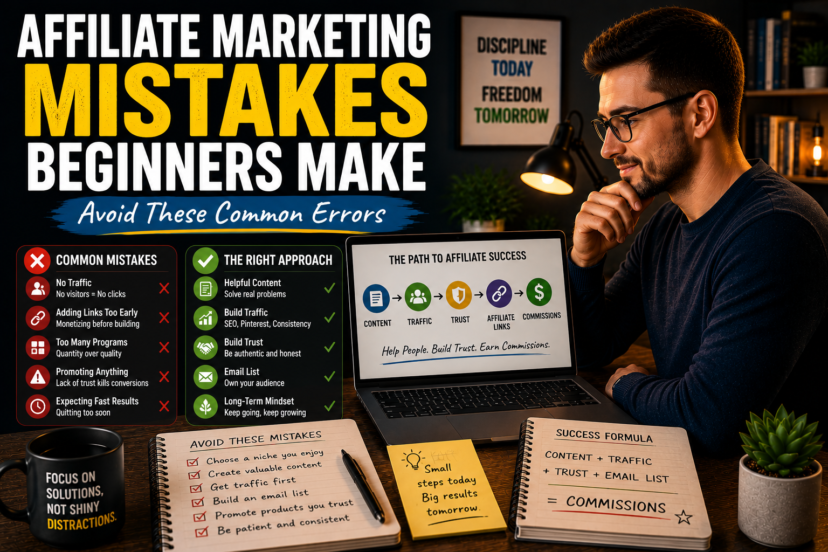
Create useful content → optimize it for search → promote it through Pinterest → collect email subscribers → recommend relevant products.
You do not need to be everywhere.
You need a system you can realistically maintain.
A Better Affiliate Marketing Strategy for Beginners
Instead of trying to optimize commissions from day one, build the business in the right order.
Start by choosing a clearly defined niche and understanding the people you want to help. Create genuinely useful content around their questions and problems. Use SEO and Pinterest to make that content discoverable, and begin building an email list so some visitors become part of an audience you can reach again.
Once that foundation exists, research a small number of relevant affiliate programs and introduce products naturally within tutorials, reviews, comparisons, and resource articles.
Then study what happens.
Which articles attract visitors?
Which affiliate links receive clicks?
Which topics generate email subscribers?
Which recommendations actually help readers move forward?
Use those signals to decide what to create next.
This approach is slower than the “add links and make passive income” version of affiliate marketing.
It is also far more realistic.
Think in Assets, Not Just Commissions
One of the most useful mindset changes for a beginner is to stop measuring every day’s work by immediate income.
A useful blog article is an asset.
A Pinterest Pin that brings visitors is an asset.
A growing email list is an asset.
A well-written tutorial is an asset.
A trusted recommendation is an asset.
Individually, these assets may produce very little at first. Together, they can eventually create a system where content attracts people, useful information builds trust, email maintains the relationship, and affiliate recommendations provide a way to monetize that value.
That is the kind of affiliate marketing business worth building.
Conclusion
The most common affiliate marketing mistakes beginners make usually come from trying to reach the income stage too quickly.
Beginners chase commissions before traffic.
They chase products before understanding problems.
They join programs before building trust.
And sometimes they quit before their content has had enough time to gain momentum.
A stronger approach is much simpler:
Focus on your audience.
Create useful content.
Build traffic.
Develop trust.
Grow an email list.
Recommend products selectively.
And give the process enough time to work.
Affiliate marketing is not a shortcut to effortless income. But when it is built around useful content and genuine recommendations, it can become a realistic long-term component of an online side-income business.
FAQs
1. What is the biggest affiliate marketing mistake beginners make?
One of the biggest mistakes is focusing on commissions before building traffic and trust. Affiliate links only become valuable when relevant people actually see them and trust the recommendations surrounding them.
2. Should beginners add affiliate links to a new website?
Yes, when the links are genuinely useful and relevant to the content. However, a new website should generally prioritize creating valuable content and attracting visitors rather than filling every article with affiliate links.
3. How many affiliate programs should a beginner join?
There is no perfect number, but beginners usually benefit from starting with only a few highly relevant programs. Learning several products thoroughly is often more effective than promoting dozens of unrelated offers.
4. Do I need to use a product personally before recommending it?
Personal experience is highly valuable because it allows you to provide more useful and credible insights. If you have not personally used a product, research it carefully and be transparent rather than implying experience you do not have.
5. How long does affiliate marketing take to work?
There is no fixed timeline. Results depend on factors such as your niche, content quality, traffic sources, competition, consistency, and the buying intent of your visitors. For most beginners, it is more realistic to think in terms of building a long-term content business rather than expecting meaningful commissions within a few weeks.


