
How Much Traffic Do You Need Before Monetizing?
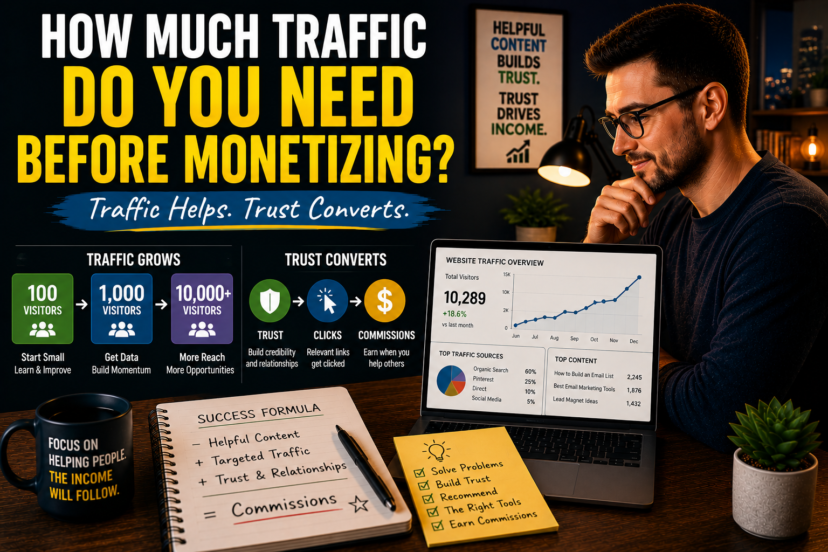
Introduction
One of the most common questions new website owners ask is:
How much traffic do you need before monetizing?
It sounds like there should be a simple answer.
100 monthly visitors?
1,000?
10,000?
But there is no magic traffic number that suddenly makes a website ready to earn money.
A small website with highly targeted visitors can sometimes generate its first affiliate commission surprisingly early. At the same time, a website with thousands of visitors may earn almost nothing if those visitors have little buying intent or the monetization strategy does not match their needs.
The better question is not:
“How many visitors do I need?”
It is:
“Do I have the right visitors, useful content, and a relevant way to monetize them?”
That distinction can save beginners from waiting unnecessarily—or trying to monetize far too aggressively before they have built anything worth monetizing.
Why There Is No Magic Traffic Number
It is tempting to think of website monetization as a milestone:
Reach X visitors → start making money.
Unfortunately, online business does not work that neatly.
Traffic creates opportunities, but it does not guarantee income.
Your results also depend on factors such as:
- what your visitors are searching for
- how closely your content matches their needs
- how much they trust your recommendations
- which monetization method you use
- whether you recommend relevant products
- how well your pages convert
This is why two websites receiving exactly 1,000 monthly visitors can produce completely different results.
One might earn nothing.
The other might already generate affiliate commissions, email subscribers, or digital product sales.
Traffic Quality Matters More Than Traffic Alone
Imagine two websites.
Website A receives 10,000 monthly visitors from broad informational searches.
Website B receives only 1,000 visitors, but many of them arrive after searching for phrases such as:
- “best email marketing platform for beginners”
- “best hosting for a new blog”
- “GetResponse alternatives”
- “best Pinterest scheduling tool”
Which audience has greater commercial potential?
Very often, Website B.
Those visitors are not simply browsing. They may already be researching solutions and comparing products.
This is called search intent, and it is one of the reasons raw traffic numbers can be misleading.
A smaller, highly relevant audience can be much more valuable than a large audience with little interest in taking action.
Can You Monetize With Only 100 Monthly Visitors?
Technically, yes.
There is no rule preventing a small website from using affiliate links or promoting a relevant product.
But expectations need to remain realistic.
With only 100 monthly visitors, you have very little data. A single purchase—or no purchases at all—can dramatically change your apparent conversion rate.
At this stage, your primary goals should usually be:
- publishing useful content
- learning what readers respond to
- improving your internal linking
- building early traffic
- starting an email list
- understanding your audience
If a product naturally belongs in an article, there is nothing wrong with including an affiliate link.
You simply should not expect those links to produce reliable income yet.
If your website is still at this early stage, How to Get Your First 100 Website Visitors should probably be a higher priority than maximizing revenue.
What About 1,000 Monthly Visitors?
At around 1,000 monthly visitors, a small niche website begins to provide more useful information.
You may start seeing:
- which articles attract the most traffic
- which topics keep readers engaged
- which Pinterest Pins generate clicks
- which pages produce email signups
- which affiliate links receive attention
You may also earn occasional commissions if your visitors are highly targeted.
But 1,000 visitors still does not guarantee anything.
A website attracting people who are researching products may monetize more effectively than one attracting visitors looking only for free information.
So instead of treating 1,000 visitors as a monetization threshold, think of it as another stage in learning what your audience actually wants.
What Changes as Your Traffic Grows?
Higher traffic certainly helps.
More visitors mean more opportunities for:
- affiliate clicks
- email subscribers
- digital product sales
- advertising revenue
- data collection
- testing and optimization
More traffic can also make your results less dependent on individual visitors.
For example, if you receive only 100 visitors per month, one sale can make the month look unusually successful.
With several thousand visitors, patterns become easier to recognize.
You can begin asking better questions:
Which articles convert?
Which traffic sources produce subscribers?
Which recommendations get clicked?
Which pages attract visitors but fail to move them forward?
This is where monetization gradually becomes less about guessing and more about optimization.
Different Monetization Methods Need Different Amounts of Traffic
This is one of the most important points beginners often overlook.
Not every monetization strategy depends on traffic in the same way.
Affiliate Marketing
Affiliate marketing can work with relatively low traffic because one conversion may generate a meaningful commission.
A highly targeted article that helps someone choose the right product can earn money even without thousands of monthly readers.
But the recommendation must be relevant.
If you are unsure about the right timing, When Should You Add Affiliate Links? explains why useful content and trust should come before aggressive monetization.
Email Marketing
You do not need a huge audience to start building an email list.
In fact, I would begin collecting subscribers much earlier than I would worry about maximizing affiliate revenue.
Even a small list gives you something extremely valuable: a way to communicate with people who have already shown interest in your content.
My guide to Building an Email List as a Beginner explains how to start building that audience asset from the beginning.
Digital Products
Digital products can also work with smaller audiences.
A useful template, checklist, guide, or planner that solves a specific problem does not necessarily need tens of thousands of visitors.
Here again, audience relevance and trust can matter more than raw traffic volume.
Display Advertising
Display advertising is different.
Because you generally earn small amounts from individual ad impressions, meaningful advertising revenue usually requires substantially more traffic than affiliate marketing or direct product sales.
That makes display ads less attractive as the first monetization strategy for many new niche websites.
Why Trust Can Be More Valuable Than Another 1,000 Visitors
Imagine that a reader has visited several of your articles.
Your content answered their questions.
You explained both advantages and disadvantages.
You did not recommend a product every second paragraph.
Then, when you finally recommend a tool, that recommendation carries more weight.
That is why trust matters so much.
Affiliate marketing works best when the reader thinks:
“This recommendation makes sense based on everything I just learned.”
Not:
“This website is trying to sell me something.”
This principle is central to How to Write Affiliate Content That Converts. Conversion-focused content does not mean aggressive selling. It means helping readers make better decisions.
Signs Your Website May Be Ready to Monetize
Instead of waiting for an arbitrary traffic milestone, look for evidence that your website is becoming useful to real people.
You may be ready to begin monetizing when several of these things are happening:
You Have a Clear Niche
You understand who your content is for and which problems you are helping them solve.
You Have Useful Content
Your website contains enough helpful information that a visitor can explore several related articles rather than landing on an almost empty site.
Visitors Are Actually Arriving
You do not need huge numbers, but some consistent traffic confirms that people can discover your content.
You Understand Reader Intent
You are beginning to see which questions, problems, and topics attract your audience.
Relevant Products Exist
There are tools, services, courses, or other products that genuinely help solve those problems.
Recommendations Fit Naturally
You can mention a product because it improves the article—not because you desperately need somewhere to put an affiliate link.
You Are Building Trust
Your website looks credible, provides useful information, and does not feel like a collection of sales pages.
These signals tell you far more than an arbitrary visitor count.
Do Not Wait Too Long Either
There is another side to this discussion.
Some beginners become so afraid of monetizing “too early” that they wait indefinitely.
You do not need 10,000 visitors before adding your first relevant affiliate link.
If you write a detailed tutorial about building an email list and genuinely use an email marketing platform that helps with the process, mentioning that platform can improve the article even when your website is still small.
The key distinction is natural monetization versus forced monetization.
A relevant recommendation can be useful from the beginning.
Covering every page with affiliate links before you have built useful content is something entirely different.
Monetization Should Follow the Reader Journey
A useful way to think about monetization is to follow the reader rather than the traffic number.
A typical journey might look like this:
Helpful Content → Trust → Solution → Recommendation → Action
For example, someone searching for ways to start an email list may first need to understand:
- why an email list matters,
- how to attract subscribers,
- what lead magnet to create,
- which software can deliver it,
- and how to automate the process.
A relevant software recommendation at Step 4 makes sense.
Putting the same recommendation at the top of an unrelated article does not.
That is why context matters so much.
Common Monetization Mistakes Beginners Make
One mistake is waiting for a magical traffic number. There is no universal threshold.
Another is monetizing every article. Some articles should simply educate, attract traffic, and lead readers toward other useful content.
A third mistake is choosing products based only on commission rates. A high commission is worthless if the product does not fit your audience.
Beginners also sometimes ignore their email list while chasing page views. Traffic can disappear when algorithms change. An email subscriber gives you a much more direct relationship.
And finally, many new site owners expect immediate results. Adding affiliate links does not transform an early-stage website into an income-producing business overnight.
Many of these problems are covered in greater detail in Affiliate Marketing Mistakes Beginners Make.
A Realistic Monetization Strategy for Beginners
If I were building a new niche website from zero today, I would not set a goal such as:
“I will monetize when I reach 5,000 visitors.”
Instead, I would use stages.
Stage 1: Build the Foundation
Choose a clear niche and publish genuinely helpful content.
Stage 2: Generate Traffic
Use SEO, Pinterest, internal linking, and consistent publishing to help people discover that content.
Stage 3: Build an Audience You Own
Start collecting email subscribers rather than relying entirely on Google, Pinterest, or social media.
Stage 4: Identify Natural Monetization Opportunities
Look at the problems your readers are trying to solve and identify products or services that genuinely help.
Stage 5: Add Relevant Affiliate Recommendations
Place affiliate links where they improve the reader’s experience.
Stage 6: Measure and Improve
Watch which pages attract traffic, which links get clicked, and which content produces results.
Then improve what is already working.
If you are unsure which stage deserves your attention right now, the Side Hustle Roadmap provides a broader path from choosing an idea to building traffic, growing an audience, and eventually monetizing it.
How Much Traffic Do You Really Need?
So, let us return to the original question.
How much traffic do you need before monetizing?
There is no fixed minimum.
You can potentially earn your first affiliate commission with a very small audience.
But reliable income generally becomes easier as you build:
more useful content + more targeted traffic + more trust + better offers + better conversion data.
Traffic matters.
But it is only one part of the equation.
For a beginner, reaching the first 100, 500, or 1,000 visitors should be celebrated as progress—not treated as a switch that suddenly turns monetization on.
Conclusion
You do not need to wait for a magical number of monthly visitors before monetizing your website.
A small, targeted audience can sometimes generate results earlier than expected, while a much larger but poorly targeted audience may generate very little.
Instead of asking only how much traffic you have, ask:
Who are these visitors?
What problems are they trying to solve?
Do they trust my content?
Can I recommend something that genuinely helps them?
Build useful content first.
Attract the right visitors.
Grow your email list.
Earn trust.
Then introduce monetization naturally.
That creates a far stronger foundation than chasing an arbitrary traffic milestone.
FAQs
1. How much traffic do you need before monetizing a website?
There is no fixed minimum. A website can potentially earn its first affiliate commission with a small amount of highly targeted traffic. However, consistent income usually becomes easier as your content, traffic, audience trust, and conversion data grow.
2. Can I monetize a website with only 100 monthly visitors?
Yes, but income is likely to be inconsistent at that stage. Your main priorities should still be creating useful content, attracting more targeted visitors, building an email list, and learning what your audience needs.
3. Is 1,000 monthly visitors enough for affiliate marketing?
It can be. If those visitors have strong intent and your recommendations closely match their needs, 1,000 targeted visitors may already produce affiliate clicks or commissions. Traffic quality matters more than the number alone.
4. Should I wait until I have 10,000 visitors before adding affiliate links?
No. There is no reason to wait for 10,000 visitors if an affiliate recommendation naturally helps the reader. The important factors are relevance, trust, transparency, and useful content—not reaching a predetermined traffic milestone.
5. Which monetization method works best with low traffic?
Affiliate marketing, email marketing, and targeted digital products can work with relatively small audiences because they depend heavily on relevance and trust. Display advertising generally becomes more meaningful when a website receives substantially more traffic.