
How to Get Your First 100 Website Visitors: A Realistic Beginner’s Guide
Introduction
Many new website owners spend hours designing their site, writing articles, and creating content.
Then they check their analytics.
Nothing.
A few days later they check again.
Still nothing.
If this sounds familiar, don’t worry.
Learning how to get your first 100 website visitors is one of the biggest challenges every beginner faces.
The good news is that you do not need thousands of followers or a large advertising budget to start getting traffic.
What you need is a simple system, realistic expectations, and consistent action.
If you’re still looking for ideas that fit around a full-time job, you may want to explore some of the best side hustles for busy employees. Understanding your long-term goal will help you choose the right traffic strategy from the beginning.
Why the First 100 Visitors Matter
Your first 100 visitors are important because they prove something.
They prove that real people can find your website.
Those visitors may come from:
- social media
- referrals
- email marketing
The source matters less than the lesson.
Traffic is possible.
And once you reach 100 visitors, reaching 500 becomes easier.
The Biggest Traffic Myth Beginners Believe
Many people believe traffic arrives automatically.
They think:
“I published an article, so Google should send visitors.”
Unfortunately, that is not how it works.
Millions of websites compete for attention.
Google does not know your site exists yet.
Pinterest does not know your content exists yet.
Traffic usually comes from consistent effort over time.
Understanding Where Website Traffic Comes From
Most beginner websites get visitors from four main sources.
Search Engines
Google, Bing, and other search engines.
One of the best traffic sources for beginners.
Social Media
Facebook, X, Instagram, LinkedIn, and others.
Direct Traffic
People who visit your website directly.
Understanding these sources helps you focus your efforts.
Why Content Comes First
Traffic starts with content.
Without content, there is nothing to discover.
Every article you publish becomes another opportunity for someone to find your website.
Think of content as fishing lines in the water.
One line catches very little.
Twenty lines catch much more.
Fifty lines catch even more.
That is why content creation is the foundation of website growth.
This is exactly why content marketing for beginners is such an important skill. The more helpful content you create, the more opportunities people have to discover your website through search engines and Pinterest.
Publishing Your First Helpful Articles
Many beginners wait too long before publishing.
Perfection becomes the enemy of progress.
Instead, focus on publishing useful content.
Examples include:
- beginner guides
- tutorials
- checklists
- comparisons
- case studies
The goal is not perfection.
The goal is helping readers.
If you want to learn how to build a content-focused website, my guide on blogging for busy employees explains how blogging can become a long-term traffic asset.
Using Pinterest to Get Early Traffic
Pinterest is one of the easiest ways for beginners to start attracting visitors.
Unlike many social platforms, Pinterest acts more like a search engine.
People actively search for:
- side hustle ideas
- blogging tips
- affiliate marketing advice
- work-from-home opportunities
Create multiple Pins for every article.
This increases the chances of your content being discovered.
Pinterest has become one of my favorite traffic sources because Pins can continue generating visitors long after they are published. In Pinterest marketing for busy employees, I explain exactly how this strategy works.
Basic SEO for Beginners
SEO stands for Search Engine Optimization.
At its core, SEO helps search engines understand your content.
Simple SEO basics include:
- using a focus keyphrase
- writing clear headings
- adding internal links
- creating useful content
- optimizing meta descriptions
You do not need to be an SEO expert to start.
Internal Linking Matters
Many beginners ignore internal links.
That is a mistake.
Internal links help:
- visitors discover more content
- search engines understand your website
- increase time spent on your site
Every article should connect naturally to related articles.
Internal links help visitors discover more content and encourage them to stay on your website longer. They also help search engines understand how your content is connected.
Why Most Websites Stay Invisible
Most websites fail because people stop publishing.
They write:
- three articles
- five articles
- maybe ten articles
Then they quit.
Successful websites often have:
- dozens of articles
- hundreds of articles
- years of consistent publishing
Patience is a competitive advantage.
Building Momentum Through Consistency
Traffic growth is rarely linear.
It often feels slow at first.
Then one article starts ranking.
A Pin begins performing well.
An email subscriber shares your content.
Small wins begin to compound.
Consistency creates momentum.
As your traffic starts growing, your next goal should be turning visitors into subscribers. That’s where building an email list as a beginner becomes important. An email list allows you to stay connected with readers even after they leave your website.
Tracking Your Traffic
You should monitor your traffic using tools such as:
Google Analytics
Tracks visitors and behavior.
Google Search Console
Shows search performance.
Pinterest Analytics
Shows Pin performance.
Tracking helps you understand what works.
As your traffic grows, you should also focus on converting visitors into email subscribers. Building an email list allows you to stay in touch with readers long after they leave your website. For a step-by-step guide, read Building an Email List as a Beginner.
Common Beginner Mistakes
Publishing Too Few Articles
More content creates more opportunities.
Ignoring Pinterest
Pinterest can accelerate traffic growth.
Expecting Instant Results
Traffic takes time.
Focusing Only on Monetization
Build traffic first.
Quitting Too Early
Most websites fail because owners stop.
Many beginners worry about affiliate commissions before they have any visitors. In reality, traffic comes first. If you’re interested in long-term monetization, my guide to affiliate marketing for busy employees explains why audience building should come before affiliate links.
Realistic Expectations
Let’s be realistic.
Most websites do not get 100 visitors overnight.
Your first 100 visitors may take:
- a few weeks
- several months
depending on your niche and activity.
The goal is progress.
Not perfection.
My Recommended Traffic Strategy
If I were starting from zero today, I would:
Step 1
Publish one article every week.
Step 2
Create three Pinterest Pins for every article.
Step 3
Build internal links.
Step 4
Collect email subscribers.
Step 5
Track performance.
Step 6
Continue publishing consistently.
This strategy is simple, realistic, and sustainable.
Many beginners wonder how much income is realistically possible once traffic starts growing. If you’re curious about the numbers, take a look at How Much Can You Really Earn with a Side Hustle?
Conclusion
Learning how to get your first 100 website visitors is one of the most important milestones in building an online business.
It teaches patience.
It teaches consistency.
And it proves that people are interested in your content.
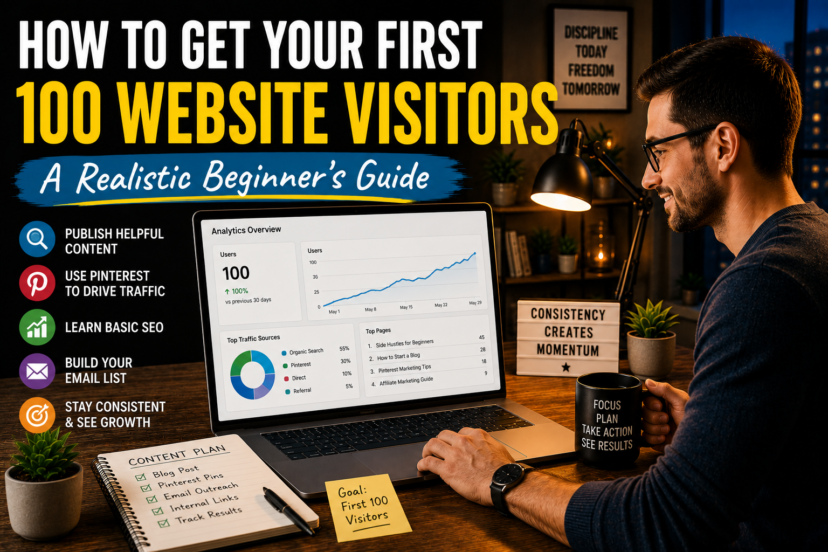
Focus on creating helpful articles.
Use Pinterest.
Learn basic SEO.
Build your email list.
Keep going.
The first 100 visitors are only the beginning.