
Common Pinterest Mistakes (And How Beginners Can Avoid Them)
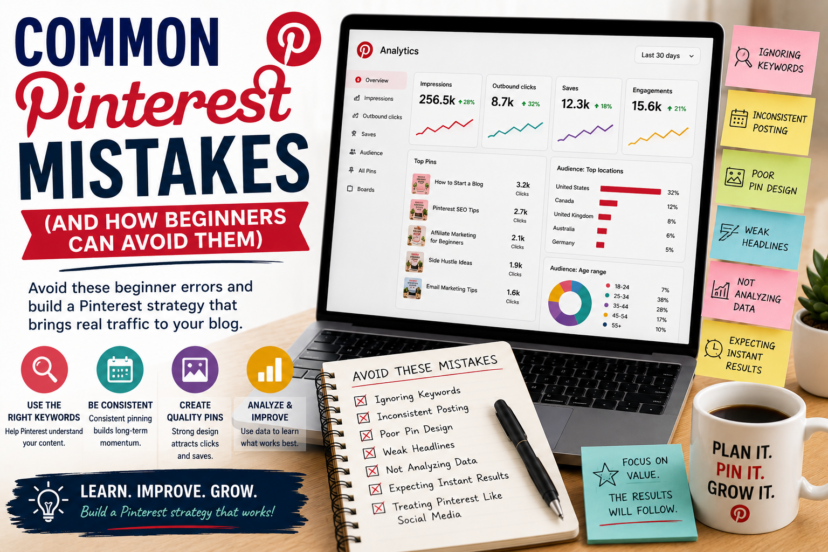
Introduction
Understanding common Pinterest mistakes can save beginner bloggers months of frustration. Many people start using Pinterest because they hear stories about bloggers getting thousands of visitors from the platform. However, after a few weeks, they often become disappointed when their pins receive very few impressions and almost no clicks.
The problem is rarely Pinterest itself. More often, beginners misunderstand how the platform works. They treat Pinterest like Instagram, expect instant results, or spend hours creating beautiful pins without thinking about keywords or strategy.
The good news is that most Pinterest mistakes are easy to avoid once you understand the basics. In this guide, you’ll learn the most common errors beginners make and discover how to build a Pinterest strategy that works over the long term.
Mistake #1: Treating Pinterest Like Social Media
One of the biggest beginner mistakes is assuming that Pinterest works like Instagram, Facebook, or TikTok.
On social media platforms, success often depends on:
- followers
- likes
- comments
- viral trends
Pinterest works differently.
People do not usually visit Pinterest to socialize. Instead, they come to search for solutions, ideas, and inspiration. Pinterest behaves much more like a search engine than a traditional social network.
That means your success depends less on followers and more on:
- keywords
- search intent
- pin quality
- consistency
- helpful content
Many beginners waste time trying to gain followers when they should focus on creating useful pins and optimizing their account.
Mistake #2: Ignoring Keywords
Some creators spend hours designing beautiful pins but never think about keywords.
Unfortunately, Pinterest cannot recommend your content if it does not understand what your pin is about.
Keywords help Pinterest determine:
- who should see your content
- where your pins appear
- which searches match your topic
Without proper keyword research, even the best designs may fail.
For example, a blogger writing about side hustles should include phrases such as:
- side hustle ideas
- work from home jobs
- online income
- blogging for beginners
Keywords should appear naturally in:
- your profile description
- board titles
- pin titles
- descriptions
- blog posts
If you want to learn how to find effective search terms, read Pinterest Keyword Research, where we explain step by step how beginners can discover keywords that drive traffic.
Mistake #3: Expecting Immediate Results
Pinterest is a long-term traffic source.
Unfortunately, many beginners publish a few pins, wait two weeks, and conclude that Pinterest does not work.
In reality, Pinterest often needs time to:
- understand your content
- test your pins
- identify your audience
- collect engagement data
Many successful creators see very little activity during their first months.
Growth on Pinterest is usually gradual.
A pin that receives only a few impressions today may still generate traffic months later.
This long lifespan is one of Pinterest’s greatest strengths, but it also requires patience.
Our guide How Pinterest Works in 2026 explains why Pinterest behaves differently from platforms like Instagram and why patience is essential for long-term success.
Mistake #4: Creating Only One Pin Per Article
Many beginners write a blog post, create a single pin, and move on to the next article.
Experienced Pinterest creators take a different approach.
They often design several pins for the same post.
For example, one article can produce:
- a minimalist pin
- a list-style design
- a colorful version
- a seasonal design
- a tutorial-style pin
Pinterest values fresh content, and different designs attract different audiences.
Sometimes, changing only the headline or the image can dramatically improve performance.
In How to Create Click-Worthy Pins, you’ll learn how to design multiple pin styles that encourage users to click through to your website.
Mistake #5: Posting Inconsistently
Consistency matters more than intensity.
Many beginners start with great enthusiasm. They create twenty pins during their first week and then disappear for several months.
Pinterest rewards creators who remain active over time.
That does not mean you need to publish dozens of pins every day.
Even a simple schedule can work:
- three pins per week
- five pins every weekend
- one batch session per month
The best strategy is the one you can realistically maintain.
Small efforts repeated consistently often produce better results than short bursts of activity.
If you struggle to build long-term habits, our article How to Stay Consistent as a Blogger shares practical strategies that can help you stay motivated.
Mistake #6: Prioritizing Quantity Over Quality
Pinterest encourages fresh content, but that does not mean you should create hundreds of low-quality pins.
Poor pins often suffer from:
- unreadable fonts
- cluttered designs
- vague headlines
- misleading promises
- weak images
Many beginners mistakenly believe that more pins automatically lead to more traffic.
In reality, one excellent pin often performs better than ten mediocre ones.
Before publishing a pin, ask yourself:
- Is the text easy to read?
- Does the headline spark curiosity?
- Does the image fit the article?
- Would I personally click on this?
Quality remains essential.
Mistake #7: Ignoring Pinterest Analytics
Pinterest Analytics provides valuable information about your performance.
However, many beginners never open their analytics dashboard.
That means they miss important insights, such as:
- which pins generate clicks
- which topics perform best
- which designs attract engagement
- which keywords drive traffic
Without analytics, improving your strategy becomes much harder.
Successful Pinterest creators study their data and use it to make better decisions.
To understand what metrics actually matter, read Pinterest Analytics Explained, where we break down impressions, saves, clicks, and engagement in simple terms.
Mistake #8: Using Weak Headlines
Pinterest users scroll quickly.
If your headline fails to capture attention, people will continue scrolling.
Weak examples:
- My Thoughts on Blogging
- Marketing Ideas
- Random Tips
Stronger examples:
- 10 Side Hustles You Can Start Today
- Pinterest SEO Tips for Beginners
- How to Start a Blog While Working Full-Time
Effective headlines often promise:
- a solution
- a shortcut
- a benefit
- a list
- a process
A stronger headline can significantly increase clicks.
Mistake #9: Neglecting Your Website
Pinterest can send visitors to your website, but it cannot compensate for poor content.
Some bloggers spend all their time creating pins while neglecting:
- SEO
- article quality
- internal links
- email marketing
- content planning
Pinterest works best when combined with a strong website.
Imagine two creators:
The first creates excellent pins but links to weak articles.
The second creates solid pins that lead to valuable, well-structured content.
Over time, the second creator will almost always achieve better results.
Pinterest traffic starts on Pinterest—but real growth happens on your website.
A strong content strategy makes Pinterest much more effective. In How to Plan Blog Content, you’ll learn how to organize your articles into topic clusters that support long-term growth.
Mistake #10: Constantly Comparing Yourself to Others
Pinterest can sometimes feel discouraging.
You may see creators with:
- millions of monthly views
- thousands of followers
- professional designs
- teams and assistants
What you do not see are:
- years of experience
- countless experiments
- failed pins
- slow beginnings
Every successful creator started from zero.
Comparing your chapter one to someone else’s chapter ten is rarely helpful.
Focus on:
- your own progress
- your own audience
- your own strategy
Long-term growth matters more than short-term comparisons.
How to Build a Better Pinterest Strategy
Avoiding mistakes is important, but what should beginners actually do?
A solid Pinterest strategy usually includes:
- researching keywords
- creating attractive pins
- publishing consistently
- analyzing results
- improving older content
- writing helpful articles
The goal is not perfection.
The goal is continuous improvement.
Instead of trying to master everything at once, focus on learning one skill at a time.
Pinterest rewards creators who stay patient and keep improving.
Want to avoid even more beginner mistakes and build a sustainable Pinterest strategy? Visit our Pinterest Hub, where you’ll find practical guides on Pinterest SEO, keyword research, pin design, analytics, and long-term traffic growth. Whether you’re just getting started or looking to improve your results, the Pinterest Hub will help you grow step by step.
Final Thoughts
Every successful Pinterest creator has made mistakes.
The difference is that they learned from those mistakes and kept going.
If you avoid the most common beginner errors—such as ignoring keywords, posting inconsistently, or expecting instant results—you will already be ahead of many new creators.
Pinterest is not a shortcut to overnight success.
However, when combined with helpful content, good design, and consistent effort, it can become one of the most powerful traffic sources for your blog.
Remember: Pinterest rewards patience, quality, and long-term thinking.
FAQ
1. What is the biggest Pinterest mistake beginners make?
Many beginners treat Pinterest like social media instead of using it as a search engine.
2. How long does it take to see results on Pinterest?
Most creators need several weeks or months before they see meaningful traffic.
3. Are keywords important on Pinterest?
Yes. Keywords help Pinterest understand your content and show it to the right audience.
4. Should I create more than one pin for each article?
Yes. Many creators design multiple pins to test different headlines and layouts.
5. How often should beginners post on Pinterest?
Consistency matters more than volume. Three to five high-quality pins per week is a realistic starting point.


