
How to Stay Consistent as a Blogger Without Burning Out
Learning how to stay consistent as a blogger sounds simple when you are full of ideas and excited about a new website.
In the beginning, motivation often does most of the work.
You brainstorm article ideas on your lunch break, spend evenings improving your website, create Pinterest pins on the weekend, and keep thinking about everything you want to build next.
Then normal life returns.
Work gets busy. An article takes longer than expected. Family responsibilities need your attention. Traffic grows slowly. You miss the publishing date you had planned—and suddenly your carefully designed blogging routine starts falling apart.
This is where many beginners misunderstand consistency.
Being consistent does not mean publishing every Tuesday, working on your blog every day, or never taking a break.
It means building a way of working that you can return to repeatedly—even when your available time, energy, and motivation change.
For someone building a blog alongside a job and other responsibilities, that distinction matters.
The goal is not maximum productivity.
The goal is sustainable progress.
Consistency Is Not the Same as Publishing Frequently
When bloggers talk about consistency, the conversation often turns immediately to publishing schedules.
Once a week.
Twice a week.
Three posts a month.
But frequency and consistency are not the same thing.
Imagine two bloggers.
One decides to publish three articles every week. For a month, everything goes according to plan. Then the workload becomes impossible to maintain, and the blog receives no new content for the next four months.
Another publishes two carefully planned articles each month and continues doing so at a pace that fits comfortably around work and family.
The second blogger publishes less frequently but has the more sustainable system.
That is what consistency should mean.
Your ideal schedule is not the most ambitious one you can survive for a few weeks.
It is one you can realistically maintain while still producing useful content and managing the other parts of your website.
Stop Building Your Blog Around Motivation
Motivation is useful.
It helps you begin.
But it is unreliable as an operating system.
Some days, writing feels easy. On others, opening WordPress feels like another task on an already full list.
If your blogging routine depends on feeling inspired, progress becomes unpredictable.
Instead of asking:
“Do I feel motivated enough to work on my blog today?”
give yourself a clearer question:
“What is the next useful task?”
Perhaps you do not have enough concentration to draft 1,500 words after work.
But you may be able to improve an outline.
Add two internal links.
Research one section.
Create an image.
Update a meta description.
Check an older article.
Schedule a Pinterest pin.
A blog is built from many different tasks. Writing is only one of them.
Recognizing that makes consistency much easier.
Create a Minimum Blogging Routine
One useful way to make your blogging system more resilient is to decide what your minimum sustainable routine looks like.
Not your ideal week.
Not the schedule you could manage during a holiday.
Your minimum.
Suppose you normally hope to spend six hours a week on your website.
What happens when you only have two?
Instead of treating that week as a failure, decide in advance what deserves priority.
Perhaps your minimum is finishing the article already in progress.
Perhaps it is maintaining your Pinterest activity and spending one focused session on content.
Perhaps publishing has to wait while you update an article that is already attracting visitors.
The exact routine will be different for every blogger.
What matters is having a reduced version of your system for busy periods.
That prevents an all-or-nothing mindset:
“I can’t do everything this week, so there is no point doing anything.”
You do not need a perfect blogging week to make useful progress.
Plan Around Your Real Life, Not Your Ideal Life
A sustainable blogging schedule starts with the time you actually have.
If you work full-time, have a family, commute, manage a household, or have other responsibilities, those are not temporary obstacles standing between you and your “real” blogging schedule.
They are part of the schedule.
Start there.
Look at a normal week and identify when focused work is genuinely possible.
Maybe you have two quiet evenings.
Perhaps Saturday morning works better.
Maybe shorter sessions before work are easier than trying to write for three hours at night.
Do not copy another blogger’s routine simply because it looks productive.
Your system needs to fit your circumstances.
This also means accepting that different seasons of life may require different rhythms.
A schedule that worked six months ago does not have to remain permanent.
Know What You’re Going to Work on Before You Sit Down
Limited blogging time becomes even more limited when the first 20 minutes are spent deciding what to do.
You open WordPress.
Check your posts.
Look at Pinterest.
Read an email.
Think about the next article.
Check a keyword.
Return to WordPress.
Nothing substantial has happened, but your available hour is already disappearing.
A simple content plan removes many of those decisions.
Instead of sitting down to “work on the blog,” sit down to:
finish the outline for Article 45
or:
edit Sections 1–4 of the current draft
or:
update internal links in three related posts
A defined task makes it much easier to begin.
If you regularly lose time deciding what to write next, How to Plan Blog Content shows how to maintain an idea bank and a realistic short-term publishing plan without scheduling dozens of articles months in advance.
Break Articles Into Separate Stages
One reason blogging becomes difficult to maintain is that we think of “write an article” as one task.
It isn’t.
A complete article may involve choosing the topic, understanding search intent, researching, outlining, drafting, checking facts, editing, adding internal links, optimizing images, preparing SEO elements, publishing, and promotion.
Trying to complete all of that in one session makes an article feel enormous.
Instead, use stages:
Define → Research → Outline → Draft → Edit → Optimize → Publish → Promote
You might complete two stages in one session or spend several sessions on a single stage.
That is fine.
The advantage is that you always know where to continue.
You are no longer returning to a vague unfinished project called “article.”
You are returning to a specific next step.
This is the same workflow we developed in How to Write Blog Posts Faster. The purpose is not only to write faster—it also makes writing easier to resume after interruptions.
Match the Task to the Time and Energy You Have
Not every blogging task requires the same level of concentration.
Writing a difficult article may require a clear mind and an uninterrupted block of time.
Compressing an image probably does not.
This gives you another way to stay productive without forcing yourself to do demanding creative work at the wrong time.
When you have strong concentration, use it for tasks such as research, outlining, drafting, or major editing.
When your energy is lower, you might handle image optimization, internal links, WordPress formatting, Pinterest scheduling, or simple content updates.
This is much more realistic than expecting every available 30-minute period to become a productive writing session.
Your blog needs both deep work and maintenance work.
Use your available energy accordingly.
Batch Repetitive Tasks When It Saves Time
Some blogging activities become easier when you do several similar tasks together.
Instead of creating one Pinterest image, returning to WordPress, writing an email, and then going back to Pinterest, you might create several pins in one session.
You could also batch:
keyword research for several planned articles,
image preparation,
internal-link reviews,
SEO titles and meta descriptions,
WordPress formatting,
or content updates.
Batching reduces the mental effort of repeatedly switching between different types of work.
But it should remain a tool, not another productivity rule.
If batching five articles’ worth of keyword research feels overwhelming, don’t do it.
The purpose is to remove friction.
Build Systems That Reduce Repeated Decisions
Consistency becomes easier when you do not have to reinvent your process every week.
Think about all the small decisions involved in publishing.
How large should the featured image be?
What do you check before publishing?
Where should the email form appear?
How do you format FAQs?
Which SEO elements need reviewing?
How do you create your Pinterest content?
Which older articles should receive internal links?
If you make those decisions from scratch every time, they consume attention.
Reusable processes remove that friction.
A publishing checklist, image template, article workflow, content calendar, internal-link routine, and Pinterest workflow can all make blogging easier to continue.
The goal is not to turn creativity into a factory.
It is to standardize the repetitive parts so that you have more energy for the work that actually requires thought.
Don’t Let Your Goals Become a Source of Pressure
Goals can be useful.
“Publish 50 articles” gives you a clear target.
“Reach 10,000 monthly visitors” gives you something measurable.
But goals can also become misleading.
You control whether you publish an article.
You do not fully control whether Google sends you 10,000 visitors next month.
And reaching 50 posts does not automatically make a blog successful.
That is why process goals are often more useful for day-to-day consistency.
Instead of only measuring:
50 published articles
you might focus on:
Maintain a manageable content workflow.
Instead of:
Reach X visitors by December
focus on:
Review search performance regularly and improve promising content.
You still have ambitions.
But your daily work is built around actions you can actually take.
If article counts are becoming the main measure of progress, How Many Articles Do You Need? explains why there is no magic publishing number that unlocks traffic or monetization.
Leave Some Space in Your Schedule
A schedule that uses 100% of your available blogging time has no room for reality.
An article takes longer than expected.
WordPress needs attention.
A Pinterest graphic needs replacing.
An older post contains outdated information.
You get sick.
Work becomes unusually busy.
Suddenly the entire plan is behind.
Instead of scheduling every available hour, leave some flexibility.
A little unused capacity gives you somewhere to put unexpected work without destroying the rest of the plan.
This is particularly important if your blog is a side project.
Your schedule needs to survive normal life.
Learn to Stop at “Good Enough to Publish”
Perfectionism can look like dedication.
Sometimes it is simply procrastination wearing better clothes.
You rewrite the introduction for the seventh time.
Change the featured image again.
Spend an hour adjusting a paragraph that was already clear.
Compare three possible words in the SEO title.
At some point, additional work produces almost no meaningful improvement.
That does not mean publishing careless content.
Accuracy matters.
Clarity matters.
Useful information matters.
But perfection is not available.
A well-researched, helpful article can be published today and improved later.
In fact, you may make better improvements later because you will have real information about how readers and search engines interact with the page.
Publishing is not necessarily the end of an article.
It can be the beginning of its next stage.
Don’t Measure Consistency Only by New Articles
This becomes increasingly important as your blog grows.
When you have five posts, creating new content may be the obvious priority.
When you have 50, 100, or more, maintaining existing content becomes a larger part of the job.
A productive week might involve no new article at all.
Perhaps you modernize two older posts.
Improve an important hub page.
Fix internal links.
Refresh outdated information.
Create Pinterest graphics for existing content.
Work on your email sequence.
Analyze which pages are beginning to gain search visibility.
Those activities still move the blog forward.
Consistency should therefore be measured by useful progress, not simply the number of times you press Publish.
Track Signals That Help You Make Decisions
Tracking progress can be motivating, but collecting numbers simply to watch them change is not especially useful.
Choose metrics that help you understand what is happening.
Depending on your current strategy, that might include search impressions and clicks, website traffic, Pinterest outbound clicks, email subscribers, affiliate clicks, conversions, or performance of particular articles.
You do not need to check them every day.
In fact, daily checking can make slow-moving strategies feel more frustrating than they really are.
Review performance at intervals that allow meaningful changes to become visible.
Then ask:
What is improving?
What seems stuck?
Which articles deserve attention?
What should I do differently next?
Tracking should support decisions—not create anxiety.
Create a “Next Time” Note Before You Stop
This is a small habit that can make a surprisingly large difference.
Before ending a blogging session, write down exactly where to continue.
For example:
“Next: write the section about internal links and add the Article 41 reference.”
or:
“Draft finished. Next session: structural edit, then fact-check examples.”
When you return several days later, you do not have to reconstruct your thought process.
You already know the next action.
This is particularly useful when blogging time comes in short, interrupted sessions.
Make it easy for your future self to restart.
Take Breaks Without Turning Them Into Failure
Sometimes you need to stop.
Not because you have lost discipline.
Because life happens.
A demanding period at work, a family situation, a holiday, illness, or simply exhaustion may temporarily reduce the time available for your website.
That does not erase the work you have already done.
And you do not need to “catch up” by doubling your workload when you return.
Resume from where you are.
Review what is currently important.
Choose the next manageable task.
Continue.
This is a healthier interpretation of consistency than:
“Never miss a week.”
A sustainable system includes the ability to pause and restart.
Know When Consistency Isn’t the Problem
There is another important side to this subject.
If you have been consistently doing the same thing for a long time without meaningful signs of progress, the answer is not necessarily to become even more consistent.
You may need to change the strategy.
Perhaps your topics have little search demand.
Maybe your content does not match search intent.
Your Pinterest strategy may need adjustment.
Your internal linking could be weak.
Perhaps you are creating content for too many unrelated subjects.
Or your monetization does not fit the audience you are attracting.
This is why we made an important distinction in Blogging Mistakes Beginners Make:
Persistence should be combined with feedback.
The useful cycle is not:
Do the same thing → Keep doing it → Hope
It is:
Do → Measure → Learn → Adjust → Continue
Consistency helps a good system compound.
It cannot turn a poor strategy into a good one simply through repetition.
Develop a Blogging Rhythm You Can Return To
After enough repetition, many parts of blogging become easier.
You recognize when research is sufficient.
Outlines take less time.
You become more decisive when editing.
WordPress feels familiar.
You know how to prepare images, add internal links, complete your SEO fields, and publish without having to remember every step from scratch.
Your routine gradually becomes less dependent on conscious effort.
That is the real value of consistency.
Not an unbroken streak on a calendar.
Not 52 articles because someone told you to publish weekly.
Not working on your website every single day.
It is developing a rhythm that makes continuing easier than constantly starting over.
A Simple Consistency System for Busy Bloggers
If all of this still feels complicated, reduce it to a simple cycle:
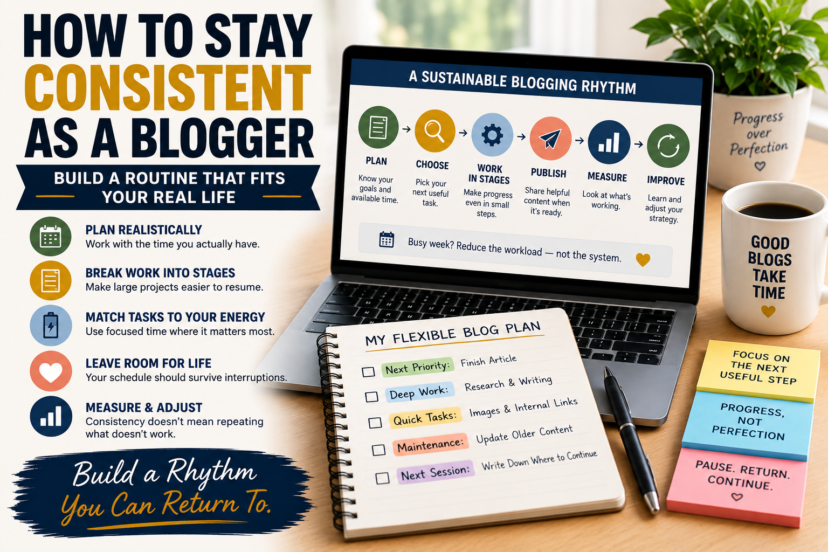
Plan → Choose the Next Task → Work in Stages → Publish → Measure → Improve → Repeat
During busy periods, reduce the workload without abandoning the system.
During quieter periods, use the additional capacity to move further ahead, update older content, or build assets that make future work easier.
And when something stops working, investigate instead of assuming that more effort is always the answer.
That is sustainable consistency.
Final Thoughts
Learning how to stay consistent as a blogger is not about developing enough discipline to work every day.
It is about designing a blogging process that can survive ordinary life.
Choose a publishing rhythm that fits your actual schedule.
Break large projects into manageable stages.
Use systems to reduce repetitive decisions.
Match difficult tasks to the time and energy available.
Leave room for unexpected interruptions.
Track progress without becoming obsessed with daily numbers.
Take breaks when you need them.
And most importantly, build a system you know how to return to.
Consistency does not mean never stopping.
It means not having to start from zero every time you come back.
If you want to continue building that system, the Blogging Hub brings together our beginner guides on planning, writing, SEO, keyword research, internal linking, traffic, and long-term blog growth.
FAQs
1. How often should a beginner blogger publish?
There is no ideal publishing frequency for every beginner. Choose a rhythm that gives you enough time to create useful content without neglecting promotion, updates, internal linking, or your other responsibilities. A sustainable schedule is more useful than an ambitious one you cannot maintain.
2. How do I stay consistent when I don’t feel motivated?
Reduce your dependence on motivation by knowing the next specific task before you begin. On low-energy days, work on smaller activities such as internal links, formatting, images, or content updates instead of forcing yourself to complete a demanding writing session.
3. Is it okay to take a break from blogging?
Yes. A sustainable blogging routine should allow for work, family responsibilities, holidays, illness, and periods when you simply have less capacity. When you return, reassess your priorities and continue with the next manageable task rather than trying to compensate for everything you missed.
4. How can I avoid blogging burnout?
Set a workload based on the time you genuinely have, leave some flexibility in your schedule, separate large projects into smaller stages, and avoid measuring productivity only by the number of new articles you publish. Maintaining and improving existing content also counts as productive blogging work.
5. Can I grow a blog with only a few hours each week?
It is possible to make meaningful progress with limited time, but there is no guaranteed growth rate. Prioritize the work most relevant to your current goals, reduce unnecessary task switching, and use repeatable processes so that more of your available time goes toward useful work.