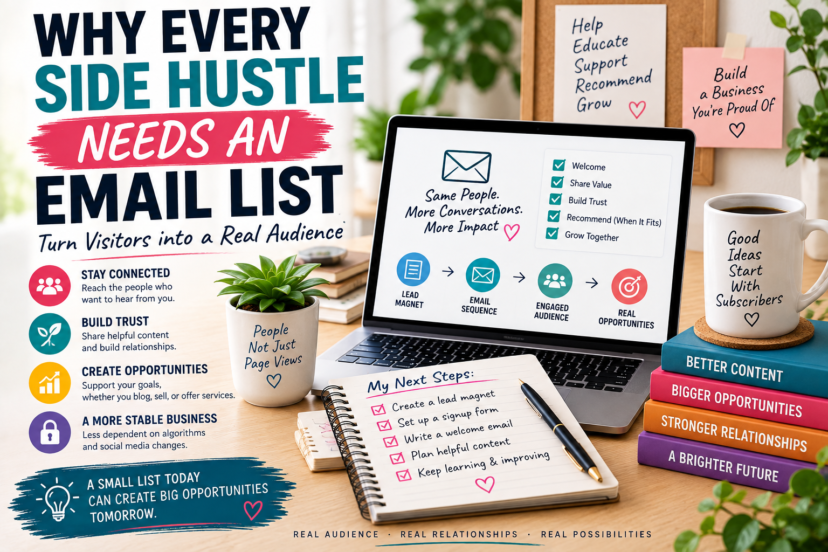
Why Every Side Hustle Needs an Email List: Build an Audience You Can Stay Connected With
Introduction
Traffic feels important when you are building an online side hustle.
And it is.
Without discovery, very few people will find your articles, resources, products, or recommendations. That is why bloggers spend so much time learning Google SEO, Pinterest, social media, and other traffic strategies.
But traffic creates another question:
What happens after someone visits your website?
A reader may find exactly what they needed, close the tab, and never remember the name of your site.
That does not mean the visit was wasted. Your content helped someone, and they may return through search or another source later.
But you have no direct connection with that person.
Email can change that.
When a visitor voluntarily subscribes, you gain permission to continue the relationship beyond a single website visit.
That is the real value of an email list.
Not a guaranteed source of income.
Not a shortcut to sales.
And not simply a database of addresses.
An email list gives interested people a way to stay connected with your business after the first visit.
For many content-based side hustles, that can become an important long-term asset.
What Is an Email List?
An email list is a group of people who have voluntarily provided their email addresses and agreed to receive communication from you.
Someone might subscribe because they want:
- a useful guide or checklist,
- regular tips,
- updates about new content,
- access to a resource,
- information about a particular topic,
- or simply a way to continue learning from you.
The important part is permission.
You are not collecting random addresses and sending unsolicited marketing messages.
The subscriber has actively chosen to establish an ongoing connection.
That makes email fundamentally different from a website visit.
A visitor arrives.
A subscriber says:
“You may contact me again.”
That permission is valuable—and it should be treated with respect.
Traffic and Audience Are Not the Same Thing
Imagine 100 people visit an article this week.
Those visits tell you that people reached the page.
They do not necessarily tell you whether those people will ever return.
Traffic is therefore useful, but it should not automatically be confused with an audience.
An audience develops when people begin to recognize your work, return to it, trust it, or intentionally choose to hear from you again.
Email provides one way to create that continuity.
The difference can be expressed simply:
Traffic → Someone discovers you
Email subscription → Someone chooses to stay connected
Both matter.
They simply serve different purposes.
This is also why the traffic strategies we developed in the Pinterest cluster are only part of the larger RSI system. The Pinterest Marketing Hub can help people discover your website, while email creates an opportunity for the relationship to continue afterward.
Your Email List Is Closer to an Owned Audience
You will often hear marketers say:
“You own your email list.”
That idea contains an important principle, but it needs some nuance.
You do not own your subscribers.
And email is not completely independent of outside systems. You still rely on email service providers, inbox providers, technical infrastructure, deliverability, and applicable laws.
What you gain is greater control over the connection.
On Pinterest, Google, Instagram, Facebook, or another discovery platform, an algorithm or ranking system influences whether someone encounters your content again.
An email subscriber has explicitly given you permission to contact them through another channel.
That makes email considerably different from accumulating followers or impressions on a platform.
A useful way to think about it is:
External platforms help you reach an audience.
Email helps you build a direct relationship with part of that audience.
Your website and subscriber list can therefore become important components of the business infrastructure you are building.
Why This Matters for a Side Hustle
Most side hustles begin with limited resources. Time is scarce, the content library is still growing, traffic may be small, and there is rarely a large marketing budget available.
That makes it especially important to use the attention you already earn wisely.
Imagine someone discovers one of your articles about affiliate marketing. The information answers an immediate question, but the reader is still at an early stage. They may not know which niche to choose, how affiliate programs work, or whether this business model is even right for them.
Expecting that person to make a purchase—or any other major decision—during the first visit would miss an important part of the journey.
A relevant email signup offers another option.
Instead of ending the connection when the browser tab closes, the reader can choose to continue learning from you. One message might help with niche selection. Another could explain how affiliate commissions work. Later, you might share a guide to evaluating affiliate programs or point toward a tool when it genuinely fits the reader’s needs.
Each interaction can build naturally on the one before it.
That is particularly valuable for a side hustle because you do not need to turn every visitor into a customer immediately. You can focus first on being useful, while giving interested readers a way to stay connected as they learn, compare options, and decide what makes sense for them.
Email extends the opportunity to help beyond a single website visit.
Email Gives You More Than One Opportunity to Help
A website article usually solves one primary problem.
Email can connect that solution to the next one.
Imagine someone downloads a beginner guide about starting a side income.
Their first question may be:
Where should I start?
Later:
Which business model fits me?
Then:
How do I get traffic?
Eventually:
How could I monetize it?
A useful email strategy can support that progression.
Instead of repeatedly asking:
What can I sell to this subscriber?
ask:
What would be genuinely useful for this person next?
That principle fits the broader Realistic Side Income philosophy:
Help first. Recommend second.
Monetization can become part of the relationship, but it does not need to dominate it.
An Email List Does Not Automatically Create Trust
The old version of this article says email helps build trust.
That is true only when the emails deserve it.
Simply appearing in someone’s inbox does not make you trustworthy.
Trust can grow when your communication is:
- useful,
- accurate,
- relevant,
- recognizable,
- respectful,
- and aligned with what the person expected when subscribing.
The opposite can happen too.
If someone signs up for a useful checklist and immediately receives a stream of aggressive sales messages, email may damage the relationship rather than strengthen it.
So the better equation is not:
Email → Trust
It is:
Permission + Useful Communication + Time → Opportunity to Build Trust
That distinction matters.
Welcome Emails Can Establish the Relationship
The first messages after someone subscribes are particularly useful because the subscriber still remembers why they joined.
A welcome email can confirm the signup, deliver the promised resource, explain what kind of communication to expect, and point toward a sensible next step.
Additional emails can then expand on the subject that originally interested the person.
For example:
Lead Magnet → Welcome → Useful Lesson → Related Resource → Next Step
This does not need to become a complicated funnel.
A simple sequence can already help a new subscriber understand who you are, what Realistic Side Income is about, and where they can find useful information.
Our The Perfect Welcome Email Sequence guide looks more closely at how that first relationship can be structured.
Does Every Side Hustle Literally Need an Email List?
No.
And this is an important qualification to the title of this article.
A person occasionally doing local lawn care for three neighbors does not necessarily need a newsletter.
A freelancer receiving enough work through referrals may have other priorities.
Someone testing an idea for a few weekends might not need an email marketing system on day one.
But email becomes particularly useful when your side hustle depends on building an audience over time.
Examples include:
- blogging,
- affiliate marketing,
- digital products,
- online education,
- newsletters,
- content businesses,
- creator businesses,
- and many service businesses that benefit from ongoing client relationships.
So when we say “every side hustle needs an email list,” the more precise lesson is:
If repeated communication with an interested audience could strengthen your business, building an email list deserves serious consideration.
For Realistic Side Income, the answer is clearly yes.
You Do Not Need Large Traffic Before Starting
Another common assumption is that email marketing belongs to a later stage.
First build traffic.
Then build an audience.
Then think about email.
There is no universal reason the process must happen in that order.
If five relevant people visit your website and one genuinely wants to hear more from you, there is no strategic benefit in preventing that person from subscribing simply because the website is still small.
At the same time, this does not mean you need a sophisticated funnel before publishing your first article.
Start with something manageable.
A simple signup opportunity with a clear reason to join can be enough.
Then improve it as you learn.
This avoids both extremes:
Waiting indefinitely
and
Building an elaborate email system before you have useful content.
Give People a Clear Reason to Subscribe
“Join my newsletter” may work for an established creator whose audience already knows what to expect.
For a new website, the value may be less obvious.
A visitor might reasonably ask:
Why should I give you access to my inbox?
A lead magnet can provide a clear answer.
It might be:
- a checklist,
- a short guide,
- a template,
- a worksheet,
- a resource list,
- or another practical tool related to the content the visitor is already reading.
The important part is not making the free resource enormous.
It is making it relevant.
Someone reading about Pinterest traffic is more likely to appreciate a Pinterest-related resource than an unrelated guide about freelancing.
That connection can be represented as:
Article → Relevant Need → Useful Resource → Voluntary Signup
Our guide on How to Create a Lead Magnet That People Actually Download explores this process in more detail.
Pinterest and Email Can Play Different Roles
The previous Pinterest cluster gives us a perfect example of how traffic and email can work together without pretending that one guarantees the other.
Pinterest may help someone discover a Pin.
The Pin may lead to an article.
The article may solve the immediate problem.
A relevant signup opportunity then allows the visitor to decide whether they want to continue hearing from you.
The process looks like this:
Pinterest Discovery → Useful Article → Relevant Signup Opportunity → Email Relationship
Notice what is missing:
Guaranteed income.
An email subscriber does not automatically become a customer.
But you now have permission to continue providing value rather than relying entirely on the person finding you again through Pinterest.
The same principle applies to Google traffic and other discovery channels.
Email Can Support Different Business Models
The role of email changes depending on what you are building.
For an affiliate website, email might introduce useful educational content and occasionally point toward relevant recommendations.
A digital product creator can help subscribers understand a problem before presenting a paid solution.
Freelancers may use email to remain visible to past clients or interested prospects.
Bloggers can bring readers back to useful articles.
Course creators may use it to answer common questions and provide educational material.
The point is not that every business should send the same type of emails.
It is that email can create a bridge between initial interest and future interaction.
What Should You Send to Subscribers?
This question often feels harder than collecting the first email address.
But you do not need an endless supply of clever newsletter ideas.
Start with the problems your audience already has.
An email might:
- answer a common question,
- expand on an article,
- explain a mistake,
- share a useful resource,
- point toward an updated guide,
- provide a practical tip,
- describe something you learned,
- or recommend a relevant tool when there is a genuine reason to do so.
Your existing content library can become a major source of ideas.
For example, RSI already contains connected clusters around blogging, affiliate marketing, Pinterest, and building a side income.
Email can help subscribers navigate those resources in a logical order.
You are not starting from an empty page.
You are creating another way to deliver useful information.
How Often Should You Email?
There is no universally correct frequency.
Daily emails may suit one business.
Weekly communication may fit another.
A less frequent schedule may make sense when each message requires substantial research or when the audience expects occasional updates rather than regular commentary.
The important questions are:
Can you maintain the schedule?
Does each message have a useful purpose?
Does the frequency match what subscribers were led to expect?
That is more helpful than declaring:
“Once a week is best for beginners.”
A sustainable rhythm is valuable because it helps you maintain the relationship without forcing yourself to send messages simply because the calendar says you should.
We explore that decision more fully in How Often Should You Email Subscribers?.
Permission and Trust Come With Responsibilities
An email address is personal information, and email marketing comes with legal and practical responsibilities.
Rules vary by jurisdiction, but permission, transparency, privacy, and the ability to stop receiving marketing messages are fundamental considerations.
For example, EU rules governing direct electronic marketing interact with privacy and data-protection requirements, while other jurisdictions have their own standards.
That means your signup process should not be designed merely to maximize the number of addresses collected.
Subscribers should understand what they are signing up for.
They should receive what was promised.
And leaving the list should not be unnecessarily difficult.
This article is not legal advice, but the principle is straightforward:
Permission is not a technical hurdle. It is the foundation of the relationship.
A Bigger List Is Not Automatically a Better List
Email marketing often creates another numbers trap.
10 subscribers become 100.
Then the goal becomes 1,000.
Then 10,000.
But list size alone tells you surprisingly little.
A large list containing people who no longer care about the subject may be less useful than a much smaller group that genuinely wants the information you send.
Instead of asking only:
How many subscribers do I have?
also ask:
Why did they subscribe?
Are my emails still relevant to that reason?
Do people continue engaging with the content?
Are they finding useful next steps?
What am I learning about their needs?
Growth matters when it represents relevant relationships—not merely a larger number in a dashboard.
Email Is Not Immune to Platform Risk
There is another misconception worth correcting.
Email is often described as completely independent from algorithms.
It is more controllable than many discovery platforms, but it is not immune to outside systems.
Inbox providers make filtering decisions.
Messages can land in spam.
Deliverability can change.
Email platforms can change their pricing or policies.
Subscribers can become inactive.
Technical mistakes can affect sending.
This does not reduce the value of an email list.
It simply gives us a more accurate reason to value it.
Email is powerful because you can build a permission-based, portable relationship that is less dependent on a single discovery feed—not because outside systems disappear entirely.
Build the System in Layers
For a beginner with limited time, email marketing does not need to become another overwhelming project.
A practical progression might look like:
1. Publish useful content
Give people something worth discovering.
2. Create a relevant signup opportunity
Explain clearly why someone might want to hear from you again.
3. Deliver what you promised
If you offered a guide, checklist, or resource, make access simple.
4. Welcome the subscriber
Establish expectations and provide a useful next step.
5. Continue helping
Use email to answer questions and connect subscribers with relevant resources.
6. Learn from the response
Observe what people read, click, ignore, or unsubscribe from.
7. Improve
Refine the content, offer, signup placement, and email strategy based on evidence.
The system does not need to be perfect before the first person joins.
It needs to be useful and trustworthy.
Your Email List Should Support the Asset You’re Building
This connects directly with the broader philosophy behind Realistic Side Income.
A sustainable online side hustle is not simply:
Traffic.
Nor is it:
Followers.
Or:
Email subscribers.
It is a collection of useful assets and relationships that reinforce one another.
For example:
Useful Content → Discovery → Website Visit → Email Permission → Continued Value → Trust → Relevant Opportunity
Pinterest can contribute discovery.
Google can contribute discovery.
Your articles provide value.
Email provides continuity.
Products, services, or affiliate recommendations can eventually provide monetization where they genuinely fit.
No single element needs to carry the entire business.
That makes the system stronger.
Common Email List Mistakes Beginners Make
Most early mistakes come from focusing on the mechanics rather than the person.
Waiting forever because the audience feels “too small” can mean missing opportunities to build relationships.
The opposite mistake is constructing an elaborate funnel before there is enough useful content behind it.
Other problems include offering an unrelated lead magnet, emailing only when there is something to sell, failing to explain what subscribers will receive, or treating subscriber count as the primary measure of success.
Perhaps the most damaging mistake is forgetting why someone subscribed in the first place.
They did not join because your business needed an email list.
They joined because they expected something useful.
Keep that expectation at the center.
Final Thoughts
Traffic helps people discover your work.
Email gives some of those people a way to continue the relationship.
That is why an email list can become such a valuable part of a content-based side hustle.
You do not need thousands of visitors before you begin.
You do not need an elaborate automation system.
And you do not need to email every day—or even every week—simply because somebody says you should.
Start with a useful reason to subscribe.
Respect the permission you receive.
Deliver what you promise.
Continue providing value.
Then let the system develop alongside the rest of your business.
The goal is not to collect as many email addresses as possible.
The goal is to turn temporary attention into a relationship people voluntarily choose to continue.
For the next steps, visit the Email Marketing Hub for guides on lead magnets, welcome sequences, email writing, list growth, and monetization.
FAQ
1. Does every side hustle need an email list?
Not literally. Email is especially useful for businesses that benefit from ongoing audience or customer relationships, including blogs, affiliate sites, digital products, creator businesses, online education, and many service businesses.
2. When should beginners start building an email list?
There is no required traffic threshold. Once you have useful content and a relevant reason for visitors to subscribe, you can begin collecting voluntary signups without waiting for a particular number of visitors or articles.
3. Do I need a large email list to make it worthwhile?
No fixed subscriber number determines whether a list is valuable. Relevance, engagement, trust, audience needs, and your business model matter more than list size alone.
4. How often should I email subscribers?
There is no universal schedule. Choose a frequency you can sustain, make the purpose of your emails clear, and consider what subscribers were led to expect when they joined.
5. Is an email list really an asset you own?
It is better described as a permission-based audience relationship over which you have greater control. You do not own subscribers, and email still depends on service providers, inbox systems, deliverability, and applicable laws.