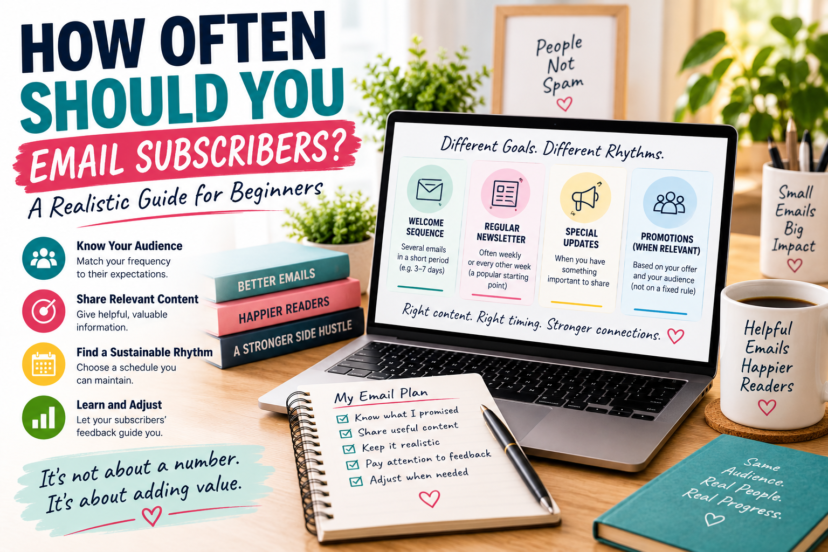
How Often Should You Email Subscribers? A Realistic Guide for Beginners
Introduction
You have started building an email list.
Perhaps your welcome sequence is ready, a few subscribers have joined, and now another question appears:
How often should you email them?
Once a week?
Twice a month?
Several times a week?
Only when you have something important to say?
You can find confident recommendations for almost every possible schedule. The problem is that there is no universal email frequency that works for every audience, business, or type of email.
A daily newsletter and a monthly business update serve very different purposes. Someone who signs up for a short email course may expect several messages close together, while a reader joining a general blogging newsletter may expect something entirely different.
Instead of searching for the perfect number, it is more useful to ask:
What frequency makes sense for the communication I promised and the people who chose to receive it?
That question gives you a much better starting point.
Why Email Frequency Matters
Every email enters someone’s inbox and asks for a little attention.
That does not make frequent communication automatically bad. Nor does it mean that sending fewer emails automatically makes them more valuable.
Frequency changes the context in which your messages are received.
A subscriber who knowingly signs up for a daily five-day course may expect an email every day during that period. The same person might find daily messages surprising if the signup form simply promised occasional side-hustle tips.
Expectations therefore matter.
So do relevance and purpose.
A useful way to think about frequency is:
Expectation + Relevance + Purpose + Sustainable Delivery
The schedule should support the communication rather than become the strategy itself.
There Is No Universal Best Email Frequency
Different businesses use email in different ways.
A news publication may have a reason to send several updates in one day. A creator might publish a carefully prepared newsletter every other week. An online store may communicate more frequently around a particular promotion and less frequently at other times.
A blogger building a side hustle may choose another rhythm entirely.
None of these schedules is automatically correct or incorrect.
The relevant questions are what subscribers signed up for, what you have to communicate, and whether the emails continue to justify the attention they request.
This is why copying another creator’s schedule can be misleading.
You can see how often they send.
You cannot necessarily see why that frequency makes sense for their audience, business model, content process, or goals.
Start With What You Promised
The best place to begin is not your calendar.
It is your signup form.
What did you tell people they would receive?
If the form promises:
“Weekly practical tips for building a realistic side income”
then a weekly rhythm is part of the expectation you created.
If it says:
“Occasional updates and useful resources”
the expectation is different.
And if someone signs up for a seven-day email course, several messages within one week may be exactly what they requested.
This principle also applies to your welcome email sequence. The timing of those messages should reflect the onboarding experience you want to create rather than an arbitrary rule about how many days must pass between emails.
Frequency works best when it matches the expectation created at signup.
Your Welcome Sequence and Regular Emails Serve Different Purposes
It is useful to distinguish between an automated welcome sequence and your ongoing communication.
A welcome sequence is triggered by a specific event: someone has just subscribed.
Those messages may arrive relatively close together because they form part of one connected experience.
Regular emails have a different role.
They continue the relationship after that initial introduction.
The transition might look like this:
Signup → Welcome Sequence → Regular Communication
This means you do not necessarily need one frequency for every type of email you send.
A subscriber might receive several onboarding messages during the first two weeks and then move into a less frequent regular newsletter.
The important part is that the experience makes sense from the subscriber’s perspective.
How Often Should a Beginner Email?
There is no number I can responsibly give every beginner.
A weekly email can be a practical option for some side-hustle bloggers because it creates a regular opportunity to communicate without requiring daily content.
But that does not make weekly the default everyone should follow.
Every other week may fit your publishing process better.
A monthly newsletter may be appropriate if it contains substantial information and matches what subscribers expect.
More frequent emails can also make sense when there is a clear reason for them.
Instead of starting with:
“How many emails should I send?”
try:
“What can I realistically send that remains useful and relevant?”
Then choose an initial rhythm and learn from it.
Sustainable Does Not Mean Rigid
Because many side hustles are built alongside a job, family responsibilities, and other commitments, sustainability matters.
However, a sustainable email strategy does not require sending on exactly the same day forever.
There will be weeks when you have something particularly useful to share.
There may be periods when you are launching a new resource or running a short educational series.
At other times, fewer emails may make sense.
The goal is not perfect calendar obedience.
It is to create a communication process you can manage without sacrificing the usefulness of the messages themselves.
A schedule is a tool.
It should help you communicate—not become another obligation that forces you to send an email simply because Tuesday has arrived.
Do Not Send an Email Just to Maintain a Streak
This is one of the problems with rigid consistency advice.
If you believe you must email every week, you may eventually find yourself staring at an empty draft thinking:
“I need to send something today.”
That is not a particularly strong reason to enter someone’s inbox.
Instead, begin with purpose.
Perhaps you have:
- a useful lesson from a new article,
- an important update,
- an answer to a common reader question,
- a practical tip,
- a relevant resource,
- a personal experience that teaches something,
- or a recommendation that fits the audience.
The email does not need to be groundbreaking.
It simply needs a reason to exist.
Regular communication can be valuable. Communication for its own sake is not the goal.
What Can You Email About?
Running out of ideas is a common concern, particularly when you are also creating blog content.
Fortunately, your emails do not need to exist in a separate content universe.
A blog post can become the starting point for an email without simply copying the article.
Suppose you publish a guide about Pinterest keyword research.
The email might explain one mistake beginners make when choosing Pinterest keywords and then link to the full guide for readers who want to continue.
An article about affiliate marketing could inspire an email about a misconception you frequently see.
A reader question might become a short explanation that helps the rest of your list as well.
Your existing content can therefore become raw material:
Article → Useful Idea → Email → Relevant Next Step
This approach is especially practical when you are building a business with limited time.
Relevance Matters More Than Filling the Calendar
The original version of this article argued that “quality always beats quantity.” The idea is understandable, but even quality can be difficult to define.
A beautifully written email is not necessarily useful to someone who did not subscribe for that topic.
Relevance is often a better lens.
Consider a subscriber who joined because they want help starting a blog.
A thoughtful email about an unrelated subject might be well written, but it may still feel out of place.
A short message answering a specific blogging question could be far more useful.
So before sending, ask:
Why is this relevant to the people receiving it?
That question can improve both the content and your decisions about frequency.
Can You Email Too Often?
Yes—but there is no universal number at which “too often” begins.
Context matters.
Subscribers may become dissatisfied when the volume of email is different from what they expected, when messages become repetitive, or when communication becomes dominated by promotions that are not relevant to them.
More frequent sending can also increase the number of opportunities for people to unsubscribe or report unwanted messages.
But it would be equally misleading to say that frequent email is inherently bad.
If someone knowingly subscribes to frequent communication and continues to find it useful, that is a very different situation.
The better question is not:
“Is three emails a week too many?”
It is:
“Does this frequency still make sense for what subscribers were promised and what I am sending?”
Can You Email Too Rarely?
Infrequent communication creates a different set of considerations.
If a long time passes between signup and later messages, some subscribers may no longer remember the context in which they joined.
Their interests may also have changed.
That does not mean every list must be contacted weekly to prevent people from “forgetting you.” The original article made that connection too confidently.
Instead, think about continuity.
Does your communication still feel connected to the relationship the subscriber originally chose?
If you have been quiet for an extended period, it may be better to acknowledge that gap rather than suddenly reappear with an aggressive promotion.
The goal is not constant visibility.
It is meaningful continuity.
What About Promotional Emails?
Your regular schedule does not have to determine every promotional email you send.
There may be periods when you have a relevant launch, limited-time event, new product, or other reason to communicate more frequently.
The same principles still apply:
Subscribers should understand what they are receiving.
The messages should be relevant.
Promotional claims should be accurate.
And people should have a clear way to unsubscribe.
For Realistic Side Income, this also means recommendations should fit naturally into the broader relationship.
Help first. Recommend second.
That principle is more useful than deciding that every fourth email must contain an offer.
Let Subscriber Behavior Inform Your Decisions
Once you begin sending emails, your own audience can provide information that generic advice cannot.
Depending on your email platform, you may be able to observe:
- delivery,
- opens,
- clicks,
- replies,
- unsubscribes,
- spam complaints,
- and actions that matter to your business.
But these metrics require interpretation.
An open does not necessarily mean someone carefully read an email, and privacy features can affect open tracking.
A click tells you that a link received an interaction, but it does not automatically explain why.
An unsubscribe does not always mean the email was poor. Sometimes a person’s interests simply changed.
Rather than treating one number as a verdict, look for patterns and ask better questions.
For example:
Did unsubscribes change after I increased frequency?
Do certain topics generate more useful responses?
Are subscribers clicking through to the resources I intended to highlight?
Does a particular type of email consistently lead to replies?
The purpose of analytics is to improve your understanding, not to chase a universal benchmark.
Replies Can Tell You What Metrics Cannot
Email is not only a broadcast channel.
It can also create conversation.
A reply such as:
“This is exactly the problem I’m struggling with.”
may tell you something that an open-rate percentage never could.
Subscriber questions can reveal confusing topics, unmet needs, or ideas for future content.
If people repeatedly ask about the same issue, you may have found a subject for another email, blog article, lead magnet, or resource.
This creates a useful loop:
Send → Observe → Listen → Learn → Adjust
Frequency is one part of that process, not the whole strategy.
Segmentation Can Change the Frequency Question
As your list becomes more developed, not every subscriber necessarily needs to receive every email.
Someone primarily interested in Pinterest may not need every message about affiliate marketing.
A subscriber who has already purchased a product may need different communication from someone who has just discovered your site.
Segmentation can allow email content—and sometimes frequency—to reflect different interests or stages.
You do not need a complicated segmentation system when you are starting.
But it is useful to understand the larger principle:
The more relevant the communication becomes, the less useful a single “perfect frequency” becomes as a strategy.
Who receives the email can matter just as much as how often you send it.
Your Blog and Email List Can Support Each Other
Email does not need to compete with blogging for your limited time.
The two can work together.
A new article gives you something useful to discuss with subscribers.
Subscriber questions can give you ideas for future articles.
A blog visitor may become a subscriber through a relevant lead magnet, and an email subscriber may later return to the website to explore additional resources.
The relationship can look like this:
Useful Article → Relevant Signup → Email Communication → Website Return → Further Learning
If you are still developing the signup side of that system, How to Create a Lead Magnet That People Actually Download explains how to give visitors a relevant reason to join your list.
A Practical Way to Choose Your Starting Frequency
Instead of adopting someone else’s schedule, work through four considerations.
1. What did you promise?
Begin with the expectation created by your signup form or lead magnet.
2. What kind of communication are you sending?
A newsletter, educational course, product update, and promotional sequence may reasonably have different rhythms.
3. What can you sustain?
Choose a pace that fits the time and resources available to your side hustle.
4. What does your audience response teach you?
Observe relevant metrics, replies, unsubscribes, and other feedback. Then adjust when the evidence gives you a reason.
That gives us a much more useful process:
Set Expectations → Choose a Starting Rhythm → Send Useful Emails → Observe → Learn → Adjust
Notice that the process does not end with “be consistent.”
It ends with learning and adjusting.
Changing Your Email Frequency Is Allowed
Your first schedule is not a permanent contract.
Your business can change.
Your available time can change.
Your content strategy can change.
And your subscribers can teach you things you did not know when you started.
If you decide to change the frequency significantly, communicating that change clearly can help subscribers understand what to expect.
This is particularly useful when increasing the volume of emails.
A strategy that adapts to evidence is healthier than maintaining a schedule simply because you chose it six months ago.
Remember the Bigger Purpose of Email
Article 56 explained why an email list can matter for a side hustle: it gives interested readers a way to continue the relationship after a website visit.
That is still the larger goal.
Email frequency is only one operational decision inside that relationship.
The broader process is:
Permission → Relevant Communication → Continued Value → Relationship → Appropriate Opportunity
Sending more often does not automatically strengthen that process.
Sending less often does not automatically weaken it.
The messages still need to deserve the attention they request.
If you are building this system from the beginning, Why Every Side Hustle Needs an Email List explains how email fits into the wider RSI strategy.
Final Thoughts
So, how often should you email subscribers?
There is no universal number.
Weekly can work.
Every other week can work.
Monthly communication can make sense.
More frequent emails can also be appropriate in the right context.
The better goal is to establish a rhythm that matches what subscribers expected, gives you a genuine reason to communicate, and remains realistic for your business.
Then pay attention to what happens.
Learn from subscriber behavior.
Listen to replies.
Adjust when necessary.
And do not send simply because someone else’s email-marketing formula says today is a sending day.
Choose a frequency with a reason. Then let experience—not a universal rule—help you improve it.
For more beginner-friendly guides on welcome sequences, lead magnets, list building, email content, and automation, continue through the Email Marketing Hub.
FAQ
1. How often should beginners email their subscribers?
There is no required frequency for beginners. Weekly or every other week can be practical starting points for some side-hustle businesses, but the right choice depends on what subscribers were promised, what you send, and what you can realistically maintain.
2. Is emailing once a week best?
Not universally. A weekly schedule can provide a useful structure, but another frequency may fit your audience, content, and business better. Start with a reason for the schedule rather than treating weekly email as a rule.
3. Can I email subscribers too often?
Yes, particularly when the volume differs from what subscribers expected or the messages become repetitive or irrelevant. There is no fixed number that automatically counts as “too often.”
4. Is emailing once a month enough?
It can be. Monthly communication may suit certain newsletters and audiences, particularly when that frequency matches the signup expectation and the messages remain relevant. There is no requirement to email weekly simply to keep a list active.
5. Can I change my email frequency later?
Yes. Your schedule can evolve as your business, audience, content, and available time change. If you make a significant change—especially toward more frequent communication—it can be helpful to tell subscribers what to expect.