
Writing Emails People Open: A Practical Guide for Beginners
Introduction
You can spend an hour writing an excellent email.
The information may be useful, the examples relevant, and the recommendation carefully chosen.
But before any of that matters, the subscriber has to decide whether the message deserves their attention.
That decision happens in a crowded inbox.
Your email appears alongside work messages, personal conversations, newsletters, receipts, notifications, promotions, and countless other demands on the reader’s time.
So how do you write emails people want to open?
There is no subject-line formula that guarantees it.
The better approach is to give subscribers an honest and relevant reason to consider opening, while making sure the message that follows justifies the expectation you created.
That relationship can be expressed simply:
Recognition → Relevance → Accurate Expectation → Useful Email → Future Decision
Notice that the final step is a decision.
A subscriber may open your next email—or they may not. Your job is not to manufacture that behavior. It is to communicate in a way that makes opening a reasonable choice.
Why Do People Open Marketing Emails?
It is tempting to reduce an email open to the subject line.
But the decision can involve much more.
A subscriber may notice who sent the message, recognize the topic, remember why they joined the list, consider whether the subject is relevant, and decide whether they have time to read it.
Some of those factors are outside your control.
Others are influenced by the email experience you create.
That means subject-line optimization should not be separated from the rest of your email strategy.
A brilliant subject line cannot compensate indefinitely for messages that repeatedly disappoint the expectation behind it.
And a straightforward subject line may be entirely appropriate when the subscriber already understands why the sender and topic are relevant.
The subject line creates an expectation. The email decides whether that expectation was justified.
Make the Sender Easy to Recognize
Before someone reads the subject line, they may notice the sender.
That makes the From name an important part of the inbox experience.
Depending on your brand, that could be:
Realistic Side Income
or:
Antje from Realistic Side Income
There is no universal format every business should use.
What matters is that the name accurately identifies the sender and gives subscribers enough context to understand where the message came from.
Frequent unexplained changes can make recognition harder.
The goal is not to manipulate familiarity.
It is much simpler:
Help subscribers understand who is contacting them.
Previous Emails Create Context for Future Ones
Every new email arrives with some history behind it.
Perhaps the subscriber joined yesterday and has only received your welcome message. Maybe they have been on the list for months. They may remember a useful article you shared, an irrelevant promotion, a recommendation that helped, or a promise that was not kept.
Those experiences create context.
They do not guarantee what someone will do next, but they can influence how future messages are interpreted.
This is why How to Build Trust Through Email matters here.
The goal is not to accumulate “trust points” until subscribers automatically open your messages. It is to communicate in ways that repeatedly give people enough information to decide whether your emails remain worth their attention.
Start With the Reason for the Email
Before writing the subject line, identify why the email needs to exist.
Perhaps you want to explain an idea, answer a subscriber question, share a useful article, provide an update, recommend a relevant tool, tell a story that illustrates a lesson, or introduce a product.
Having a clear purpose helps you decide what belongs in the message.
This does not mean every email is limited to one idea, one link, or one call to action.
Those can be useful constraints when you are learning to write emails, but they are not universal rules.
A better question is:
Can the subscriber understand why this email was worth sending?
If several ideas support the same purpose, they may fit naturally together.
If five unrelated messages are competing for attention, the email may need a clearer focus.
Subject Lines Matter—but They Are Not Magic
A subject line helps someone decide whether to consider opening the message.
It does not need to explain the entire email.
It does not need to be unusually clever.
And it does not need to create maximum curiosity.
For Realistic Side Income, examples might include:
A mistake I made with Pinterest
Where should a beginner actually start?
Why your first €500 may take time
What I would skip as a new blogger
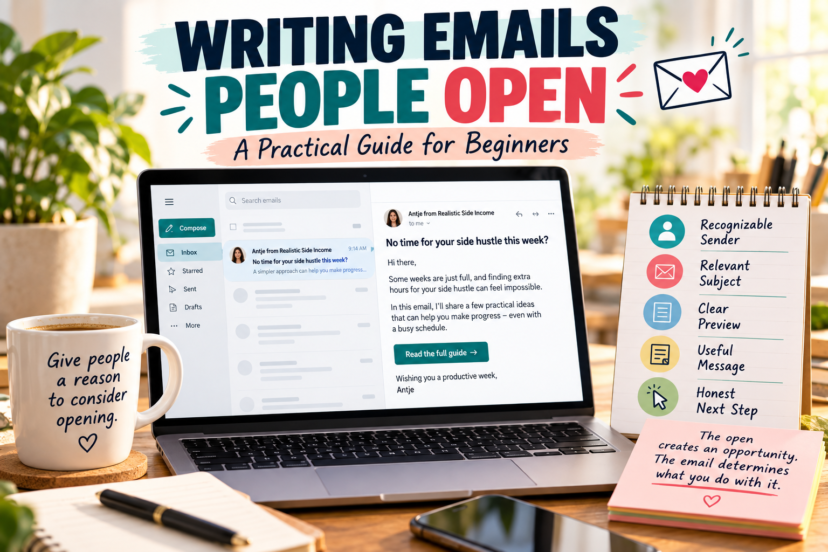
No time for your side hustle this week?
These work as examples because they establish a recognizable topic or question without promising an outcome the email cannot support.
The goal is not to create an “irresistible” subject line.
It is to give the right subscriber enough context to decide whether the message is relevant.
Clarity and Curiosity Can Work Together
Email advice often presents clarity and curiosity as competing subject-line strategies.
They do not have to be.
Consider:
The secret you’ve been waiting for…
There is curiosity, but almost no context.
Compare it with:
The blogging mistake I kept making
The second version leaves something unanswered while still identifying the subject.
Whether either subject performs better with a particular audience is an empirical question, not a universal rule.
But from a communication perspective, the second gives the reader more information with which to make a decision.
Think of curiosity as an unanswered part of an otherwise understandable message.
Create enough curiosity to invite attention—not so much uncertainty that relevance disappears.
Do Not Create an Expectation the Email Cannot Fulfill
Curiosity becomes a problem when the subject line and content stop matching.
Suppose the subject says:
This changed everything about my business
and the email contains an ordinary affiliate recommendation with little connection to that claim.
The problem is not simply that the subject is dramatic.
The reader was given one expectation and received something else.
The same applies to false urgency, misleading reply-style subjects, or exaggerated income claims.
A more responsible side-income subject might ask:
What would it take to earn your first €500 online?
rather than promise:
Make €500 this weekend!
The first opens a discussion.
The second implies an outcome that may have little basis in the reader’s circumstances.
For Realistic Side Income, accuracy is part of the brand—not an obstacle to getting attention.
Use Urgency Only When the Situation Is Actually Time-Sensitive
Sometimes an email genuinely contains a deadline.
Registration may close on Friday.
A live event may begin tomorrow.
An offer may actually expire.
In those situations, the timing is useful information.
Artificial urgency is different.
Repeated use of phrases such as LAST CHANCE, URGENT, or ENDS TONIGHT when little is actually changing teaches subscribers something about how you communicate.
Instead of asking whether urgency “works,” ask whether it is true and useful in this particular message.
If it is, say so clearly.
If it is not, relevance is a better foundation.
Capital Letters, Punctuation, and Emojis Are Style Choices
There is no need to treat capitalization, exclamation marks, or emojis as secret open-rate levers.
Compare:
MAKE MONEY ONLINE NOW!!!
with:
A realistic way to start earning online
They communicate very different expectations.
Likewise, an emoji may fit naturally in one brand or message and feel distracting in another.
Your weekend side hustle plan ☕
could suit an informal email.
A string of money bags, alarms, and flames creates a very different impression.
The useful question is not:
Do emojis increase open rates?
It is:
Does this presentation fit the message and the way I want to communicate with subscribers?
Do Not Obsess Over Subject-Line Length
There is no universal character count that guarantees a better subject line.
Inbox displays vary across devices, apps, settings, and screen sizes.
What you can control is the order of information.
Compare:
Here’s something I wanted to tell you about starting your first side hustle
with:
Starting your first side hustle? Read this first
The second reaches the central idea sooner.
That can be useful when space is limited, but it does not create a rule that shorter always means better.
Prioritize the information that helps the subscriber understand the message.
Write More Than One Subject Line
The first subject line that comes to mind may capture the general topic of your email, but it does not always express the most useful angle.
Writing a few alternatives can help you see the message from different perspectives before deciding how to introduce it in the inbox.
Suppose your email is about finding time for a side hustle alongside a full-time job. You might begin with:
No time for your side hustle?
Another version could focus on the situation:
What to do when you’re exhausted after work
Or you could challenge an assumption:
You don’t need three free hours tonight
A fourth option might emphasize the practical direction of the email:
A more realistic way to plan side-hustle time
These alternatives are not competing for the title of universally “best” subject line. Each one frames the same general topic differently and creates a slightly different expectation about what the reader will find inside.
Once you can see those differences, return to the email itself. The most suitable subject is the one that reflects the message accurately, provides enough context to establish relevance, and sounds natural for the way you normally communicate with subscribers.
You may sometimes end up choosing the first version after all. That is perfectly fine. The value of drafting alternatives is not in reaching a particular number of options, but in giving yourself enough distance to make a deliberate choice.
Do not search for the cleverest subject line. Choose the one that introduces the email you actually wrote.
Use Preview Text as Additional Context
Many inboxes display preview text alongside the sender and subject.
That creates another opportunity to explain why the message may be relevant.
For example:
Subject: No time for your side hustle?
Preview: A smaller work block may be more useful than waiting for a perfect evening.
Now the two elements complement each other.
The subject introduces the problem.
The preview adds context.
Without deliberate preview text, an email client may display whatever text happens to appear near the beginning of the message, which may not be particularly helpful.
Think of the preview as supporting information—not necessarily a “second subject line.”
Make the Opening Consistent With the Subject
Once someone opens the email, the transition into the message should make sense.
If your subject says:
What to do when you’re too tired after work
and the first several paragraphs discuss an unrelated weekend story, the reader has to work to find the reason they opened.
You could instead begin:
You finally get home after work, eat dinner, sit down—and opening your laptop for another three hours is the last thing you want to do.
Now the subject and opening belong to the same conversation.
The subscriber does not need an elaborate hook.
They need the email to start delivering on the expectation that brought them inside.
Write Clearly, Not “Like a Marketer”
Email can make otherwise natural writers sound strangely formal—or unusually theatrical.
Neither is necessary.
Instead of:
“We are delighted to inform our valued subscribers that a newly published resource is now available.”
you could write:
“I published a new guide today that answers a question I hear frequently.”
The second version is simpler without pretending that informal writing is automatically superior.
Clear email writing still benefits from structure and editing.
Use language appropriate for your audience. Explain unfamiliar concepts when necessary. Remove words that make the message harder to understand without adding meaning.
The goal is not to sound casual.
It is to sound clear, recognizable, and human.
Make the Email Comfortable to Read
Readability matters, particularly across different screen sizes.
Large uninterrupted blocks of text can be difficult to navigate, while extreme fragmentation—where every sentence becomes its own paragraph—can be distracting in another way.
Use paragraph length, headings, spacing, bullets, and links according to what helps the particular message.
Then test the actual email on a phone.
Can you follow the argument comfortably?
Are links easy to identify?
Does the layout still make sense?
Is the most important information visible without fighting the design?
Good formatting should help the content disappear into the reading experience rather than draw attention to itself.
Let the Email Do Enough Work on Its Own
Not every email needs to be a wrapper around a link.
Suppose you want to teach one small productivity principle.
You can explain the idea inside the email and then offer a related article for people who want to explore it further.
The reader should still be able to gain something even if they never leave the inbox.
For example:
Useful Idea → Brief Explanation → Optional Deeper Resource
This creates a healthier relationship between your blog and email list.
The email does not exist merely to generate a pageview.
The blog does not need to reproduce the entire email.
Each can do what its format does well.
Use Stories When They Clarify the Idea
A story can give an abstract lesson useful context.
Imagine writing:
Last Tuesday I planned to spend two hours on my website. By the time everything else was finished, I had 35 minutes left.
That could lead naturally into a lesson about choosing a task small enough to finish rather than abandoning the session.
The story has a purpose.
It helps the reader understand the situation behind the lesson.
What you want to avoid is storytelling as decoration: adding unrelated personal anecdotes because a marketing formula says every email needs a story.
Tell the story when it helps explain the point—not because storytelling itself is supposed to create engagement.
Keep Personal Experience Connected to the Reader
Your own experience can be valuable precisely because it provides context that generic advice cannot.
But the email does not need to turn every story into:
“Now let’s talk about you.”
Instead, make the connection naturally.
What did the experience teach you?
What assumption did it challenge?
Under what circumstances might that lesson be relevant to the subscriber?
A useful progression can be:
Experience → Observation → Lesson → Possible Application
That allows your personality and experience to remain part of the email without making the subscriber a prop in your story.
Calls to Action Should Explain the Next Step
When an email includes a next step, make it understandable.
Instead of:
Learn more
you could write:
Read the complete Pinterest beginner guide
Instead of:
Click here
you might use:
Explore 7 beginner-friendly side hustle ideas
The advantage is not that these phrases contain magic conversion words.
They simply give more information about what happens after the click.
Nor does every email need exactly one CTA.
A message may reasonably contain several related resources. Another may require no significant action at all.
The better principle is:
Make important next steps clear without turning the email into a collection of competing demands.
Your Blog Can Supply Email Ideas Without Becoming the Email
A content-rich website already contains many potential email topics.
One article can generate several useful angles.
An article about why side hustles fail might lead to separate emails about unrealistic expectations, constantly switching strategies, insufficient time, or trying to learn everything before starting.
But the objective should not be to mechanically turn every H2 into a newsletter.
Look for ideas that make sense in the inbox.
An email can explore one observation and then point to the article when additional depth is useful.
That makes existing content more valuable without simply announcing:
New blog post—click here.
Ask Questions When You Actually Want the Answers
Email can provide a useful feedback channel.
You might ask:
What’s the biggest challenge you’re facing with your side hustle right now?
Responses can reveal problems, terminology, misunderstandings, or interests that are difficult to see in analytics.
Those insights may influence future articles, emails, lead magnets, or products.
But asking questions should not become another engagement tactic performed for its own sake.
If you invite a response, have a reason to listen to it.
A question is more useful when the answer can change what you understand or do next.
Personalization Is About Relevance, Not Just a First Name
Adding a subscriber’s first name can personalize the appearance of an email.
It does not automatically make the message personally relevant.
Context can matter much more.
Someone who joined through a Pinterest resource has given you information about an immediate interest. A subscriber who downloaded a broad Side Hustle Roadmap may be at a different stage.
As your list develops, segmentation can help distinguish those contexts.
That does not mean beginners need an elaborate behavioral automation system from day one.
Start with a simpler principle:
Send information because you have a reasonable basis for believing it may be relevant to the recipient.
That is a more meaningful form of personalization than inserting a name into otherwise generic communication.
Use Automation for Delivery, Not Judgment
Automation can make email marketing easier to manage.
It can deliver a promised resource, send onboarding messages, schedule newsletters, or route subscribers into relevant sequences.
But automation does not decide whether the communication is useful.
That remains your responsibility.
A subscriber may never know whether an email was manually sent at 9:03 a.m. or scheduled several days earlier.
What they experience is the message itself.
Use automation to make the system reliable.
Continue applying human judgment to what the system sends.
Frequency Does Not Create Opens
Subscribers do not automatically open messages because you send on a consistent schedule.
Nor does an irregular schedule automatically destroy the relationship.
Frequency creates a communication pattern. Whether that pattern makes sense depends on the expectations you established, the type of emails you send, and the people receiving them.
The better framework is:
Set Expectations → Choose a Starting Rhythm → Communicate → Observe → Learn → Adjust
Our guide to How Often Should You Email Subscribers? explores that decision without prescribing a universal weekly schedule.
And if Tuesday arrives but the planned email has no useful reason to exist, the calendar alone is not a good reason to send it.
A content bank of subscriber questions, observations, useful lessons, existing articles, and recurring problems can make regular communication easier without manufacturing filler.
Make Leaving Easy
Writing emails people want to open also means accepting that some people no longer want them.
Interests change.
Projects change.
Inbox priorities change.
An unsubscribe is not necessarily a failure.
Trying to make departure difficult does not create a better audience.
Current Gmail sender guidance emphasizes opt-in practices and easy unsubscribe, and Google requires one-click unsubscribe for applicable marketing and subscription messages from higher-volume senders. Google Help
Technical and legal requirements vary, but the broader principle is simple:
People should remain because the communication is relevant to them—not because leaving is difficult.
What Open Rate Can—and Cannot—Tell You
If the article is about writing emails people open, naturally you will want to look at opens.
But open rate needs careful interpretation.
Traditional open tracking often depends on remote content such as a tracking pixel being loaded. Privacy technology can interfere with that process. Apple’s Mail Privacy Protection, for example, downloads remote content in the background and prevents senders from reliably determining whether a protected recipient actually opened a message. Apple
That means an open rate is not an exact count of people who consciously read your email.
It can still provide information within the context of your platform and audience, but avoid treating it as a precise measure of human attention.
Depending on your objective, you might also consider:
- clicks
- replies
- unsubscribes
- spam complaints
- relevant website actions
- purchases or other business actions
Each answers a different question.
None tells you the entire story.
The upcoming Email Marketing Metrics Explained article can explore those distinctions in much greater depth.
Do Not Diagnose Your Strategy From One Email
One message performs differently from another.
That variation can have many possible explanations.
The topic may have appealed to a smaller group. The subject might have provided less useful context. Deliverability could differ. External circumstances may have changed. Measurement itself can be imperfect.
One result rarely identifies the cause.
Instead of reacting immediately, look for patterns and formulate questions.
What happened? → What might explain it? → What should I test or investigate?
This prevents email optimization from becoming a cycle of changing strategies after every dashboard update.
Test Questions, Not Random Details
Testing can be useful when you know what you are trying to learn.
For example:
Does a subject that identifies the problem clearly produce a different response from one that emphasizes the solution?
That is a more useful experiment than changing the sender name, subject, send time, email content, CTA, and audience simultaneously.
Even then, interpret the result cautiously.
A difference between two versions does not automatically establish a universal rule.
The purpose of testing is to learn something useful about your communication with your audience.
A Simple Email Framework for Beginners
When you are staring at a blank screen, a framework can help you begin.
It is not a mandatory template.
Think of it as a set of questions.
1. Subject
Why might this message be relevant?
Example:
No time for your side hustle this week?
2. Opening
What situation or question does the email address?
Some weeks disappear before you’ve completed a single side-hustle task.
3. Useful Idea
What is the main thing you want to contribute?
Instead of waiting for a perfect three-hour block, identify a smaller task that can be completed independently.
4. Context or Example
What would help the reader understand or apply the idea?
Keyword research might fit into one short session. Outlining an article could fit into another. The point is not that 30 minutes is universally enough, but that smaller tasks can make limited time easier to use deliberately.
5. Relevant Next Step
Is there somewhere useful to continue?
If choosing a side hustle around limited time is the bigger problem, a related RSI article can provide more depth.
6. Sign-Off
End naturally.
That’s enough structure to get started without turning every email into the same formula.
Example: Give the Reader a Reason to Care
Consider this email:
Subject: New Blog Post
Hi,
We published a new blog post today about side hustles.
Click here to read it.
Thanks.
Nothing is technically wrong with it.
But it gives the subscriber very little information about why the article might matter.
Compare it with:
Subject: Only a few hours a week for your side hustle?
If you’re working full-time, finding extra hours can be harder than finding side-hustle ideas.
That’s why the business model matters. Some options depend heavily on appointments or client availability, while others give you more control over when the work happens.
I put together a guide exploring side hustles that can fit more realistically around limited weekly time.
Read: Best Side Hustles for Busy Employees
The goal isn’t to create another full-time job after your full-time job. It’s to choose something that has a realistic chance of fitting the life you already have.
The difference is not clever copywriting.
The second message provides context.
The subscriber can decide whether the article addresses a problem they actually have.
Before You Send: Experience the Email as a Subscriber
Before an email reaches your list, give yourself one final opportunity to experience it from the subscriber’s side rather than from the writer’s.
Start in the inbox. Look at the sender name, subject line, and preview text together. They should create an expectation that the email itself can reasonably fulfill. Then open the message and follow the transition into the first paragraph. The reader should not have to discover halfway through the email that the subject introduced a different conversation.
Next, read the message without editing it. Pay attention to whether the main idea remains clear, whether the amount of explanation feels appropriate, and whether any next step makes sense in the context of what came before.
Then test the parts that require action. Follow the links, make sure they lead where the wording suggests, and check any buttons, downloads, or other resources included in the message. If personalization is being used, confirm that it displays correctly rather than leaving an awkward placeholder behind.
Finally, view the actual email on a phone rather than relying entirely on the editor preview. A message that looks polished on a large screen can become difficult to follow when paragraphs, images, buttons, and links are compressed into a smaller space. Pre-send testing across the final email, links, and mobile presentation is also a standard part of email quality assurance. Salesforce Marketing Cloud User Guide
Recommendations deserve one additional check. When an email includes an affiliate relationship or another financial interest, make sure the appropriate disclosure is clear rather than leaving the subscriber to discover that relationship later.
This final review is not about polishing every sentence until the email feels perfect. It is about making sure that the experience you intended to create is the experience the subscriber is actually likely to receive.
Do not review only what you wrote. Follow the path your subscriber will experience.
The Real Goal Is Not the Open
Because this article is about writing emails people open, it would be easy to make the open itself the measure of success.
But opening an email is only the beginning of the experience.
A subject line can attract attention and still lead to a disappointing message. It may create curiosity without providing the promised answer, exaggerate the importance of what follows, or simply have little relevance once the subscriber begins reading.
The opposite is possible as well. Someone might open an email, find a useful explanation, and leave without clicking a link, replying, or taking another action that appears in your analytics. The absence of a measurable next step does not automatically mean the message had no value.
That is why the purpose of the email matters.
A message designed to explain an idea should not necessarily be evaluated in the same way as an email announcing a new resource, asking for feedback, or introducing a relevant product. The action that matters—if any—is connected to what the email was intended to accomplish.
A more useful way to think about the journey is:
Create a Relevant Expectation → Fulfill That Expectation → Provide Something Worth Reading → Offer a Useful Next Step When Appropriate
The subject line helps the subscriber decide whether to enter that journey. What happens after the open determines whether the message actually delivers what the inbox promised.
This distinction also matters because an open is not a perfect measurement of attention. Privacy features such as Apple Mail Privacy Protection can load remote email content in the background regardless of whether the recipient actively reads the message, which makes reported opens less precise than they may appear. Apple
So the better question is not simply:
“How do I get more people to open this?”
It is:
“If someone chooses to open this email, what will make that decision worthwhile?”
The open creates an opportunity. The email determines what you do with it.
Build a Recognizable Email Experience
As subscribers receive more of your emails, they gradually gain more experience with the way you communicate. They become familiar not only with your sender name or visual style, but also with the kinds of topics you discuss, how you explain them, and what usually happens when they follow one of your recommendations.
Different subscribers will respond to those experiences differently. Some may continue reading regularly, while others become interested only in particular topics. Over time, a few may decide that the emails are no longer relevant to them and unsubscribe.
That variation is normal. The objective is not to condition everyone to open every message or to create a communication habit that guarantees future attention.
A more useful goal is to make the experience coherent and recognizable.
For Realistic Side Income, that could mean readers gradually come to associate the emails with practical explanations, realistic expectations, transparent recommendations, and a cautious approach to income claims. The topics can change, the length can vary, and individual emails can have different purposes without losing those underlying principles.
Recognition therefore involves more than using the same sender name or design template. It also comes from the relationship between what subscribers were led to expect and what they actually receive.
That reputation cannot be created by declaring that your emails are trustworthy, useful, or different from everyone else’s. It develops from the communication itself—and remains open to change as subscribers have new experiences with it.
A recognizable email experience does not mean making every message the same. It means giving different messages a clear sense that they come from the same principles.
Our guide to Email Marketing Mistakes explores several practices that can weaken that experience, from unclear expectations and misleading subject lines to irrelevant communication and poorly considered promotions.
How Better Emails Fit Into the Wider Business
Email does not operate separately from the rest of your website. It becomes most useful when it connects naturally with the content, resources, and other experiences you are already creating.
Someone might first discover Realistic Side Income through a Google search, a Pinterest Pin, or a link from another website. An article answers the immediate question, and a relevant signup opportunity gives that reader the option to continue the connection. If they choose to subscribe, email creates another path through which useful information can reach them.
A simplified version of that journey might look like this:
Discovery → Useful Content → Relevant Signup → Permission → Email Communication → Further Value
The important point is that Further Value does not have to mean the same thing every time.
For one subscriber, an email may lead naturally to another article that explores the subject in greater depth. Another might reply with a question, use a worksheet, or explore a resource you mentioned. A relevant product recommendation may occasionally make sense, while some emails may be complete in themselves and require no further action at all.
Subscribers can also move through the wider RSI content in different directions. Someone who originally joined through a blogging resource may later become interested in Pinterest or email marketing. Another reader may remain focused on one topic for a long time. Email can support those changing interests without forcing everyone through an identical funnel.
This is why it helps to think of your website, email list, and content library as a connected system rather than a sequence of conversion steps.
The purpose of email is not simply to move subscribers closer to an offer. It gives you permission to continue communicating after the original website visit and creates opportunities to reconnect people with information that may be useful at different points in their journey. Permission itself should remain tied to what people actually agreed to receive rather than being treated as unlimited access to their inbox. Mailchimp
Email does not have to push every subscriber toward the same destination. It can help them find the next piece of value that makes sense for them.
Final Thoughts
Writing emails people open is not about discovering a secret collection of irresistible subject lines.
Subject lines matter because they help subscribers decide whether a message deserves consideration.
But they operate within a much larger experience.
Make the sender recognizable.
Give the subject enough context to establish relevance.
Use curiosity without misrepresentation.
Let the opening fulfill the expectation created in the inbox.
Write clearly.
Provide something worthwhile inside the email itself.
Make next steps understandable when they exist.
And use metrics as information rather than proof of what subscribers think.
Most importantly, remember that attention remains the subscriber’s choice.
You cannot guarantee the open.
You can give someone a clear, relevant, and honest reason to consider it—and make sure the email rewards that decision when they do.
Your Next Step
Once you are sending emails regularly, the next question is not simply whether people opened them.
It is what the available data can—and cannot—tell you.
That makes Email Marketing Metrics Explained the natural next article in this cluster. There we can separate opens, clicks, replies, unsubscribes, conversions, and list growth instead of combining them into one vague idea of “engagement.”
For the broader journey from signup to ongoing communication, the Email Marketing Hub brings the complete RSI email series together.
FAQ
1. How do you write emails people actually want to open?
Give subscribers enough context to understand why the message may be relevant, use a recognizable sender, write an accurate subject line, and make sure the email delivers on the expectation the subject creates. None of these elements guarantees an open, but together they create a clearer reason to consider one.
2. What makes a good email subject line?
A useful subject line accurately represents the email, provides enough context to establish relevance, and gives the intended reader a reason to consider opening. It does not need to rely on exaggerated curiosity, urgency, or a particular formula.
3. Should email subject lines be short?
There is no universal ideal length. Inbox displays vary across devices and email applications. Put important information early and make the subject understandable rather than targeting a fixed number of characters.
4. Should I use emojis in email subject lines?
They can be appropriate when they fit the brand and message. Emojis should be treated as a stylistic choice rather than a technique that automatically increases opens.
5. Is email open rate still accurate?
Open rate has important limitations. Privacy features such as Apple’s Mail Privacy Protection can prevent senders from reliably determining whether a protected recipient actually opened an email, so open rate should not be treated as an exact count of human attention.