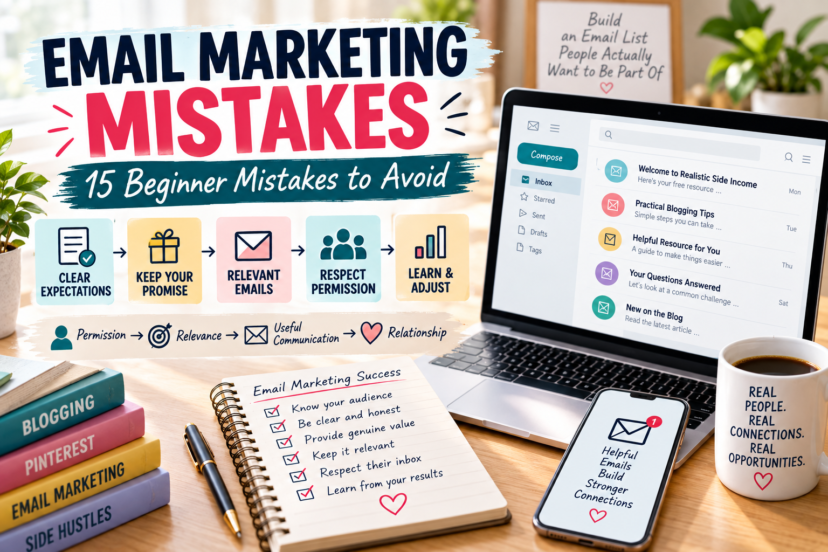
Email Marketing Mistakes: 15 Beginner Mistakes to Avoid
Introduction
Email marketing can give your side hustle something that website traffic alone cannot provide: a way to continue communicating with people who have chosen to hear from you.
But having an email list does not automatically create an audience.
A lead magnet does not automatically create trust.
Automation does not automatically create a relationship.
And sending more emails does not automatically create better results.
Many email marketing problems begin when we focus too heavily on tactics—frequency, subject lines, automation, open rates, templates—and lose sight of the person receiving the message.
A stronger approach starts with a simpler principle:
Permission → Relevance → Useful Communication → Relationship → Appropriate Opportunity
With that in mind, let’s look at 15 common email marketing mistakes beginners make and what you can do differently.
Mistake #1: Waiting for a “Perfect” Time to Start
Beginners sometimes assume they need a large audience before an email list becomes worthwhile.
There is no universal traffic threshold.
At the same time, this does not mean you need to build an elaborate email funnel before your website contains anything useful.
Email works best as part of a larger system.
You need something worth discovering, a relevant reason to subscribe, and a sensible idea of what will happen after someone joins.
A simple beginning might look like this:
Useful Content → Relevant Signup → Welcome → Continued Communication
That system can begin while your audience is still small and develop alongside your website.
The important question is therefore not:
Do I have enough traffic yet?
It is:
Do I have something useful to offer and a reason to continue communicating with the people who subscribe?
If you are still deciding what role email should play in your business, Why Every Side Hustle Needs an Email List explores that question in more detail.
Mistake #2: Giving People No Clear Reason to Subscribe
A form that says:
Subscribe to my newsletter
explains the action, but not necessarily the benefit.
A visitor may reasonably wonder what kind of emails will arrive, why they are relevant, and what subscribing adds to the information already available on your website.
A lead magnet can provide one answer, but it is not the only possible answer.
You might offer a worksheet, checklist, short email course, useful updates, practical lessons, or another resource connected to the visitor’s interests.
What matters is the relevance of the offer.
Someone reading about blog planning may appreciate a content-planning worksheet. A visitor learning about Pinterest Analytics is likely in a different situation.
The resource should continue the conversation rather than interrupt it with an unrelated freebie.
Lead Magnet Ideas for Beginners explains how to start with the reader’s current need before choosing a format.
Do not create a free resource simply because you need a lead magnet. Create it because it helps with a problem your audience already has.
Mistake #3: Making the Signup Unclear
Sometimes the problem is not the resource itself.
It is the way the signup is presented.
Visitors should be able to understand what they will receive and that they are joining an email relationship—not merely clicking a disguised download button.
That means the headline, description, form fields, button, and surrounding information should work together.
Clarity also continues after someone clicks.
The form should submit correctly, any necessary confirmation process should make sense, and the promised resource should arrive as expected.
Think beyond the form:
Offer → Signup → Confirmation → Delivery → Welcome
Each stage contributes to the subscriber experience.
Our guide to How to Increase Opt-In Rates explores this complete path rather than treating conversion optimization as a collection of button and headline tricks.
Mistake #4: Failing to Deliver What You Promised
Someone joins your list to receive something specific.
Then the link does not work.
The email goes missing.
The download is difficult to find.
Or the resource turns out to be very different from what the signup form promised.
That is a poor beginning to any email relationship.
Your first responsibility after a signup is remarkably simple:
Deliver what you said you would deliver.
Test the process yourself, including on mobile. Follow the same links a subscriber will use and make sure the resource is accessible.
This sounds basic, but it is more important than creating an elaborate onboarding campaign.
A good subscriber experience begins with keeping the first promise.
Mistake #5: Treating the Welcome Sequence as a Fixed Formula
Welcome sequences can be useful because a new subscriber may need orientation.
But that does not mean everyone needs exactly five emails delivered on Days 0, 2, 5, 8, and 12.
The appropriate sequence depends on why someone subscribed and what they need next.
A simple journey might be:
Signup Promise → Delivery → Related Help → Broader Context → Relevant Next Step
Sometimes three messages may be enough.
Another signup path might benefit from more explanation.
In other cases, a welcome email followed by regular communication may be perfectly appropriate.
The purpose is onboarding—not filling predetermined automation slots.
The Perfect Welcome Email Sequence shows how to build that journey around subscriber needs rather than an arbitrary number of emails.
Mistake #6: Treating Every Email as a Sales Opportunity
Email can support monetization.
That does not mean every message needs to push toward a purchase.
Subscribers may also value explanations, useful articles, practical lessons, resources, observations, answers to common questions, or recommendations that genuinely fit the subject.
Promotional messages are not inherently bad, either.
The problem arises when the relationship becomes disconnected from the expectations and interests that caused someone to subscribe.
A useful RSI principle is:
Help first. Recommend second.
That does not require an artificial formula such as sending four educational emails for every promotional one.
It means earning relevance before asking for attention, clicks, or purchases.
Mistake #7: Treating Frequency as the Strategy
It is easy to replace an email strategy with a calendar.
Send every Tuesday.
Never miss a week.
Consistency builds trust.
But frequency alone does not determine whether an email is worth receiving.
A weekly message can be useful.
So can an email every other week, a monthly newsletter, or a more concentrated sequence created for a particular purpose.
Start with what subscribers were led to expect, the type of communication you are providing, and what you can realistically sustain.
Then learn from the response.
Set Expectations → Choose a Starting Rhythm → Send → Observe → Learn → Adjust
Our guide to How Often Should You Email Subscribers? explores this without prescribing a universal weekly schedule.
A schedule can support your email strategy. It should not become the strategy.
Mistake #8: Making Yourself the Subject of Every Email
Personal stories can make email communication more human.
But relevance still matters.
A story about something you learned while building a website can be useful when it helps the reader understand a mistake, decision, or principle.
A long personal update with no connection to why the subscriber joined may be less useful.
The answer is not to remove yourself from your emails.
Instead, connect experience to purpose.
You might share what happened, what changed your thinking, and why that lesson could matter to someone facing a similar situation.
Your experience provides context.
The reader’s needs provide direction.
Mistake #9: Copying Someone Else’s “Authentic” Voice
Advice about email writing often says:
Write like you talk.
That can be useful, but it is incomplete.
Spoken conversation and written email are different formats. Natural email writing still benefits from structure, clarity, editing, and consideration for the reader.
The bigger mistake is copying another marketer’s version of authenticity.
You do not need their jokes, dramatic storytelling, short sentence fragments, controversial opinions, or favorite subject-line formulas.
Borrow principles when they make sense.
Develop the voice through your own writing.
Over time, your emails should sound recognizably like you communicating clearly, not like you performing someone else’s email persona.
Mistake #10: Treating Subject Lines Like Tricks
Subject lines matter because they help subscribers decide what deserves their attention.
That does not mean they need to manufacture curiosity.
A subject line should provide enough context to make the message understandable while accurately representing what is inside.
Avoid the temptation to promise something dramatic simply to generate an open.
The relationship between subject line and email matters more than the cleverness of either one.
For example, if the subject promises:
A simpler way to plan your blog content
the email should actually deliver something useful about blog-content planning.
Curiosity can be appropriate.
So can specificity.
But neither should come at the expense of accuracy.
The subject line earns attention best when the email earns the promise behind it.
Mistake #11: Assuming Emails Need a Certain Length
There is no ideal email length.
A short email can be useful.
A long email can also be useful.
The right length depends on what you are trying to communicate.
A quick link to a new resource may require only a few paragraphs. Explaining a complicated lesson or telling a relevant story may require more space.
Instead of asking:
Is this email too long?
ask:
Is every part helping the reader understand or use the message?
Remove repetition and unnecessary detours.
Keep useful explanation.
Length should follow purpose—not an arbitrary word count.
Mistake #12: Forcing Every Email Toward One CTA
Calls to action can help readers understand what they can do next.
But not every email needs to end with a promotional button.
A next step could be reading an article, replying to a question, downloading a resource, considering an idea, or exploring a relevant recommendation.
Sometimes the message itself is the value and no major action is necessary.
Likewise, the popular rule that every email must contain exactly one CTA is too rigid.
What matters is that competing actions do not make the message confusing.
Ask:
What would be a useful next step after this email?
Then make that step easy to understand.
Mistake #13: Ignoring Permission, Unsubscribe, and Deliverability
This part of email marketing is less exciting than designing lead magnets or writing subject lines.
It is also essential.
Subscribers should understand what they are agreeing to receive, and they need an appropriate way to stop receiving it.
Current Gmail sender guidance emphasizes active opt-in and easy unsubscribe mechanisms. Gmail also has authentication and additional unsubscribe requirements for certain senders, particularly higher-volume senders. Google Help
Technical foundations matter as well. Authentication technologies such as SPF, DKIM, and—in applicable circumstances—DMARC help mailbox providers verify messages and are part of Gmail’s current sender requirements. Google Help
Legal requirements vary by jurisdiction, so this article should not be treated as legal advice.
The broader principle is simpler:
Permission is not an obstacle between you and your subscriber. It is the foundation of the relationship.
Making it difficult for someone to unsubscribe does not preserve a valuable subscriber.
It preserves an unwanted email.
Mistake #14: Reading Too Much Into Email Metrics
Email platforms provide useful numbers.
But numbers need interpretation.
Open rates are a good example. Privacy features can interfere with traditional open tracking; Apple’s Mail Privacy Protection, for instance, is specifically designed to prevent senders from determining whether a protected user opened a message. Apple Support
Clicks tell you that a link was clicked, but not automatically why.
An unsubscribe tells you someone left the list, but that does not necessarily mean the email was poor.
Replies can provide valuable qualitative information that a dashboard cannot.
Instead of treating metrics as grades, use them to generate better questions:
What happened?
Is there a pattern?
What might explain it?
What should I investigate or test next?
A useful loop is:
Send → Observe → Question → Learn → Adjust
Analytics should support judgment, not replace it.
Mistake #15: Forgetting There Is a Person Behind the Address
Email marketing makes it easy to think in numbers. We measure list size, signup rates, clicks, unsubscribes, and other indicators because they help us understand what is happening.
But those numbers are only useful when we remember what they represent.
Every subscriber is a person who arrived with their own reason for joining your list. One may be trying to start a blog. Another might be exploring Pinterest for the first time, comparing side-income ideas, or looking for a practical solution to a specific problem.
Their relationship with your emails will not necessarily develop in the same way.
Some subscribers may read regularly without ever buying anything. Others might become interested in a resource you recommend later. Someone else may decide after a few weeks that the topic is no longer relevant and unsubscribe.
That is a normal part of email communication.
The goal is not to make every subscriber stay indefinitely or turn every email address into revenue. It is to communicate in a way that remains relevant to the reason people chose to hear from you in the first place.
Keeping that perspective can also make everyday email decisions easier. Before sending a promotion, collecting additional information, writing an unusually provocative subject line, or adding another message to an automation, consider whether the decision makes sense from the subscriber’s side of the relationship.
What did they expect when they signed up? Does this message fit that expectation? Is there a useful reason for it to reach their inbox?
Metrics can tell you what people did afterward. They cannot replace those questions.
An email list may be measured in addresses, clicks, and percentages. The relationship behind it is still between people.
A Better Beginner Email Marketing Framework
Avoiding the mistakes above does not require an elaborate email system. A much better starting point is to understand the purpose of each stage and make sure the transition from one to the next makes sense for the subscriber.
The process begins before the first email is sent. Useful website content attracts people with a particular interest or problem. A relevant signup opportunity then gives some of those visitors a reason to continue the connection. From there, your responsibility is to set appropriate expectations, deliver what you promised, and continue communicating in ways that remain relevant to the reason they subscribed.
A simple framework looks like this:
Useful Content → Relevant Signup → Clear Expectations → Deliver the Promise → Continue Helping → Observe → Learn → Improve
This framework deliberately leaves room for different approaches.
One audience may respond well to frequent communication, while another may prefer a slower rhythm. A simple signup might require only a short introduction before regular emails begin, whereas another could benefit from a more developed welcome sequence. Some messages can make their point in a few paragraphs; others need more explanation. Educational content and relevant recommendations can also appear in different proportions depending on the purpose of the list.
Those choices become easier when they are based on context rather than universal formulas.
The same applies to measurement. Instead of trying to reach a supposedly ideal open rate or copying someone else’s email schedule, use your own results to understand how subscribers are responding and where the experience might be improved.
In other words, the framework provides structure without turning that structure into a rigid formula.
Build the system around the relationship you want to create—not around rules that were created for someone else’s email list.
Final Thoughts
Most email marketing mistakes are not caused by choosing the wrong button color or missing a secret subject-line formula.
They happen when the system becomes disconnected from the subscriber.
A lead magnet stops matching the content.
The signup promise becomes unclear.
Automation replaces judgment.
A schedule becomes more important than relevance.
Metrics become targets rather than information.
Promotions appear without enough context.
The better alternative is not perfection.
It is a learning process:
Permission → Communicate → Observe → Learn → Adjust
Build from there.
Keep the promises you make at signup, create emails with a clear reason to exist, make recommendations when they genuinely fit, and pay attention to what your audience teaches you.
Email marketing does not become effective simply because you send more messages.
It becomes more useful when the right message has a reason to reach the right person.
Continue through the Email Marketing Hub for the complete Realistic Side Income guides to lead magnets, opt-ins, welcome emails, ongoing communication, and email strategy.
FAQ
1. What is the biggest email marketing mistake beginners make?
There is no single mistake that applies to every beginner. Common problems include unclear signup expectations, irrelevant offers, failing to deliver what was promised, treating frequency as the strategy, and focusing on metrics without understanding what they represent.
2. Should every email promote something?
No. A recommendation or promotion should make sense in the context of the email and the subscriber relationship. Useful communication can include education, resources, stories, updates, questions, recommendations, and other relevant content.
3. How often should beginners email subscribers?
There is no universal frequency. Choose a starting rhythm based on what subscribers were led to expect, the type of communication you provide, and what you can realistically sustain. Then learn from audience response.
4. Do I need a welcome email sequence?
Not necessarily a long or fixed sequence. New subscribers should receive what they were promised and understand what happens next. Depending on the signup context, that might involve one welcome email, several onboarding messages, or a longer sequence.
5. Which email metrics should beginners monitor?
The useful metrics depend on your objective. Delivery information, clicks, replies, unsubscribes, spam complaints, and relevant website or business actions can all provide information. Open-rate data should be interpreted cautiously because privacy technologies can affect open tracking.