
How Affiliate Commissions Really Work: A Beginner’s Guide
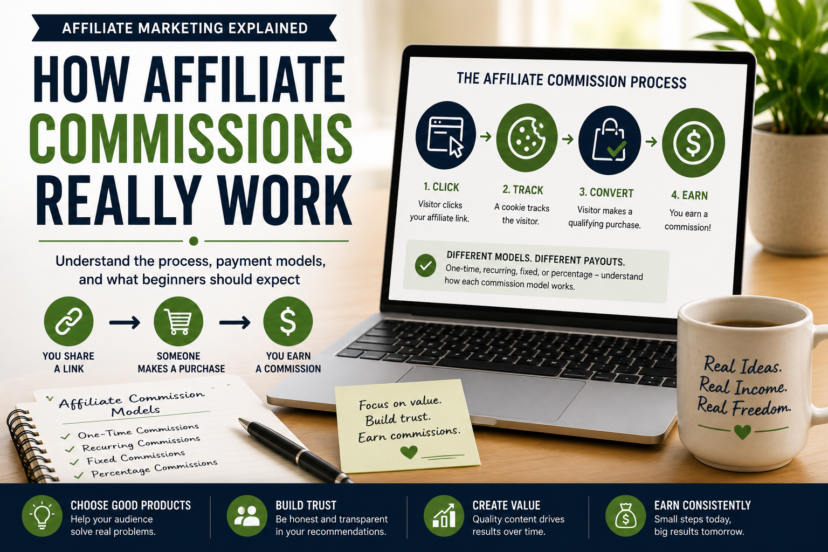
Affiliate marketing sounds simple:
Recommend a product → someone buys it → you earn a commission.
And at its core, that is exactly what happens.
But once you join your first affiliate program, you will probably encounter terms such as:
- tracking links
- cookies
- attribution
- conversion rates
- pending commissions
- recurring commissions
- payout thresholds
- EPC
Suddenly, the simple process can seem much more complicated.
Fortunately, you do not need to understand every technical detail to get started.
What you do need to understand is how a visitor becomes an attributed customer, how your commission is calculated, and when that money actually becomes yours.
Let’s walk through the process step by step.
What Is an Affiliate Commission?
An affiliate commission is compensation you receive for generating a qualifying action through your affiliate relationship.
Most commonly, that action is a purchase.
For example, imagine you recommend an email marketing platform in one of your tutorials.
A reader clicks your unique affiliate link, signs up for the service, and completes whatever action the affiliate program defines as a valid conversion.
The company may then credit a commission to your affiliate account.
You did not create the product.
You did not process the payment.
You did not provide the software.
Instead, you helped connect a potential customer with a product or service.
That is the basic affiliate marketing relationship.
If you are completely new to the business model, start with What Is Affiliate Marketing and How Does It Work? before diving deeper into commissions.
How Does Affiliate Tracking Work?
Every affiliate needs a way for the company to know:
“This customer came from that affiliate.”
That is the purpose of affiliate tracking.
When you join a program, you typically receive a unique affiliate ID that is associated with your account.
Your affiliate links contain tracking information connected to that ID.
A simplified process looks like this:
Your Content → Affiliate Link → Merchant Website → Conversion → Tracking → Commission
Let’s look at each stage.
Step 1: You Publish an Affiliate Link
Suppose you write a tutorial that mentions a useful software tool.
Instead of linking to the company’s normal homepage, you use your unique affiliate link.
That link identifies you as the referring affiliate.
Step 2: The Reader Clicks
When someone clicks your link, the affiliate system records information about the referral.
Depending on the program and technology being used, tracking may involve cookies and other attribution methods.
Step 3: The Reader Takes a Qualifying Action
The visitor might:
- purchase a product
- start a paid subscription
- register for a service
- complete another qualifying action
The exact requirement depends on the affiliate program.
Step 4: The Conversion Is Attributed
If the program determines that your referral qualifies under its attribution rules, the conversion is connected to your affiliate account.
Step 5: A Commission Appears
You may then see the commission in your affiliate dashboard.
But there is an important detail:
Seeing a commission in your dashboard does not necessarily mean you can withdraw the money immediately.
We will come back to that shortly.
What Is an Affiliate Cookie?
You will often hear affiliate marketers talk about cookie duration or the cookie window.
A cookie can help an affiliate program remember that a visitor originally arrived through your affiliate link.
Imagine someone clicks your link today but does not buy immediately.
They think about the product for several days and then return to make a purchase.
Whether you receive a commission can depend partly on the affiliate program’s tracking and attribution rules.
For example, one program might have a relatively short referral window while another might use a longer period.
The important lesson is:
Do not assume every affiliate program tracks referrals in the same way or for the same amount of time.
Check the terms of each program you join.
What Is Affiliate Attribution?
Attribution answers a deceptively simple question:
Who gets credit for the sale?
Imagine this scenario:
A reader clicks your affiliate link.
Two days later, the same person clicks another affiliate’s link.
Then the customer purchases the product.
Who receives the commission?
The answer depends on the program’s attribution model and rules.
This is one reason a click on your affiliate link does not automatically guarantee that you will eventually receive a commission.
Other factors can affect attribution too.
The practical lesson for beginners is not to become obsessed with tracking technology.
Instead:
Read the terms of the affiliate program so you understand how referrals are credited.
Different Types of Affiliate Commissions
Not every affiliate program pays affiliates in the same way.
Understanding the main models makes it easier to compare programs.
Percentage-Based Commissions
One common model pays a percentage of the qualifying sale.
For example, imagine a product costs $100 and the program offers a 20% commission.
Your commission would be:
$100 × 20% = $20
If the customer buys a more expensive qualifying product, your commission may increase accordingly.
Percentage-based commissions are common across many types of affiliate programs.
Fixed Commissions
Other programs pay a fixed amount for a qualifying referral.
For example:
$30 per qualified sale
If one customer spends $100 and another spends $150, you may still receive the same $30 commission for each qualifying transaction if that is how the program is structured.
Recurring Commissions
Recurring commissions are particularly interesting for subscription-based products.
Suppose you recommend a software service with a monthly subscription.
If the affiliate program offers recurring commissions, you may continue receiving compensation while the referred customer remains eligible under the program’s terms.
For example:
Month 1 → commission
Month 2 → commission
Month 3 → commission
and so on, subject to the program’s rules.
This can make recurring affiliate programs attractive for long-term content businesses.
But there is an important caveat.
Recurring does not mean guaranteed forever.
Customers can cancel.
Programs can have specific eligibility conditions.
Commission structures can also change.
So evaluate the product itself first rather than choosing it simply because the word “recurring” sounds attractive.
What About Leads and Sign-Ups?
Not every affiliate program requires a traditional product sale.
Some programs compensate affiliates for other qualifying actions.
Depending on the program, this could include:
- a qualified lead
- an account registration
- a free trial
- another defined conversion event
This is why you should always understand what the program actually considers a conversion.
A click alone does not necessarily mean you have earned money.
Pending, Approved and Rejected Commissions
This is one of the most useful things for a beginner to understand.
Imagine your affiliate dashboard shows:
Commission: $50
It can be tempting to think:
“Great. I just earned $50.”
Maybe.
But that commission may initially be pending.
Pending
The program has recorded the conversion but has not finalized it yet.
Approved
The transaction has passed the program’s validation process and the commission has been accepted.
Rejected or Reversed
The commission was not approved or was later reversed.
Why might that happen?
Possible reasons include:
- the customer cancelled
- the product was returned
- a payment failed
- the transaction did not meet program requirements
- the referral was invalid under the program’s terms
Exact terminology and procedures vary between affiliate programs.
That is why your pending balance and your payable balance may be very different numbers.
When Do Affiliate Programs Pay You?
Affiliate commissions are rarely deposited into your bank account immediately after a sale.
Programs typically need time to validate transactions.
They may also have a payout schedule and minimum payment threshold.
For example, a program might process payments according to its regular monthly cycle once eligible commissions meet its payout requirements.
Payment methods also vary.
Depending on the program or affiliate network, available options might include bank transfer, PayPal, or other payment services.
Before joining a program, check:
- payout schedule
- minimum payout threshold
- available payment methods
- supported countries or currencies
- validation or holding periods
- any fees that may apply
This is not the exciting part of affiliate marketing—but it matters when you actually want to receive your earnings.
A Simple Affiliate Commission Example
Let’s put everything together.
Imagine you publish an article comparing email marketing platforms.
One platform has an affiliate program.
A reader finds your article through Google or Pinterest.
The journey might look like this:
1. Reader visits your article
↓
2. Reader learns about different options
↓
3. Reader clicks your affiliate link
↓
4. Affiliate system records the referral
↓
5. Reader signs up or purchases
↓
6. Program attributes the conversion to you
↓
7. Commission appears as pending
↓
8. Transaction is validated
↓
9. Commission becomes approved/payable
↓
10. You receive payment according to the program’s payout schedule
That is affiliate marketing from click to commission.
What Determines How Much You Earn?
Knowing the commission rate is useful.
But it tells you very little about how much money you will actually make.
Your affiliate income depends on several variables.
A simplified formula is:
Traffic × Click-Through Rate × Conversion Rate × Average Commission = Potential Affiliate Revenue
Imagine you receive 1,000 visitors.
100 click an affiliate link.
Five of those visitors convert.
Your average approved commission is $20.
That would be:
5 × $20 = $100
Now imagine another affiliate receives only 500 visitors but has much more targeted content.
100 visitors click.
Ten convert.
Average commission is $20.
That affiliate earns:
10 × $20 = $200
Half the traffic.
Twice the revenue.
This is why How Much Traffic Do You Need Before Monetizing? emphasizes targeted traffic rather than chasing a magical visitor number.
What Is Conversion Rate?
Your conversion rate tells you what percentage of relevant visitors complete the desired action.
In affiliate marketing, you might examine different conversion points.
For example:
Content → Affiliate Click
and then:
Affiliate Click → Purchase
These are not the same thing.
If many readers visit your article but almost nobody clicks your affiliate link, the problem may involve:
- poor product relevance
- weak placement
- unclear recommendations
- mismatched search intent
If many readers click but few purchase, other factors may be involved, including the merchant’s offer, pricing, landing page, audience fit, or attribution rules.
Understanding this difference helps you optimize intelligently instead of simply adding more affiliate links.
What Is EPC in Affiliate Marketing?
As you explore affiliate networks, you may encounter the abbreviation EPC.
It generally stands for earnings per click, although exactly how a platform calculates and reports the metric can vary.
EPC can help you evaluate the relationship between clicks and affiliate earnings.
But beginners should be careful not to treat an advertised or network-wide EPC figure as a prediction of their own income.
Your results depend on your:
- audience
- traffic source
- content
- product positioning
- reader intent
- conversion performance
Use metrics as information—not promises.
High Commission Does Not Mean Best Affiliate Program
Suppose Program A offers a 50% commission.
Program B offers 20%.
Program A must be better, right?
Not necessarily.
What if your readers do not need Product A?
What if Product B solves exactly the problem they came to your website to solve?
A lower commission on a highly relevant product can be far more valuable than a huge commission on something nobody wants.
Other factors matter too:
- product quality
- company reputation
- conversion potential
- refund rates
- recurring vs one-time payments
- cookie or attribution rules
- payout conditions
- customer support
That is why The Best Affiliate Programs for Beginners focuses on audience fit rather than simply ranking programs by commission percentage.
And if you have not selected your partnerships yet, How to Find Affiliate Programs for Your Website explains what to look for.
Your Content Still Does Most of the Work
The affiliate system may track clicks and calculate commissions automatically.
But it cannot create trust for you.
That is your job.
A reader is more likely to consider a recommendation when your content explains:
- the problem
- possible solutions
- why the product may help
- who it is suitable for
- its important advantages
- its limitations
That is why affiliate marketing is ultimately a content and trust business.
Our guide to How to Write Affiliate Content That Converts goes much deeper into creating recommendations that help rather than pressure readers.
You Must Disclose Your Affiliate Relationship
Affiliate commissions also create a responsibility.
If you may receive compensation because someone follows your recommendation, that commercial relationship should be transparent.
Do not hide it.
A clear disclosure helps readers understand why the affiliate relationship exists and supports the trust you are trying to build.
Our guide to Affiliate Disclosure and Legal Requirements explains this topic in detail.
When Should You Start Adding Affiliate Links?
You do not need to wait until your website reaches an arbitrary traffic number.
If a relevant product genuinely improves an article, an affiliate recommendation may make sense even when your website is still small.
However, affiliate links do not create traffic.
Without readers, there is nobody to click them.
That is why your early priorities should still include:
Helpful Content → Targeted Traffic → Trust → Relevant Recommendations
You can learn more about this distinction in When Should You Add Affiliate Links?.
What Can Beginners Realistically Expect?
Your first affiliate commission might be exciting.
It should be.
It proves that someone:
- found your content
- trusted it enough to click
- considered your recommendation
- completed a qualifying action
But one commission is not yet a predictable income stream.
Affiliate marketing becomes more interesting when the process can happen repeatedly.
That usually requires building assets over time:
- useful articles
- search visibility
- Pinterest traffic
- an email list
- trustworthy recommendations
- relevant affiliate partnerships
Some months may perform better than others.
Some articles may generate clicks but no sales.
Other articles may surprise you.
That is normal.
The goal is not to get rich from one affiliate link.
The goal is to build a system that can continue helping readers and producing opportunities long after the original article was published.
Don’t Confuse Affiliate Revenue With Profit
There is one more distinction worth understanding.
Affiliate commissions are revenue.
They are not necessarily profit.
If your website has expenses for things such as:
- hosting
- email marketing software
- premium tools
- advertising
- design services
- other business costs
those expenses still exist.
This becomes more important as your website grows.
A business earning $500 in monthly affiliate commissions while spending $400 to generate them is in a very different position from a business earning $500 while spending $50.
So eventually, track both:
Revenue and expenses.
That gives you a much more realistic picture of whether your side income is actually profitable.
Focus on the Reader, Not the Dashboard
Affiliate dashboards can become addictive.
Clicks.
Conversions.
Pending commissions.
Approved commissions.
EPC.
It is tempting to check them constantly.
But your dashboard is the result of your work—not the work itself.
The activities that create long-term results happen elsewhere:
Publishing useful content.
Improving old articles.
Building traffic.
Understanding your audience.
Growing your email list.
Recommending better products.
Helping readers solve problems.
If those things improve, the numbers in your affiliate dashboard have a much better chance of improving too.
Conclusion
Affiliate commissions are not mysterious once you understand the process.
A reader discovers your content.
They click a tracked affiliate link.
The affiliate program records the referral.
The reader completes a qualifying action.
The program attributes and validates the conversion.
Your commission is approved.
And eventually, you receive payment according to the program’s terms.
But the technology is only the mechanism.
The real foundation remains:
Helpful Content → Targeted Traffic → Trust → Relevant Recommendations → Commissions
Do not choose products simply because they offer the highest percentage.
Do not assume every click will become a commission.
And do not treat pending commissions as guaranteed income.
Instead, build a useful website, recommend products that genuinely fit your audience, disclose your affiliate relationships clearly, and give the process time to grow.
That is how affiliate commissions become part of a realistic long-term side income rather than another promise of quick money.
FAQs
1. How do affiliate commissions work?
Affiliate commissions are payments you may receive for generating qualifying actions through tracked affiliate referrals. When someone follows your affiliate link and completes an eligible action, the affiliate system can attribute the conversion to your account according to the program’s tracking and attribution rules.
2. How long do affiliate cookies last?
There is no universal cookie duration. Affiliate programs use different tracking and attribution rules, so referral windows can vary considerably. Always check the terms of the individual program rather than assuming a standard duration.
3. Why is my affiliate commission still pending?
Programs often keep commissions pending while transactions are validated. Refund periods, cancellations, failed payments, and other eligibility checks can delay approval. A pending commission therefore should not automatically be treated as guaranteed income.
4. Are recurring affiliate commissions better than one-time commissions?
Not necessarily. Recurring commissions can be attractive because an eligible customer may generate multiple payments, but product relevance, conversion potential, customer retention, commission terms, and product quality all matter. A good one-time program can be more valuable than a poorly matched recurring program.
5. How much can a beginner earn from affiliate commissions?
There is no reliable standard amount. Earnings depend on targeted traffic, click-through rates, conversion rates, commission structures, product relevance, audience trust, and other factors. Beginners should focus first on building useful content and traffic rather than expecting a particular income figure.