Selling Digital Products as a Side Hustle: A Realistic Guide for Busy Employees
There is one fundamental problem with many side hustles:
You stop working, and the income stops too.
Freelancing is a good example. You complete a project and get paid. Virtual assistant work is similar. You provide five hours of support and receive payment for those five hours.
There is absolutely nothing wrong with this. In fact, service-based side hustles can be among the fastest ways to earn your first money online.
But what if you want to build something that is less directly tied to every hour you work?
That is where selling digital products as a side hustle becomes interesting.
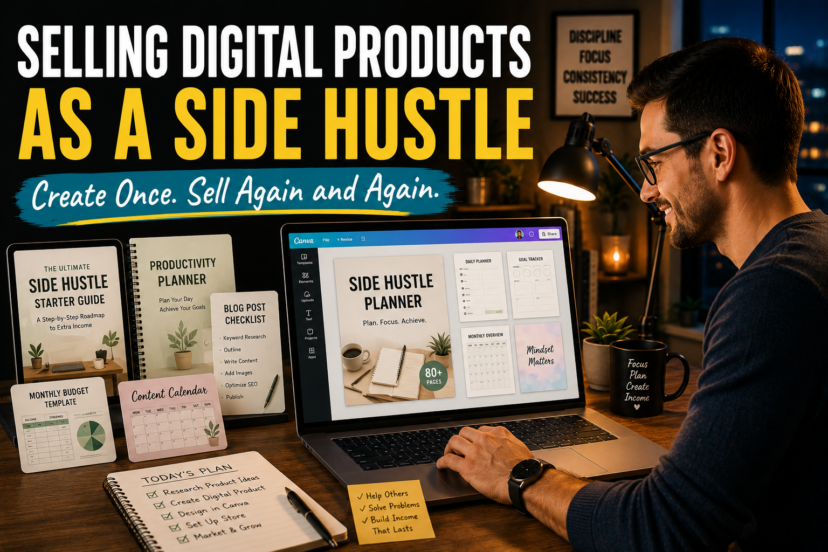
With a digital product, you create something once and can potentially sell the same product again and again.
A planner you create this month could still sell next year. A spreadsheet you build over a weekend could potentially be purchased by dozens or hundreds of people. A short guide could help customers without requiring you to personally deliver the information every time.
For someone with a full-time job, that difference matters.
Your available time is limited. Instead of only asking, “How can I earn more per hour?”, digital products allow you to ask a different question:
“What useful asset can I create with the limited time I have?”
That makes digital products an interesting addition to the other Best Side Hustles for Busy Employees, especially if your goal is to build something gradually rather than take on another traditional job.
What Exactly Is a Digital Product?
A digital product is something customers can purchase and receive electronically.
There is no physical inventory sitting in your home.
You don’t have to package a box.
You don’t have to visit the post office.
And in many cases, delivery can happen automatically after payment.
Digital products can include:
- ebooks and practical guides
- checklists
- worksheets
- spreadsheets
- printable planners
- digital planners
- Canva templates
- Notion templates
- content calendars
- email templates
- business resources
- mini-courses
- full online courses
But don’t let that list make the business model sound more complicated than it needs to be.
Your first digital product could be a five-page checklist.
It doesn’t have to be a 200-page ebook or a twelve-hour video course.
In fact, a small product that solves one specific problem well can be a much better starting point.
Why Digital Products Work So Well as an After-Work Side Hustle
The biggest advantage isn’t that digital products are “passive.”
That word is often overused.
You still need to:
- research an idea
- create the product
- design it
- write a sales page
- attract potential customers
- answer occasional questions
- improve the product
- market it
So this isn’t income without work.
The real advantage is leverage.
Suppose you spend six hours creating a useful spreadsheet.
If you sell the spreadsheet once, those six hours produced one sale.
But if you sell exactly the same spreadsheet 50 times, you don’t need to recreate it 50 times.
That’s fundamentally different from selling a service.
For an employee who may have only five or six hours per week available for a side hustle, that can become very attractive.
You’re using some of today’s time to create an asset that can potentially produce results tomorrow.
Digital Products vs. Freelancing: Which Is Better?
Neither is automatically better.
They solve different problems.
Freelancing can often produce income sooner because you don’t need a large audience first. You find someone who needs a service, complete the work, and get paid.
Digital products are usually slower.
Before someone can buy your product, they first have to discover it.
That means you need some combination of:
product + audience + traffic + trust.
This is why beginners sometimes become disappointed with digital products.
They create a beautiful planner, upload it somewhere and expect sales.
Then nothing happens.
The problem may not be the planner.
Nobody knows it exists.
If earning your first money relatively quickly is your main priority, Freelancing After Work may therefore be a better starting point.
But if you’re willing to build gradually, digital products offer something freelancing cannot provide as easily: the ability to sell the same piece of work repeatedly.
And the two models can even complement each other.
A freelancer may discover the same client problem again and again and eventually turn the solution into a template, checklist, guide, or course.
That’s often how good digital products are born.
Start With the Problem, Not the Product
This may be the most important lesson in this entire guide.
Beginners often start like this:
“I want to create an ebook. What could I write about?”
Try reversing the question:
“What problem does my audience repeatedly struggle with, and what is the simplest product that could help?”
That shift changes everything.
People don’t usually wake up thinking:
“I hope I can buy another PDF today.”
They think:
“I need to organize my finances.”
“I don’t know what to publish on Pinterest.”
“I need a better way to plan my week.”
“I don’t know how to start my side hustle.”
“Writing these emails takes me forever.”
The product is simply the format in which you deliver the solution.
A person struggling to organize their side hustle might need a planner.
Someone who doesn’t know what to publish might need a content calendar.
Someone who repeatedly creates the same business document might need a template.
Problems create demand. Formats don’t.
Where Can You Find Good Digital Product Ideas?
You don’t necessarily need sophisticated market research.
Start by paying attention.
Look at:
- questions readers ask
- comments on relevant content
- search queries
- popular blog articles
- emails from subscribers
- recurring problems in online communities
- tasks people repeatedly find difficult
- processes that take people too much time
Your own experience can also be useful.
Think about something you’ve learned to do more efficiently.
Perhaps you’ve developed a spreadsheet that makes budgeting easier.
Maybe you’ve created a weekly system for working on a side hustle after your day job.
Perhaps you have a checklist that makes publishing blog posts simpler.
The question is:
Would this make someone else’s life easier too?
If yes, you may have the beginning of a product idea.
Beginner-Friendly Digital Products You Can Actually Create
You don’t need advanced technical skills to start.
Let’s look at several realistic formats.
Checklists
Checklists are deceptively simple.
They work because people don’t always need more information. Sometimes they simply need to know what to do next.
Examples might include:
- Blog Post Publishing Checklist
- First Side Hustle Setup Checklist
- Pinterest Pin Checklist
- Monthly Website Maintenance Checklist
- Affiliate Marketing Starter Checklist
A checklist could take relatively little time to create while still saving the buyer significant time or uncertainty.
Templates
Templates help people avoid starting from a blank page.
That is valuable.
Examples include:
- email templates
- blog post templates
- Pinterest planning templates
- social media calendars
- client onboarding templates
- invoice templates
- business planning sheets
If your template saves someone an hour every week, the value isn’t the number of pages.
It’s the time and frustration saved.
Spreadsheets
Spreadsheets are particularly useful when people need to organize, calculate, track, or compare information.
Examples include:
- income trackers
- side hustle expense trackers
- content planners
- affiliate income dashboards
- budgeting spreadsheets
- project trackers
A simple spreadsheet can sometimes solve a problem better than a 50-page ebook.
Printables and Planners
Printables can work particularly well for audiences interested in organization and planning.
Examples include:
- weekly planners
- savings trackers
- goal worksheets
- habit trackers
- meal planners
- productivity planners
But this is also a competitive area.
A generic “weekly planner” has little differentiation.
A “5-Hour-a-Week Side Hustle Planner for Full-Time Employees” is much more specific.
Specificity helps potential customers immediately understand who the product is for.
Ebooks and Guides
An ebook doesn’t need to be a traditional book.
A concise 25-page guide that solves one problem may be more useful than 150 pages of general information.
A good beginner guide might answer:
- Where do I start?
- What do I need?
- What should I avoid?
- What should I do first?
- What comes next?
Think practical rather than impressive.
Digital Planners
Digital planners can be designed for people who prefer using tablets, laptops, or digital note-taking systems.
Again, niche positioning matters.
Instead of creating another generic productivity planner, you could create something designed for:
- bloggers
- freelancers
- students
- remote workers
- busy employees
- small business owners
The clearer the user, the easier it becomes to design the right product.
Online Courses
Courses are attractive because they can command higher prices.
But they are rarely the product I would recommend creating first.
Why?
Because they’re much more work.
You may need:
- lessons
- scripts
- videos
- worksheets
- hosting
- technical setup
- customer support
And after all that work, you could discover that the audience wasn’t particularly interested in the topic.
A smaller product allows you to test demand with much less risk.
If a €15 guide sells and customers keep asking for more help, then a larger course may make sense.
You Don’t Need to Be an Expert
This is another common obstacle.
People think:
“Who am I to create a product about this?”
You don’t need to be the world’s leading expert.
But you should understand what you’re teaching or providing well enough to create something genuinely useful and accurate.
There is a big difference between:
pretending to be an expert
and
helping someone with a problem you’ve learned how to solve.
Suppose you’ve spent a year learning how to organize a blog around a full-time job.
Someone starting today may benefit enormously from the systems you’ve developed.
You don’t need to know everything.
You need to provide honest, useful value within the scope of what you’re offering.
How to Validate an Idea Before Spending Weeks Creating It
One of the biggest digital product mistakes is disappearing for two months to create something nobody asked for.
Before you invest significant time, look for evidence of interest.
If you already have a blog, check which articles receive traffic.
If you have an email list, look at what subscribers click.
If readers repeatedly engage with one topic, that is useful information.
For example, imagine your audience responds particularly well to content about organizing a side hustle around a full-time job.
A planner or weekly action system might be worth testing.
You can even mention the idea to your audience before creating it.
Ask:
“Would a step-by-step weekly planner for building a side hustle in five hours per week be useful?”
You don’t need hundreds of responses.
You’re looking for signals.
And this is one reason building an audience before creating products can be so powerful.
Your Email List Can Tell You What to Create
An email list isn’t only a marketing channel.
It’s a research tool.
Subscribers can tell you what they:
- struggle with
- click on
- reply to
- want to learn
- ignore
Those signals help you create better products.
This is exactly why I recommend building the relationship before becoming obsessed with monetization.
As explained in When to Start Monetizing Your Email List, you don’t need an enormous list before making an offer. You need enough understanding and trust to make the offer relevant.
A smaller engaged audience can provide much better product insights than thousands of anonymous visitors.
How to Create Your First Digital Product Step by Step
Let’s keep the process manageable.
Step 1: Choose One Person
Don’t create something “for everyone.”
Who exactly are you helping?
For example:
Busy employees who want to start their first online side hustle.
Already much clearer.
Step 2: Choose One Problem
What is stopping them?
Perhaps:
“I don’t know what to work on each week.”
Now you have a specific problem.
Step 3: Choose the Simplest Useful Format
Do they need a course?
Probably not.
Maybe they need:
a 12-week side hustle action planner.
That’s simpler to create and easier to use.
Step 4: Create the Minimum Useful Version
Include what people need to achieve the result.
Leave out unnecessary material.
Your goal isn’t to create the largest product.
Your goal is to create a product someone actually finishes and uses.
Step 5: Make It Easy to Understand
Use:
- clear headings
- simple instructions
- examples
- white space
- logical steps
Professional doesn’t mean complicated.
Step 6: Test Everything
Before selling:
- open every file
- check every link
- test the download
- proofread the content
- check formatting on different devices where relevant
The buying experience is part of the product.
Step 7: Launch Small
You don’t need a huge launch campaign.
Offer the product to a small audience first.
Then observe.
What do buyers like?
What confuses them?
What questions do they ask?
Improve from there.
Tools for Creating Digital Products
You can create many products with tools you may already use.
Canva works well for planners, worksheets, checklists, ebooks, and visual templates.
Google Docs or Microsoft Word can be enough for guides, workbooks, and written resources.
Google Sheets or Microsoft Excel are excellent for trackers, calculators, dashboards, and planning systems.
PowerPoint can be useful for presentations and course materials.
Notion can be used for dashboards, planners, content systems, and productivity templates.
You don’t need all of them.
Choose the simplest tool that produces the product your customer needs.
Where Can You Sell Digital Products?
There are two broad options:
marketplaces and your own audience.
Platforms such as Etsy, Gumroad, Payhip, and similar services can simplify payments and digital delivery.
Marketplaces may also give you access to people already searching for products, although competition and platform fees need to be considered.
Your own website gives you more control over:
- branding
- customer relationships
- pricing
- content
- email collection
- the overall buying journey
But there is a catch.
Having your own website doesn’t automatically provide customers.
You still need traffic.
That’s why the surrounding system matters so much.
Creating the Product Is Only Half the Business
This is where many digital product beginners get stuck.
They spend 90% of their effort creating the product and 10% marketing it.
In reality, you may eventually spend just as much time — or more — attracting potential buyers.
Imagine creating the best side hustle planner in the world and putting it on a webpage nobody visits.
No traffic means no one knows it exists.
Your marketing system could include:
Google → Blog → Email List → Product
or:
Pinterest → Blog → Email List → Product
or even:
Pinterest → Product Page → Sale
This is why Blogging for Busy Employees and Pinterest Marketing for Busy Employees aren’t separate ideas from selling digital products.
They can become the traffic engine behind them.
How Content Can Sell a Digital Product Without Feeling Pushy
Suppose you create a Pinterest planning template.
You could publish useful articles such as:
- How to Plan Pinterest Content for a Month
- How Many Pins Should Beginners Create?
- Pinterest Marketing After Work
- How to Organize a Pinterest Workflow
Those articles genuinely help readers.
Within a relevant article, you can naturally mention:
“If you’d rather not build your own planning system from scratch, I’ve created a template you can use.”
That doesn’t feel like an unrelated advertisement.
It is the logical next step.
Good monetization feels connected to the problem the reader is already trying to solve.
Your Email List Makes Digital Products More Powerful
Blog and Pinterest traffic can bring people to your website.
But many visitors leave and never return.
An email list gives you another opportunity.
A visitor discovers an article.
They download a useful free resource.
They join your list.
Over time, they receive helpful emails.
They become familiar with your approach.
Later, when you introduce a relevant digital product, you’re no longer selling to a complete stranger.
You’re making an offer to someone who already knows what kind of help you provide.
That is a much stronger position.
It’s also why the principles in How to Build Trust Through Email matter well beyond email marketing itself.
Trust supports almost every form of monetization.
Free Lead Magnets Can Become Product Research
There is another useful connection between email marketing and digital products.
Your first “digital product” may actually be free.
A lead magnet is essentially a small digital product that you give away in exchange for an email subscription.
That makes it an excellent testing ground.
Suppose you create a free checklist and people love it.
That tells you something.
Maybe there is demand for:
Free checklist → Paid workbook → Complete planner
You don’t need to build all three immediately.
But the free resource can show you what your audience wants.
If you’re looking for ideas for that first free resource, Lead Magnet Ideas for Beginners is a natural place to start.
How Much Should You Charge?
There is no universal answer.
Price depends on factors such as:
- problem being solved
- target audience
- product depth
- time saved
- alternatives
- niche
- perceived value
Don’t price purely by page count.
A five-page template that saves a business owner five hours every month could be more valuable than a 100-page ebook they never finish.
For a first product, a lower-priced offer can sometimes make testing easier.
But don’t automatically assume cheap is better.
Your product should have a price that makes sense for the value it provides and the audience you’re serving.
What Can You Realistically Earn?
This is where expectations matter.
Digital products can be scalable.
That does not mean they automatically scale.
You might create your first product and sell:
zero copies.
That’s possible.
You might make a few sales.
You might eventually build several products that generate regular monthly revenue.
The result depends on:
- demand
- product quality
- pricing
- traffic
- trust
- positioning
- marketing
- consistency
Instead of focusing immediately on €5,000 per month, try thinking in stages.
First goal: Create something genuinely useful.
Second goal: Make the first sale.
Third goal: Understand why that person bought.
Fourth goal: Make ten sales.
Fifth goal: Improve the system.
Your first sale is valuable because it proves something important:
A real person was willing to pay for your solution.
From there, you have data rather than just an idea.
For a broader look at realistic side hustle earnings, see How Much Can You Really Earn with a Side Hustle?
Digital Products Aren’t Automatically Passive Income
It’s worth repeating this because the internet often presents digital products as effortless passive income.
They’re not.
Even after creation, you may need to:
- update products
- answer customers
- fix technical problems
- improve sales pages
- create new content
- send emails
- create Pinterest Pins
- analyze conversions
- handle refunds
- maintain your website
But digital products can create more scalable income because each additional sale doesn’t necessarily require another hour of production.
That’s the important distinction.
Don’t chase “passive.”
Build leverage.
Common Digital Product Mistakes
Creating Something Too Broad
“Ultimate Guide to Everything About Side Hustles” is difficult to position.
“12-Week Side Hustle Planner for Busy Employees” is much clearer.
Building Before Validating
Weeks of work don’t create demand.
Look for evidence that people want the solution first.
Starting With a Huge Course
Start smaller.
Learn from actual buyers before building something complex.
Making the Product About You
Customers don’t care how difficult the product was to create.
They care what it helps them accomplish.
Ignoring Marketing
A product hidden on an empty website isn’t a business.
Creating Too Many Products
One useful product with consistent traffic can be better than ten unfinished ideas.
Expecting Immediate Sales
Audience building takes time.
Constantly Discounting
If your product only sells when it’s heavily discounted, investigate the positioning and value rather than immediately reducing the price again.
Quitting After the First Attempt
Your first product is also an education.
Use what you learn.
Don’t Create Ten Products Before Selling One
This deserves its own section.
Creating products can feel productive.
And it is productive — up to a point.
But it can also become a way to avoid marketing.
You create:
- planner
- checklist
- ebook
- template
- workbook
…without knowing whether anyone wants the first one.
Instead:
Create → Launch → Measure → Learn → Improve.
Then decide whether you need another product.
Your audience should help shape your catalog.
A Realistic Digital Product Strategy for Busy Employees
If I were building this side hustle around a full-time job, I would keep the first phase extremely simple.
Phase 1: Build the Foundation
Choose one niche and create helpful content.
Phase 2: Attract an Audience
Use SEO, Pinterest, or another sustainable traffic source.
Phase 3: Build an Email List
Offer a useful lead magnet related to the audience’s main problem.
Phase 4: Listen
Watch which articles, emails, and topics generate interest.
Phase 5: Identify One Problem
Choose something specific that repeatedly appears.
Phase 6: Create One Small Product
Not a huge course.
Create the smallest solution that delivers a meaningful result.
Phase 7: Sell It to Your Existing Audience
Start with the people who already know you.
Phase 8: Learn From the Results
Clicks but no purchases?
Perhaps the product, price, or sales page needs work.
No clicks?
Perhaps the problem or positioning isn’t compelling.
Sales and positive feedback?
Now you have something worth improving.
Phase 9: Scale What Works
Create more relevant content.
Build more traffic.
Improve the product.
Add complementary offers later.
This approach may feel slower than creating a giant online store immediately.
But it is much more manageable for someone building a side business after work.
Digital Products and Affiliate Marketing Can Work Together
You don’t necessarily have to choose between selling your own products and affiliate marketing.
They can serve different purposes.
Your own digital product might solve one part of a problem.
An affiliate product might solve another.
For example, you could sell your own blogging planner while recommending the hosting or email software needed to implement the plan.
The important thing is that recommendations remain useful and relevant.
If affiliate marketing is also part of your strategy, Affiliate Marketing for Busy Employees explains why trust and traffic should come before aggressively chasing commissions.
The same principle applies to digital products.
Think in Terms of a Product Ladder — Later
Once you understand your audience, you may eventually build a simple progression.
For example:
Free: Side Hustle Starter Checklist
↓
Low-Cost: Weekly Side Hustle Planner
↓
Mid-Level: Complete Side Hustle Workbook
↓
Higher-Level: Course or personalized service
Each step solves a larger problem.
But don’t build the entire ladder before anyone has climbed the first step.
Start with one useful offer.
Let real customer behavior guide what comes next.
The Real Advantage of Digital Products
The most exciting part of digital products isn’t waking up to hundreds of effortless sales.
That image makes good social media content, but it’s not a useful business strategy.
The real advantage is quieter.
You spend an evening creating something useful.
You improve it next weekend.
You publish it.
Someone buys it.
Then another person buys the same product.
You don’t need to recreate it.
That is the beginning of leverage.
Combine that with a growing blog, Pinterest traffic, and an email audience, and you gradually create a system in which your previous work continues supporting your future work.
That’s very different from simply taking on more hours.
Conclusion
Selling digital products as a side hustle can be an excellent long-term strategy for busy employees, but it works best when you approach it realistically.
You don’t need to create a giant course.
You don’t need ten products.
And you don’t need to spend months building something before finding out whether anybody wants it.
Start with a person.
Identify a problem.
Create the smallest useful solution.
Then put it in front of real people.
Listen to their feedback.
Improve it.
And only then think about expanding.
Digital products are not a shortcut to effortless passive income.
They are a way to turn knowledge, systems, ideas, and useful solutions into assets that can be sold more than once.
That is what makes them powerful.
A freelancer can earn more by finding another client.
A virtual assistant can earn more by working another hour.
A digital product creator can eventually earn more by selling the same useful solution to another customer.
And for someone building a business with only a few hours available after work, that scalability can make a significant difference.
Start small.
Solve something real.
Build the audience.
Earn their trust.
Create one useful product.
And let the business grow from there.
FAQ
Are digital products a good side hustle for beginners?
Yes, particularly if you’re willing to learn about both product creation and marketing. Simple products such as templates, checklists, spreadsheets, and practical guides can be easier starting points than complex courses.
Can I sell digital products while working full-time?
Yes. One advantage is that product creation can be divided into small work sessions during evenings or weekends. Automated payment and delivery systems can also reduce the amount of manual work required for each sale.
What is the easiest digital product to create?
There is no single best format, but checklists, templates, spreadsheets, short guides, and simple planners can be relatively manageable for beginners. Choose the format based on the problem you’re solving.
Do I need a website to sell digital products?
Not necessarily. Marketplaces and digital selling platforms can handle product listings and delivery. However, your own website can become valuable for building content, traffic, an email audience, and greater control over your business.
Do digital products generate passive income?
They can create more scalable income, but calling them completely passive is misleading. Products still require creation, marketing, customer support, updates, and ongoing traffic generation.
Should I create a course as my first product?
Usually, a smaller product is easier to test. A template, guide, workbook, or planner lets you validate demand before investing the time required to build a complete course.
How many digital products should I start with?
One is enough. Create one useful product, launch it, gather feedback, and learn what customers actually want before expanding your product catalog.
How do I know what digital product people will buy?
Look for recurring problems. Your blog analytics, email clicks, subscriber replies, search behavior, customer questions, and discussions within your niche can all provide clues about what people need.