
How to Build Trust Through Email: A Realistic Guide for Beginners
Introduction
Getting someone to join your email list is an important step.
But the email address itself does not tell you very much about the relationship behind it.
A subscriber may have downloaded a checklist because it solved an immediate problem. They may have discovered one useful article and decided to hear more from you. Perhaps they are simply curious about a topic you cover.
None of those actions automatically means they trust your recommendations, understand your perspective, or want to buy something from you.
Those things can develop later—but they should not be assumed.
Learning how to build trust through email is therefore less about finding the perfect sequence, sending schedule, or writing formula and more about creating experiences that give subscribers good reasons to believe your communication is worth their attention.
That means keeping promises, being clear about your intentions, sharing useful information, acknowledging limitations, and respecting the permission people gave you when they subscribed.
A useful way to think about the process is:
Clear Expectations → Reliable Experience → Relevant Communication → Transparency → Opportunity for Trust
The important word is opportunity.
You can communicate in ways that support trust. The subscriber ultimately decides whether that trust is deserved.
What Does Trust Mean in Email Marketing?
Trust is often discussed as though it were an email metric.
It is not.
You cannot open your email dashboard and find a reliable Trust Score next to clicks and unsubscribes.
Instead, trust is better understood as an expectation that develops from experience.
A subscriber may gradually learn that your emails usually match what was promised, your recommendations come with useful context, your links lead where you say they will, and your claims do not suddenly become exaggerated when money is involved.
That experience can influence whether someone wants to continue hearing from you.
But be careful about using behavioral metrics as direct evidence of trust.
An open does not prove trust.
A click does not prove trust.
A purchase certainly does not prove it.
And an unsubscribe does not necessarily mean trust was lost.
People act for many different reasons.
Email metrics can help you understand behavior. Trust is part of the relationship behind that behavior.
Trust is not something you extract from a subscriber. It is something your communication can give them reasons to develop.
Trust Begins With the Signup Experience
The email relationship starts before the first regular newsletter arrives.
A visitor sees a signup opportunity and decides whether the exchange makes sense.
Perhaps you offer a Blog Planning Worksheet, Side Hustle Roadmap, or another relevant resource.
The signup form creates expectations.
If you promise a particular resource, deliver that resource. If subscribing also means receiving future emails, make that understandable rather than presenting the form as though someone is simply downloading a file.
The transition should make sense:
Offer → Permission → Delivery → Welcome → Continued Communication
Problems at the beginning can create unnecessary uncertainty. A missing download, broken link, unexpected promotional sequence, or resource that does not resemble what was promised all create a different experience from the one the subscriber expected.
If you are still building this foundation, Why Every Side Hustle Needs an Email List explains why email is best viewed as a permission-based way to continue a relationship rather than simply a database of contacts.
Keep the Promises You Actually Make
“Keep your promises” sounds obvious, but in email marketing those promises can be surprisingly easy to overlook.
Some are explicit.
If you promise a checklist, the subscriber should receive the checklist. If a link says it leads to a free resource, it should not unexpectedly lead to an unrelated sales page.
Others involve expectations you create through your wording.
For example, if a signup form explicitly promises a particular type or frequency of communication, subscribers have a reasonable basis for expecting something similar.
This does not mean every future email must follow an inflexible template.
It means the experience should remain recognizable in relation to what people originally agreed to receive.
That is one reason clarity at signup matters so much.
The easier it is to understand the promise, the easier it is for your communication to remain consistent with it.
Make the Welcome Experience Useful
A welcome email does not need to impress a new subscriber.
It needs to orient them.
Start by delivering whatever caused the signup. Then make it easy to understand who the email is from, why they are receiving it, and what kind of communication may follow.
A simple welcome might say:
“Welcome to Realistic Side Income—and thanks for joining me. Your guide is ready below. I hope it gives you a practical starting point for building a side income at a pace that fits your life.”
From there, you can introduce relevant resources or explain what the subscriber can expect next.
There is no requirement for a particular number of welcome emails.
The right onboarding experience depends on the signup context and how much orientation the subscriber actually needs.
Our Perfect Welcome Email Sequence uses this principle to build a flexible subscriber journey rather than prescribing a fixed schedule.
Let Usefulness Come Before Monetization Pressure
Email can support affiliate marketing, products, services, and other forms of monetization.
That does not require turning every subscriber interaction into a sales opportunity.
Someone who has just joined your list may still be learning about the problem itself. They could need more information before a particular tool or product is even relevant.
Useful communication might therefore include an explanation, a practical lesson, a new article, a resource, an answer to a common question, or a personal experience that provides meaningful context.
A recommendation can also be useful when it genuinely fits.
That distinction is important.
The principle is not:
Never sell until enough free emails have been sent.
There is no magic ratio.
A better principle is:
Help first. Recommend second.
A recommendation should make sense because of the subscriber’s needs and the context—not because an automation says Email #5 is where the sales pitch belongs.
Write Clearly Rather Than Trying to Sound Impressive
Email advice often recommends “writing like you talk.”
That can be helpful, but natural communication does not mean writing exactly as you would speak.
A good email still benefits from editing, structure, and clarity.
You do not need formal corporate language to appear credible. Nor do you need exaggerated informality to appear authentic.
Aim for language that sounds like a real person who understands the subject and respects the reader.
Explain complicated ideas in accessible terms.
Use personal language when it fits.
Remove unnecessary jargon.
And do not make the writing more dramatic simply because you think email marketing requires a stronger personality than your website.
The objective is not to perform authenticity.
It is to communicate clearly.
Be Precise About What You Know
Credibility becomes especially important when you discuss results, products, strategies, or your own experience.
There is nothing wrong with saying:
“This is what worked in my situation.”
“This is what I am currently testing.”
“Here is what the available evidence suggests.”
“I don’t know yet whether this change will improve the result.”
Those statements give readers useful context.
Problems begin when uncertainty disappears from the language even though it still exists in reality.
A strategy that worked for one website does not become a guaranteed method for another.
A tool you like is not automatically the best tool for every subscriber.
And a successful experiment does not establish a universal rule.
Trustworthy communication distinguishes between:
Experience → Evidence → Interpretation → Recommendation
Those are related, but they are not interchangeable.
Share Personal Experience When It Adds Context
Personal stories can make email communication more distinctive because they show the experience behind your perspective.
But the story should have a reason to be there.
Suppose you spent weeks working on content that attracted very little traffic.
The useful part is not simply that the experience happened.
The value may come from explaining what you initially assumed, what the results showed, what you changed, and what remains uncertain.
Now the subscriber learns something about both the subject and the way you think.
This is especially relevant for Realistic Side Income.
You do not need to present yourself as someone who has solved every online-business problem. Your experience since entering online marketing can provide context for the practical, cautious approach behind the site.
Share experience to illuminate the lesson—not simply to make the email more personal.
Do Not Confuse Familiarity With Trust
Sending emails regularly can make your name more familiar.
But familiarity and trust are not the same thing.
A subscriber could recognize your name because you send frequently and still find the messages irrelevant.
Conversely, someone may hear from you less often but consider the communication highly useful when it arrives.
That is why there is no universal frequency that builds trust.
Your sending rhythm should reflect what subscribers were led to expect, the purpose of the emails, and what you can reasonably sustain.
Then observe what happens and adjust when appropriate.
The process is:
Set Expectations → Communicate → Observe → Learn → Adjust
How Often Should You Email Subscribers? explores this distinction in more detail.
Frequency determines how often you appear in the inbox. It does not determine whether you deserve trust when you get there.
Respect the Reader’s Attention
Permission to send an email is not a guarantee of attention.
The subscriber still decides whether a particular message deserves their time.
That makes purpose a useful filter before sending.
Ask what the email is trying to accomplish and why that matters to the person receiving it.
Perhaps you are explaining one idea, sharing a relevant article, answering a recurring question, recommending a resource, or providing an update subscribers reasonably expect.
An email does not have to be short.
It does not have to cover only one topic.
It does not have to contain exactly one call to action.
Those are formatting choices, not universal trust rules.
What matters is that the message has a coherent reason to exist and does not make the subscriber work unnecessarily hard to understand it.
Make Recommendations With Context
Recommendations are one of the places where trust can be tested most clearly.
A product should not become relevant simply because it offers an affiliate commission.
Before recommending something, consider whether it fits the problem being discussed and whether you have enough information to make the recommendation responsibly.
Explain what the product does, why it may be useful, who it might suit, and any important limitations you know about.
If your knowledge comes from research rather than personal use, say so rather than implying first-hand experience.
If there are situations where the product is not a good fit, that information can be useful too.
The objective is not to make every recommendation sound convincing.
It is to help the reader evaluate whether the recommendation makes sense for them.
Be Transparent About Affiliate Relationships
When a recommendation can financially benefit you, that relationship matters.
For example, the U.S. Federal Trade Commission says material connections that consumers might not expect should be disclosed clearly and conspicuously, and its affiliate guidance emphasizes placing disclosure close enough to the recommendation that people can understand the connection. Simply labeling something an “affiliate link” may not always communicate that you can earn money from a purchase. Federal Trade Commission
A straightforward disclosure can often communicate the important point without turning the email into legal prose.
For example:
“If you purchase through this link, I may earn a commission at no additional cost to you.”
Exact legal obligations can differ by jurisdiction, so this is general information rather than legal advice.
The broader communication principle applies regardless:
Readers should not have to discover your financial interest after they have acted on your recommendation.
Do Not Use the Subject Line to Create a False Expectation
A subject line helps a subscriber decide whether an email deserves attention.
Curiosity can be useful.
Misrepresentation is different.
A subject such as:
“The blogging mistake I kept making”
can be entirely reasonable when the email actually explains that mistake.
But false urgency, misleading implications of a personal message, or a promise the email does not fulfill create a mismatch between expectation and reality.
The problem is larger than one open.
You have taught the subscriber something about how accurately your subject lines represent your messages.
A better objective is therefore not simply:
Get the open.
It is:
Create an accurate reason to consider opening.
Invite Conversation Without Pretending Every Email Is a Conversation
Email can create opportunities for two-way communication.
Questions can be especially useful when you genuinely want to understand what subscribers are struggling with.
A reply might reveal a problem you had not considered, clarify why a resource was confusing, or suggest a topic worth exploring in greater depth.
That information can influence future articles, emails, resources, or products.
But do not ask for replies simply because “engagement” is supposed to be good.
If you invite people to respond, be prepared to pay attention to what they say.
The value of the conversation is the information and connection it creates—not the engagement statistic.
Make It Easy for People to Leave
An unsubscribe is not necessarily evidence that something went wrong.
Interests change.
Projects end.
People receive too much email.
A subscriber may simply no longer need what you provide.
Making that decision unnecessarily difficult does not create loyalty.
It creates friction.
Current Gmail sender guidance explicitly recommends making it easy for recipients to unsubscribe, and Google requires one-click unsubscribe for applicable marketing/subscription messages from certain senders. Google Help
Your legal and technical requirements will depend on your circumstances and jurisdiction, but the relationship principle is straightforward:
Permission should be meaningful when someone joins and when someone decides to leave.
Your Lead Magnet Influences the Relationship That Follows
A lead magnet does more than generate a signup.
It provides context.
Someone who downloads a Pinterest keyword worksheet has revealed a different immediate interest from someone who chooses a broad Side Hustle Roadmap.
That does not tell you everything about the subscriber.
But it gives you useful information about why the relationship began.
You can use that context to make subsequent communication more relevant.
This is another reason not to choose a lead magnet simply because a particular format supposedly “converts well.”
The better question is:
What does this resource help the reader do, and what would be a natural continuation afterward?
Lead Magnet Ideas for Beginners develops that approach in detail.
Do Not Reduce Trust to Email Metrics
It is tempting to use opens, clicks, replies, unsubscribes, and purchases as indicators of trust.
They can tell you something about behavior.
They cannot tell you exactly what someone thinks about you.
A click may indicate curiosity.
A reply may indicate a question.
A purchase may indicate that a product solved an immediate need.
An unsubscribe may simply mean that the topic is no longer relevant.
Look for patterns and use your data to generate questions rather than conclusions.
For example:
What happened? → What might explain it? → What should I investigate next?
That approach keeps analytics useful without turning subscriber behavior into psychological assumptions.
Trust Does Not “Compound” on a Schedule
The original version of this article imagined sending one useful email every week for a year and accumulating more than 50 opportunities to build trust. Pasted markdown
The arithmetic is simple.
The relationship is not.
Fifty emails do not automatically create more trust than ten.
Repeated communication can create more experiences from which a subscriber forms an opinion, but those experiences can be positive, neutral, irrelevant, or negative.
What matters is not the accumulated number of messages.
It is what those messages repeatedly demonstrate.
Do your claims remain realistic?
Do recommendations have context?
Do you correct mistakes?
Do you keep important promises?
Does the content continue to relate to why people subscribed?
That leads to a more useful model:
Experience → Evaluation → More Experience → Re-evaluation
Trust is not deposited into an account with every email.
It remains open to revision.
Every email is not another unit of trust. It is another piece of evidence from which the subscriber can decide whether your communication deserves it.
A Practical Framework for Trustworthy Email Communication
You do not need to engineer trust.
Instead, build a communication process that gives people good reasons to evaluate your emails positively.
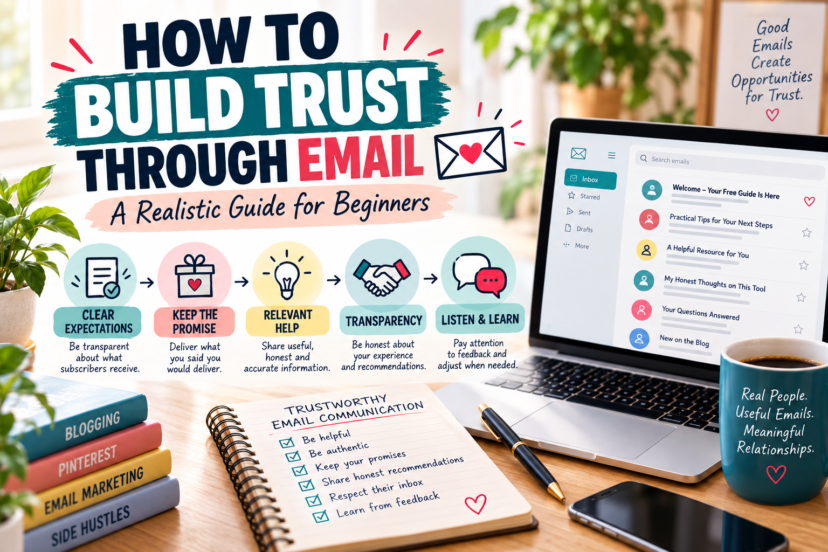
Start with clear expectations at signup. Deliver what you promised. Continue with communication that remains relevant to the subscriber’s reason for joining. Be precise about what you know, transparent when money influences a recommendation, and willing to let people leave when the relationship no longer serves them.
Then listen and learn.
The process might look like this:
Set Expectations → Keep the Promise → Provide Relevant Help → Communicate Honestly → Listen → Learn → Adjust
Notice that trust itself is not one of the steps.
That is intentional.
Trust is the subscriber’s judgment about the experiences those steps create.
You control how you communicate. The subscriber decides whether that communication deserves trust.
Final Thoughts
Learning how to build trust through email does not mean discovering a sequence of techniques that makes subscribers trust you.
There is no such sequence.
What you can do is create a pattern of communication that is understandable, useful, honest, and consistent with the expectations you set.
Keep meaningful promises.
Explain uncertainty when it exists.
Use personal experience without turning it into universal evidence.
Recommend products with context.
Disclose financial relationships clearly.
Respect attention, permission, and the decision to unsubscribe.
And use subscriber behavior to learn rather than to make assumptions about what people think.
The result is not guaranteed trust.
It is something more realistic: a relationship in which trust has good reasons to develop.
For the broader system behind that relationship, the Email Marketing Hub brings together the Realistic Side Income guides to lead magnets, signup optimization, welcome emails, ongoing communication, and email strategy.
FAQ
1. How do you build trust through email?
You cannot make subscribers trust you, but you can create good reasons for trust to develop. Set clear expectations, keep important promises, provide relevant information, communicate honestly, and be transparent about recommendations and financial relationships.
2. How long does it take to build trust with email subscribers?
There is no fixed timeline. Trust depends on the subscriber’s experiences and expectations rather than a particular number of emails or weeks.
3. Should I share personal stories in my emails?
Personal stories can be useful when they provide relevant context or help explain a lesson. They do not need to appear simply to make an email feel more personal.
4. Can I promote affiliate products without damaging trust?
Affiliate recommendations can be appropriate when they are relevant, accurately represented, and accompanied by appropriate disclosure. Explain why the product may be useful, mention important limitations, and do not imply personal experience you do not have. Disclosure requirements vary by jurisdiction; FTC guidance, for example, requires relevant material connections to be disclosed clearly and conspicuously. Federal Trade Commission
5. Is an engaged email list more trustworthy than a large one?
List size and engagement metrics do not directly measure trust. Opens, clicks, replies, and unsubscribes provide information about behavior, but they should not be treated as a direct measure of what subscribers think or how much they trust you.