Print-on-Demand for Busy Employees: A Realistic Beginner’s Guide
Starting an online store sounds exciting—until you think about everything that normally comes with it.
You need products. You need inventory. You need somewhere to store it. Then there is packaging, shipping, returns, customer service, and the uncomfortable possibility that you spend hundreds or thousands of euros on products nobody buys.
For someone who already works a full-time job, that can quickly turn a promising side hustle into another source of stress.
That is what makes print-on-demand for busy employees so interesting.
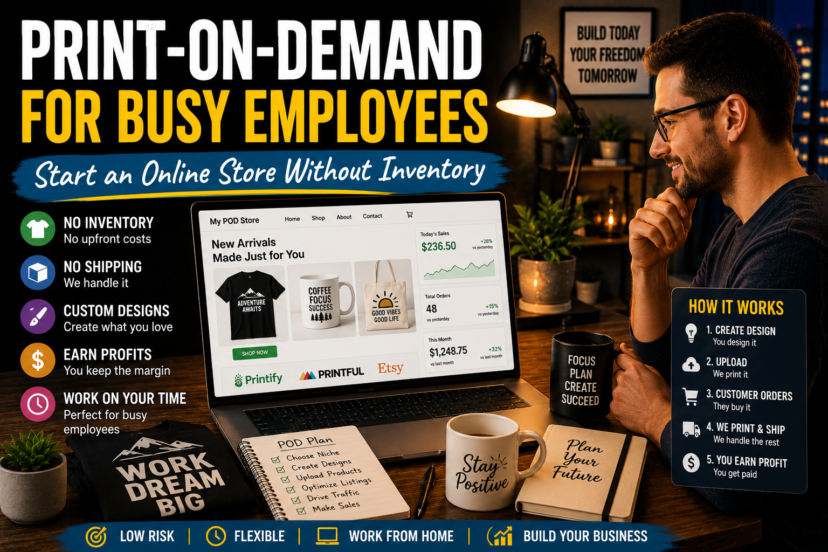
With print-on-demand, or POD, you can create and sell customized products without ordering large quantities in advance. A product is normally produced only after a customer places an order, and the print-on-demand provider handles much of the production and shipping process.
That removes one of the biggest barriers to traditional e-commerce: inventory.
But there is something beginners need to understand from the beginning.
Print-on-demand may be relatively easy to start, but that does not mean it is easy to succeed.
You still need good ideas, a clear niche, attractive products, effective listings, and—most importantly—a way for potential customers to discover what you sell.
For a busy employee, that makes POD less of a quick-money opportunity and more of a small online business that can be built gradually after work.
What Is Print-on-Demand?
Print-on-demand is an e-commerce model in which products are produced after someone orders them rather than being manufactured and stored in advance.
You create a design and place it on products such as T-shirts, mugs, posters, notebooks, tote bags, hoodies, or other customizable items.
When a customer buys one of those products, the order is sent to the print provider. The provider produces the item, packages it, and ships it to the customer.
You receive the difference between your selling price and the costs associated with producing and fulfilling the order, minus any marketplace, payment, advertising, or other applicable fees.
That last part matters.
Your revenue is not your profit.
If a customer pays €25 for a product, you do not automatically earn €25. Production costs, shipping, platform fees, taxes, refunds, and possibly advertising costs can significantly reduce your margin.
Understanding that distinction early helps you approach POD like a real business instead of assuming every sale is highly profitable.
Why Print-on-Demand Can Work Well for Busy Employees
The biggest advantage of print-on-demand is not necessarily its income potential.
It is its flexibility.
You can research niches on Tuesday evening, create a design on Thursday, prepare a listing on Saturday, and then let the fulfillment system handle an order while you are at your regular job.
There are no boxes filling your spare room and no daily trips to the post office.
That makes POD fundamentally different from many traditional product businesses.
It also makes it one of several business models worth considering if you have limited time. In my guide to Best Side Hustles for Busy Employees, I look at different approaches depending on whether you prefer faster active income or slower but potentially more scalable online assets.
POD belongs somewhere in the middle.
You are building products that can potentially sell repeatedly, but you still need to maintain listings, create new designs, monitor orders, answer occasional customer questions, and market the business.
So it is flexible—but not completely passive.
How Print-on-Demand Actually Works
The basic process is surprisingly straightforward.
First, you choose a niche and research the kinds of products that audience might want.
Then you create a design and upload it to a print-on-demand provider. You select the products you want the design to appear on, create mockups, write your product title and description, and connect the product to a marketplace or online store.
When a customer orders, the fulfillment provider receives the order and produces the item.
The provider then ships it directly to the customer.
You never physically touch the product.
This is what makes the model so attractive to people who want to run an e-commerce side hustle from home.
But the technical process is actually the easy part.
The harder question is:
Why should someone buy your product instead of thousands of similar products?
That is where niche research, product positioning, design, keywords, and marketing become important.
Choosing a Niche Before Creating Products
One of the biggest mistakes beginners make is opening a design tool before deciding who they want to sell to.
They create a funny T-shirt.
Then a motivational mug.
Then a dog poster.
Then a gardening tote bag.
Eventually, the store becomes a collection of unrelated ideas.
A more strategic approach is to start with an audience.
For example, instead of targeting everyone who likes dogs, you might focus on owners of a particular breed. Instead of creating generic teacher products, you could focus on elementary school teachers or a specific teaching subject.
Other potential audiences might include gardeners, hikers, book lovers, nurses, campers, hobbyists, new parents, or people interested in a particular profession.
The point is not simply to find the smallest possible niche.
You want an audience that is specific enough to understand but large and interested enough to buy.
A defined niche also makes marketing much easier because you know exactly who your content, products, keywords, and Pinterest Pins are supposed to attract.
Do You Need to Be a Graphic Designer?
No—but good design still matters.
One of the advantages of print-on-demand is that successful products do not necessarily require complicated artwork.
Simple typography, clever phrases, clean illustrations, patterns, or niche-specific concepts can work well.
What matters is whether the design connects with the intended buyer.
A technically beautiful design that means nothing to the audience may sell poorly. A simple design that makes someone think, “That is exactly me,” may perform much better.
Tools such as Canva can make basic design accessible to beginners, but there is another important consideration: commercial usage rights.
Do not assume that every image, font, graphic, quote, logo, character, or phrase you find online can legally be placed on a product and sold.
Before publishing a design, make sure you have the necessary rights to use its elements commercially. Avoid simply copying designs, slogans, brand names, characters, or artwork you see elsewhere.
Building something original is not only safer; it also gives you a better chance of creating a recognizable business over time.
Which Products Should You Start With?
Print-on-demand catalogs can be overwhelming.
You may see hundreds of available products and immediately want to create everything.
Don’t.
For a beginner with limited time, a smaller product range is easier to manage.
You might start with one or two product types that make sense for your niche.
T-shirts and sweatshirts are obvious choices, but they also come with sizing considerations and intense competition. Mugs, posters, tote bags, notebooks, stickers, and other products may suit certain audiences better.
Think about the buyer rather than the catalog.
What would this person genuinely use, wear, display, or give as a gift?
That question is far more useful than asking which POD product happens to be popular.
Choosing a Print-on-Demand Platform
There are two parts to the platform decision: fulfillment and selling.
Services such as Printful and Printify can handle production and fulfillment and connect with various selling platforms. Marketplaces such as Etsy can provide a place where customers already search for products, while other sellers may prefer building their own online store.
Each approach has advantages and disadvantages.
A marketplace may give you access to existing shoppers, but you are competing with many other sellers and must follow the marketplace’s rules and fees.
Your own store gives you more control, but you are responsible for generating the traffic.
For a beginner, I would resist the temptation to open accounts everywhere.
Choose one simple setup, learn how orders, pricing, listings, fulfillment, and customer communication work, and expand only when you have a reason to do so.
Your First Goal Should Not Be 100 Products
It is easy to turn POD into a numbers game.
Upload 100 designs. Create 500 products. Publish as quickly as possible.
But quantity without direction can waste enormous amounts of time.
Your first objective should be learning.
Create a small collection of related products. Learn how to create mockups. Understand pricing. Learn how keywords and product descriptions work. See which designs receive impressions, clicks, favorites, or sales.
Then use that information to improve the next batch.
This is the same principle I recommend throughout Realistic Side Income: build a simple system first and improve it with real data.
The Part Beginners Underestimate: Getting Traffic
Creating a product does not create demand.
You can design the perfect mug, upload it to a marketplace, and receive absolutely no sales if nobody sees it.
This is where print-on-demand begins to overlap with the other skills we have been building on this website.
If you have already read How to Get Your First 100 Website Visitors, you know that publishing something online is only the beginning. Whether it is a blog article or a product listing, people need a path that leads them to it.
Marketplace search can provide one path.
Pinterest can provide another.
Google, blogging, email marketing, and other content channels can eventually create additional entry points.
That is why I would not build a POD strategy around uploading products and waiting.
I would build a small traffic system around the products.
Content Marketing Can Give POD a Long-Term Advantage
Imagine that you sell products for gardeners.
Instead of relying entirely on marketplace searches, you could also publish useful gardening-related content that attracts the same type of person who might buy your products.
The article helps the reader.
The reader discovers your brand.
Some readers may eventually visit your shop or join your email list.
This is the basic idea behind Content Marketing for Beginners: create useful content that attracts the right audience rather than constantly trying to push products in front of strangers.
For a busy employee, this strategy takes patience. But it can gradually reduce your dependence on a single marketplace.
How Pinterest Can Support a Print-on-Demand Business
Pinterest can be especially interesting for visual products because people use the platform to discover ideas, styles, gifts, hobbies, and inspiration.
But I would not treat Pinterest as a place to endlessly publish product advertisements.
Useful, attractive, niche-relevant content usually creates a stronger long-term strategy.
For example, a niche blog article can attract Pinterest users, introduce them to your brand, and then lead interested readers toward related products.
This is one reason Pinterest Marketing for Busy Employees fits so naturally with a content-based side hustle. You can create Pins in batches after work and gradually build a library of visual entry points to your website and offers.
Again, the objective is not to create instant sales.
The objective is to become discoverable.
How Much Does It Cost to Start Print-on-Demand?
Print-on-demand removes the need to purchase inventory upfront, but calling it completely free would be misleading.
Depending on how you build the business, potential expenses can include marketplace listing fees, transaction fees, website costs, design tools, sample products, advertising, subscriptions, and other business expenses.
You may also want to order samples before promoting products so you can evaluate print quality, colors, sizing, packaging, and the overall customer experience.
The advantage is that you can generally start much smaller than with traditional inventory-based e-commerce.
That makes POD particularly useful for testing ideas without committing large amounts of capital.
What Can You Realistically Earn?
This is where expectations matter.
There is no meaningful guaranteed income range for a print-on-demand beginner.
You might publish products and make no sales at all.
You might find a niche that produces occasional sales.
Or you might gradually develop a catalog that generates consistent monthly income.
Results depend on factors such as demand, competition, pricing, margins, product quality, design quality, search visibility, marketing, seasonality, and how consistently you improve.
The important number is not revenue alone.
It is profit after costs.
If you sell €1,000 worth of products but most of that amount disappears into production, shipping, marketplace fees, advertising, taxes, refunds, and other expenses, your actual side income may be much smaller.
This is also why POD should not be presented as passive money from uploading designs.
It is a real business model with real costs and real competition.
Common Print-on-Demand Mistakes to Avoid
A common beginner mistake is choosing a niche simply because it appears popular. Popular niches can have strong demand, but they can also be extremely competitive.
Another is creating only a few random products and concluding that POD does not work when they do not sell immediately.
Some beginners focus entirely on design while ignoring keywords, product descriptions, pricing, mockups, and traffic. Others create dozens of products without ever looking at the data to understand what people actually respond to.
And perhaps the most dangerous mistake is copying what is already selling.
Successful products can give you clues about demand, but they should inspire research—not imitation.
Originality, audience understanding, and consistent testing create a much healthier foundation.
Print-on-Demand vs. Digital Products
Print-on-demand and digital products have something important in common: both allow you to create something that can potentially be sold more than once.
But their economics are different.
A physical POD product must be manufactured and shipped every time it sells. A digital product such as a template, checklist, planner, or ebook can normally be delivered repeatedly without manufacturing a new physical item.
That can give digital products higher margins, although they come with their own challenges.
If the idea of creating scalable products appeals to you but you are not sure physical merchandise is right for you, Selling Digital Products as a Side Hustle is worth reading next. Comparing the two models may help you decide which better fits your skills and available time.
A Realistic POD Strategy for Someone With a Full-Time Job
If I were starting print-on-demand alongside a regular job, I would keep the first few months deliberately small.
I would choose one audience, research what that audience actually cares about, select one or two appropriate product types, and create a small group of original designs.
Then I would publish them and learn from the results rather than immediately producing hundreds more.
At the same time, I would begin building a traffic asset.
That might mean niche-related Pinterest content, useful blog articles, or eventually both.
As visitors begin arriving, I would also give interested people an opportunity to subscribe rather than relying entirely on a marketplace to maintain the customer relationship. Building an Email List as a Beginner explains why that becomes increasingly valuable as an online business grows.
Over time, you might combine several complementary income streams. A niche website could generate traffic through blogging and Pinterest, recommend useful products through affiliate marketing, sell your own digital products, and promote selected print-on-demand products.
You do not need to build all of that now.
In fact, you shouldn’t.
Start with one system and earn the right to make it more complicated.
Is Print-on-Demand Worth It in 2026?
Print-on-demand can still make sense in 2026, especially for someone who wants to experiment with e-commerce without investing heavily in inventory.
But the opportunity is not simply “upload a design and make passive income.”
The real opportunity is learning how to identify an audience, create products for that audience, attract attention, analyze results, and gradually build a recognizable niche business.
For some people, that will be exciting.
For others, blogging, freelancing, affiliate marketing, or digital products will be a much better fit.
And that is completely fine.
A side hustle does not need to be fashionable.
It needs to fit your skills, schedule, personality, and goals.
Conclusion
Print-on-demand for busy employees can be a realistic way to experiment with e-commerce without filling your home with inventory or spending a large amount of money on products upfront.
But removing inventory does not remove the need to build a business.
You still need to understand your audience, create products people genuinely want, make those products discoverable, monitor your costs, and keep improving.
Start with one niche.
Create a small collection.
Learn how the system works.
Build traffic.
Study the results.
Then decide whether it deserves more of your time.
That approach may not sound as exciting as “upload designs and make passive income,” but it gives you something far more useful:
a realistic way to find out whether print-on-demand can become a side income that actually fits your life.
FAQ
Is print-on-demand good for beginners?
Yes, print-on-demand can be beginner-friendly because you generally do not need to purchase large amounts of inventory before making sales. However, beginners still need to learn niche research, product creation, pricing, keywords, marketing, and customer service.
Can I do print-on-demand while working full-time?
Yes. The fulfillment process makes POD relatively flexible because a provider handles production and shipping. You can work on designs, listings, research, and marketing during evenings or weekends. The key is keeping your workload manageable.
Do I need money to start print-on-demand?
You can start with relatively little money compared with traditional e-commerce, but POD is not necessarily completely free. Depending on your setup, you may encounter marketplace fees, website costs, samples, design tools, advertising costs, and other expenses.
How many print-on-demand products should a beginner create?
There is no magic number. Instead of trying to publish hundreds of products immediately, start with a focused collection and learn from the results. Ten well-researched products in one clear niche can teach you more than 100 unrelated products created without a strategy.
How long does it take to make money with print-on-demand?
There is no guaranteed timeline. Some sellers may get an early sale, while others can work for months without meaningful revenue. Your niche, products, pricing, competition, visibility, and marketing all affect the result. Treat POD as a business that requires testing rather than a guaranteed source of quick income.