
Print-on-Demand for Busy Employees: How to Start an Online Store Without Inventory
Introduction
Many people dream of starting an online store but immediately run into a problem:
They don’t want to buy inventory.
They don’t want to package products.
And they definitely don’t want to spend thousands of dollars before making their first sale.
That is why print-on-demand for busy employees has become such a popular side hustle option.
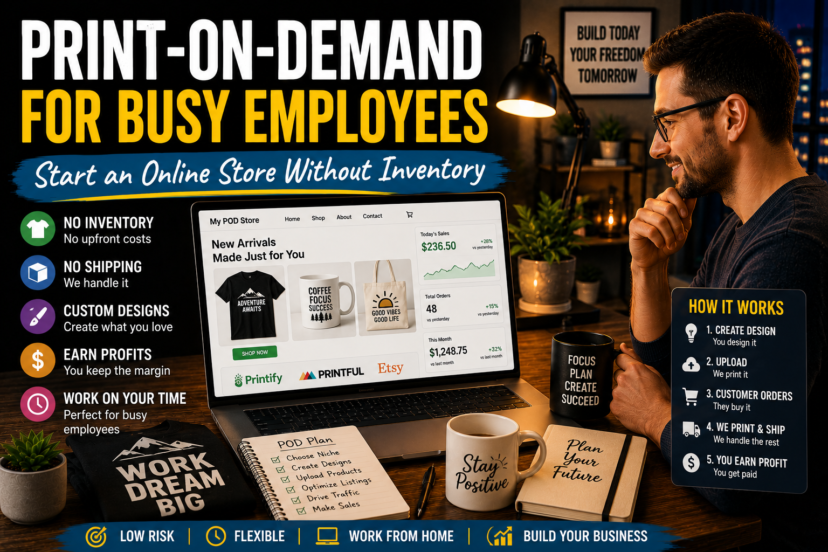
Print-on-demand allows you to sell custom products online without storing inventory or handling shipping yourself. Instead, products are only produced when a customer places an order.
For busy employees, this can be an attractive way to explore e-commerce without taking on the risks associated with a traditional online store.
What Is Print-on-Demand?
Print-on-demand (often called POD) is a business model where products are printed and shipped only after a customer buys them.
Instead of purchasing hundreds of products upfront, you create designs that can be printed on demand.
Typical products include:
- T-shirts
- Hoodies
- Mugs
- Tote bags
- Posters
- Notebooks
- Phone cases
- Stickers
The POD company handles production and shipping.
Why Print-on-Demand Appeals to Busy Employees
One reason many employees are interested in POD is flexibility.
You can create products:
- after work
- on weekends
- from home
There is no warehouse to manage.
No boxes to pack.
No trips to the post office.
This makes POD much easier to fit around a full-time job.
How Print-on-Demand Actually Works
The process is surprisingly simple.
Step 1
Create a design.
Step 2
Upload it to a POD platform.
Step 3
Publish the product.
Step 4
A customer places an order.
Step 5
The POD provider prints and ships the product.
Step 6
You receive a profit from the sale.
The business model is straightforward, but success depends heavily on marketing and niche selection.
Popular Products You Can Sell
Many beginners immediately think about T-shirts.
However, there are many other options.
Popular POD products include:
Apparel
T-shirts, hoodies, sweatshirts, and caps.
Home Products
Mugs, pillows, blankets, and wall art.
Office Products
Notebooks, planners, and journals.
Accessories
Phone cases, tote bags, and stickers.
Different niches respond better to different product types.
Do You Need Design Skills?
Not necessarily.
Many successful POD sellers use:
- simple typography
- quotes
- niche slogans
- minimalist designs
You do not need to be a professional graphic designer.
However, understanding your audience is essential.
A simple design that resonates with a niche often outsells a complex design that nobody cares about.
Choosing a Niche
This is where most successful POD businesses are won or lost.
Instead of creating products for everyone, focus on a specific audience.
Examples include:
- dog lovers
- gardeners
- nurses
- teachers
- fitness enthusiasts
- bird watchers
- hikers
The more specific the niche, the easier it often becomes to create products people actually want.
The Best Print-on-Demand Platforms
Several companies make POD accessible for beginners.
Popular options include:
Printify
Large product selection and multiple print providers.
Printful
High-quality products and strong integrations.
Redbubble
Marketplace with built-in traffic.
TeePublic
Popular for creative designs.
Etsy + Printify
A common combination used by many beginners.
Choose one platform and learn it well before expanding.
Creating Your First Product
Many beginners spend weeks trying to create the perfect design.
Instead, focus on publishing.
Your first goal should be learning the process.
Create:
- one design
- one product
- one listing
Then improve over time.
Action beats perfection.
How Customers Find Your Products
This is where many beginners become frustrated.
Simply uploading products does not guarantee sales.
Customers need a way to discover your products.
Traffic can come from:
- Etsy search
- marketplace search
- blogging
- social media
- email marketing
Without visibility, even great products remain invisible. If you’re still learning how to get your first 100 website visitors, the same principles apply to print-on-demand. Products need traffic just as much as websites do.
Why Traffic Matters More Than Designs
Many beginners focus entirely on design quality.
In reality, traffic is often the bigger challenge.
This is exactly why Content Marketing for Beginners is such an important skill. Content can help attract visitors who may eventually become customers.
Likewise, Pinterest Marketing for Busy Employees can help drive long-term traffic to niche-related products and blog content.
Common Beginner Mistakes
Choosing a Broad Niche
Competition becomes overwhelming.
Uploading Too Few Products
One product rarely generates meaningful results.
Ignoring Keywords
Search visibility matters.
Expecting Instant Sales
POD requires patience.
Focusing Only on Design
Marketing is equally important.
Realistic Income Expectations
Many YouTube videos make POD sound easy.
Reality is usually slower.
Most beginners spend their first months:
- learning
- testing niches
- creating products
- improving listings
Some never make a sale.
Others build small but consistent income streams.
Success depends on:
- niche selection
- product quality
- visibility
- consistency
My Recommended Strategy
If I were starting print-on-demand today, I would:
Step 1
Choose one niche.
Step 2
Create 10–20 simple designs.
Step 3
Publish consistently.
Step 4
Use Pinterest to generate traffic.
Step 5
Create niche-related content.
Step 6
Build an email list.
Step 7
Improve based on data.
This approach is realistic and manageable for busy employees. Once people subscribe, you can stay connected with them and share new products, promotions, and content. That’s why Building an Email List as a Beginner is such an important long-term skill.
Many successful entrepreneurs combine print-on-demand with blogging, affiliate marketing, and digital products to create multiple income streams instead of relying on a single business model.
Conclusion
Print-on-demand for busy employees can be a practical way to explore e-commerce without inventory, shipping, or large upfront investments.
The key is understanding that success rarely comes from uploading a few random designs.
Success comes from:
- choosing a niche
- creating useful products
- generating traffic
- staying consistent
Treat POD like a long-term business rather than a quick-money scheme, and your chances of success improve dramatically.