
How Many Articles Do You Need? (A Realistic Guide for Beginner Bloggers)
One of the most common questions new bloggers ask is:
“How many articles do you need?”
It is an understandable question.
When you are building a blog from scratch, a number gives you something concrete to work toward.
Maybe 20 articles are enough to start getting traffic.
Perhaps 50 are needed before monetization becomes realistic.
Or maybe Google expects a website to have 100 posts before taking it seriously.
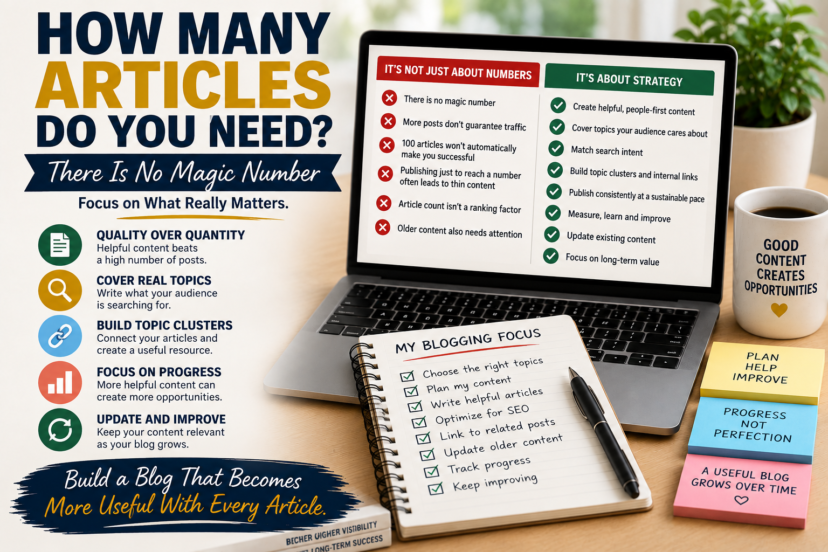
The problem is that blogging does not work according to a fixed article count.
A website with 20 well-chosen, useful articles can attract relevant visitors, while another site may publish 100 posts and struggle to gain visibility.
The difference is not simply quantity.
It is what those articles cover, how useful they are, whether people are searching for the topics, how well the content matches their needs, how the pages connect, and how effectively the website reaches its audience.
So instead of searching for a magic number, let’s look at what the size of your content library actually tells you—and what matters more than reaching a particular article count.
There Is No Magic Number of Blog Posts
Google does not require you to publish 20, 50, or 100 articles before your website can appear in search results.
Nor does reaching one of those numbers automatically unlock traffic.
Think about two hypothetical blogs.
The first has published 100 articles covering loosely related subjects. Many posts target topics with little search demand, several overlap with one another, and older content has never been updated.
The second has 30 articles organized around a clearly defined audience and several closely related topics. Each post solves a specific problem, related articles are connected naturally, and the blogger improves older content as the website develops.
Simply counting URLs would make the first blog look more established.
But article count alone tells us very little about the usefulness or structure of either site.
This is why asking “How many articles do I need?” eventually needs a second question:
“What job is each article doing?”
What Your First Articles Are Really For
When your blog is new, the first articles are important—but not because you need to reach a particular number as quickly as possible.
They help you build the foundation of the website.
At this stage, you are learning what your audience wants to know, how to research topics, how to structure an article, how SEO works, how WordPress fits into your workflow, and how your content connects.
You are also beginning to create something search engines and readers can explore.
This early period is valuable because it gives you information.
Which topics are easier to write about?
Which subjects have enough depth for additional articles?
Which pages begin receiving impressions?
Which Pinterest topics attract clicks?
What questions lead readers to your website?
Your first 10 or 20 posts may therefore teach you as much about your strategy as they contribute to your content library.
The goal is not to rush through them.
It is to use them to build a stronger foundation for everything that follows.
What Happens as Your Content Library Grows?
As you publish more useful articles, something important changes.
You have more opportunities to cover related questions.
Suppose your blog has a blogging section.
One article explains how to choose a niche.
Another covers content planning.
Then you add SEO, keyword research, internal linking, writing workflows, consistency, and monetization.
Each article can answer a specific question while supporting a broader subject.
Your site gradually becomes more useful because a reader who arrives with one question can find relevant information about the next one.
This is much more important than reaching an arbitrary milestone such as 50 posts.
A larger content library can create more opportunities for search visibility, internal linking, traffic, email signups, and monetization.
But only when those articles have a clear purpose.
More content creates more possibilities.
It does not guarantee more traffic.
Does More Content Mean More Traffic?
Not automatically.
Every useful article gives your website another potential entry point.
Someone might discover one post through Google, another through Pinterest, another through an email, and another through a link from an existing article.
As your library expands, the number of potential entry points can increase.
But there is an important distinction:
More articles create more opportunities for traffic. They do not create traffic simply because they exist.
An article still needs a reason for someone to discover and read it.
That might come from organic search, Pinterest, your email list, another website, social media, or your own internal links.
This is why publishing 100 articles without thinking about demand or distribution can be less effective than creating a smaller library with a clear strategy behind it.
If you are also wondering when that content might begin contributing to income, How Long Does Blogging Take to Make Money? explains why both traffic and monetization develop differently from one blog to another.
Quality Matters—but “Quality” Needs a Definition
“Quality over quantity” is good advice, but it can become another vague blogging slogan.
What actually makes an article useful?
It does not necessarily need to be extremely long.
It does not need dozens of images.
And it certainly does not need to repeat a keyword a particular number of times.
A strong article should understand why the reader arrived and give them an accurate, clear, useful answer.
That might mean explaining a complicated subject simply.
Providing practical steps.
Showing an example.
Addressing an important limitation.
Helping the reader make a decision.
Or connecting them to the next relevant resource when their question becomes broader.
Quality also means avoiding unnecessary content.
If a question can be answered thoroughly in 1,200 words, turning it into 3,000 words does not automatically make it better.
Likewise, producing a shorter article is not a problem if it satisfies the reader’s need.
The goal is not maximum length or maximum quantity.
It is useful coverage.
Developing an efficient writing process can help you achieve that without turning every article into a week-long project. How to Write Blog Posts Faster explains how to separate research, outlining, drafting, editing, and optimization so that you can work more efficiently without sacrificing quality.
Build Topic Coverage Instead of Chasing a Post Count
This is where article numbers become much more useful.
Instead of asking:
“How do I get from 30 articles to 50?”
ask:
“What is still missing from this topic?”
Suppose you have a cluster about blogging.
You might already cover:
- choosing a blog niche
- planning content
- writing efficiently
- beginner SEO
- keyword research
- internal linking
- realistic blogging timelines
- common blogging mistakes
- consistency
Now the important question is not whether that cluster contains nine articles or nineteen.
The better question is whether those articles cover the most important problems your intended reader needs help solving.
Perhaps there is an obvious gap.
Perhaps one existing article is too broad and deserves more supporting content.
Or maybe the cluster is already strong enough for now, and your time would be better spent developing another important area of the website.
This is the difference between publishing to increase a number and publishing to improve your content library.
Strong topic coverage begins before you write the next post. How to Plan Blog Content explains how to organize ideas into topic clusters and prioritize articles according to audience needs, search intent, and strategic value.
Don’t Create Separate Articles Just to Increase Your Numbers
There is another danger in chasing article counts.
You may begin splitting closely related ideas into separate posts simply because you want more content.
For example, imagine creating individual articles for:
- how to find keywords for a blog
- how bloggers find keywords
- how to research blog keywords
- beginner blog keyword research
Those phrases may look different, but they could represent essentially the same search intent.
Creating four weak or repetitive pages does not necessarily make your website more comprehensive.
It may simply create unnecessary overlap.
Before publishing another article, ask whether the topic genuinely deserves its own page.
Can it solve a distinct problem?
Does it serve a different intent?
Would a reader reasonably benefit from having it separate?
If not, the information may belong inside an existing article instead.
A growing blog needs better coverage, not artificial volume.
When Should You Publish a New Article?
A new article makes sense when it adds something useful to your website.
Perhaps it answers an important audience question you have not covered.
It supports an existing topic cluster.
Keyword research reveals a relevant search need.
Readers repeatedly ask about the subject.
It provides a natural next step from an existing guide.
Or it covers a subject that supports your broader business strategy.
Those are strategic reasons to publish.
“I need five more articles to reach 50” is not.
This distinction becomes increasingly important as your blog grows.
At Some Point, Updating Can Be More Valuable Than Publishing
When you have only a handful of articles, creating new content will naturally occupy much of your time.
But that balance changes.
Once you have a larger library, older pages deserve attention too.
Perhaps an article contains outdated information.
Maybe you can improve the introduction now that you understand search intent better.
An old post might need new internal links because you have since published several relevant guides.
A page may be appearing in search results but receiving few clicks.
Another might contain useful information buried under an unnecessarily long section.
At that point, the best use of your next three hours may not be Article 76.
It may be improving Article 18.
This is why a mature content strategy eventually becomes a combination of:
Create → Measure → Update → Connect → Improve
rather than an endless race to publish more URLs.
How Many Articles Should You Publish in Your First Year?
There is no number that every new blogger should aim for.
Your available time alone can make an enormous difference.
Someone blogging full-time can produce content at a very different pace from someone building a website alongside a job and family.
The complexity of the niche matters too.
A deeply researched article may require far more work than a simple tutorial.
Your publishing process, experience, promotion strategy, and need to update existing pages also affect what is sustainable.
Instead of deciding that your first year must contain 50 posts, choose a realistic publishing rhythm and use it to build a coherent library.
If that results in 20 strong articles, you have 20 assets to work with.
If it results in 40, you have 40.
The number is an outcome of your system—not the strategy itself.
Consistency Still Matters—Just Not in the Way You Might Think
This does not mean publishing consistently is irrelevant.
A blog with no new or improved content for long periods will naturally develop differently from one that receives regular attention.
But consistency does not have to mean:
One new article every week.
It can mean maintaining a sustainable rhythm of creating, updating, promoting, measuring, and improving content.
Some weeks you may publish.
Other weeks you may modernize older posts.
You might spend time improving Pinterest distribution or strengthening internal links.
That work still contributes to the website.
Our guide to How to Stay Consistent as a Blogger explains how to create a flexible routine that fits around real life rather than forcing yourself into an arbitrary publishing schedule.
What Should You Measure Instead of Article Count?
Article count is easy to measure.
That is part of its appeal.
But other questions tell you much more about whether your content strategy is developing.
Is your site covering the important questions within its main topics?
Are more pages receiving search impressions?
Which articles attract visitors?
Are people clicking through to related content?
Are older posts still accurate and useful?
Are Pinterest pins generating outbound clicks?
Is your email list growing?
Are visitors clicking relevant affiliate recommendations?
Which content is producing results—and which is not?
You do not need to monitor every possible metric.
Choose measurements that relate to your current goals.
The important point is that 50 articles with no understanding of their performance tells you less than 30 articles you are actively learning from.
When Is a Blog “Big Enough” to Monetize?
This is another place where article counts can become misleading.
You do not need to reach a particular number of posts before adding an affiliate link, building an email list, or creating another relevant monetization opportunity.
A website with ten articles could have a highly relevant page where an affiliate recommendation genuinely helps the reader.
A site with 100 articles could still struggle to monetize if it attracts the wrong audience or has no clear connection between content and offers.
Monetization depends on factors such as traffic quality, reader intent, trust, relevance, the monetization model, and the offers available within your niche.
Article count is only part of the larger picture.
If you are building your site as part of a broader side-income strategy, the Side Hustle Roadmap shows how the pieces fit together—from building the foundation to attracting traffic, developing an audience, and introducing monetization.
So, How Many Articles Do You Really Need?
Enough to build a useful resource around the topics your audience cares about.
That answer is less satisfying than “50.”
But it is much more useful.
You may start seeing encouraging signals with a relatively small content library.
Or you may need considerably more content, refinement, promotion, and time before the website develops meaningful traffic.
There is no universal threshold.
Rather than deciding that success begins at Article 50 or Article 100, use milestones as review points.
For example, after publishing a group of articles, stop and ask:
What have I learned?
Which topics are gaining visibility?
Where are the gaps?
Which older pages should I improve?
What should I publish next—and why?
Now the article count becomes useful.
It reminds you to evaluate the website rather than simply feeding it more content.
Focus on Building a Library, Not Filling a Quota
There is a subtle but important difference between a content library and a collection of blog posts.
A collection gets bigger.
A library becomes more useful.
Its subjects are organized.
Related resources connect.
Important gaps are filled.
Outdated information is maintained.
Readers can move logically from one question to the next.
And every new addition has a reason to be there.
That is the kind of website worth building.
If you want to see how the individual blogging skills fit together, visit the Blogging Hub for our complete beginner learning path covering niche selection, planning, writing, SEO, keyword research, internal linking, consistency, and long-term growth.
Final Thoughts
So, how many articles do you need?
There is no magic number.
Twenty articles are not automatically too few.
One hundred are not automatically enough.
The better goal is to build a useful, connected body of content that answers real questions and supports the direction of your website.
Publish when a new article adds value.
Update when an existing page deserves improvement.
Connect related content.
Pay attention to what your audience and your data are telling you.
And allow your content strategy to become more informed as the website grows.
Your goal is not to reach a particular post count.
It is to create a website that becomes more useful with every article you add or improve.
FAQ
1. How many articles should a new blog have?
There is no required number. A new blog needs enough useful content to begin covering the important questions within its chosen topics. Focus on building a coherent content library rather than reaching an arbitrary post count.
2. Can you make money with only ten blog posts?
It is possible for a small blog to generate revenue, but the number of posts alone does not determine whether that happens. Traffic, audience intent, trust, topic selection, and the relevance of the monetization method all matter.
3. Is quality more important than quantity?
Both can matter, but they serve different purposes. Publishing more useful articles can create additional opportunities for discovery, while publishing more weak or repetitive content does not automatically improve a website. Aim for useful coverage rather than volume for its own sake.
4. How often should beginners publish?
There is no universal publishing frequency. Choose a rhythm that allows you to research, write, edit, promote, and maintain your content without sacrificing quality or creating an unsustainable workload.
5. Does Google prefer websites with more articles?
There is no fixed article count that a website must reach to perform in search. A larger content library can cover more relevant questions and create more potential entry points, but simply adding pages does not guarantee greater search visibility.