
How Long Does Blogging Take to Make Money? A Realistic Guide
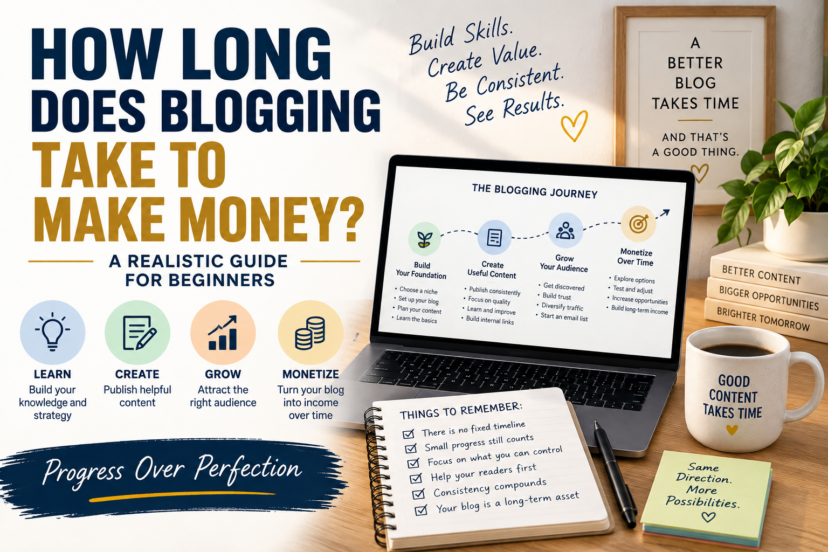
How long does blogging take to make money? It is one of the most understandable questions a beginner can ask—and one of the hardest to answer with a specific number.
You may find stories online from bloggers who earned their first commission within a few months. Others worked on their websites for a year or longer before seeing meaningful income. Some blogs grow into profitable businesses, while others never generate enough traffic or revenue to justify the time invested.
That makes promises such as “start earning after six months” appealing, but not particularly useful.
Blogging does not follow a fixed income schedule.
Your niche, content, audience, traffic sources, monetization strategy, competition, available time, experience, and willingness to improve all influence the outcome.
There is another important distinction:
Making your first €10 from a blog is very different from building reliable monthly income.
The first shows that your monetization method can work. The second requires enough traffic, trust, conversions, and consistency to produce results repeatedly.
So instead of giving you an unrealistic countdown to your first profitable month, this guide will explain what usually needs to happen before a blog can make money, why the process often takes longer than beginners expect, and which parts of that process you can actually control.
Why There Is No Standard Blogging Income Timeline
Two people can start blogs on the same day and have completely different results a year later.
One may already understand SEO, WordPress, affiliate marketing, and email marketing.
The other may be learning everything from scratch.
One might have 30 hours a week available.
Another may be building a blog alongside a full-time job and have only five.
Their niches could also be completely different. Their competition, content quality, publishing pace, promotional strategy, and monetization opportunities will differ as well.
That is why statements such as:
“Bloggers usually start making money after X months.”
need to be treated cautiously.
There are simply too many variables.
A more useful question is:
What needs to be in place before my blog has a realistic opportunity to generate income?
That we can answer.
First, Understand How a Blog Actually Makes Money
A blog does not generate income simply because articles have been published.
There needs to be a mechanism connecting the content to revenue.
For example, a visitor might discover an article through Google, click a relevant affiliate recommendation, and make a qualifying purchase.
Another reader might join your email list and later buy a digital product.
A blog with substantial traffic may qualify for advertising opportunities.
Someone else could discover your expertise through an article and eventually purchase a service.
The exact journey varies, but the basic principle is similar:
Useful Content → Discovery → Reader → Trust → Relevant Offer → Conversion → Revenue
Every step matters.
If you have excellent content but nobody discovers it, monetization becomes difficult.
If you have traffic but the visitors have little connection to what you recommend, conversions may remain low.
If you recommend products aggressively before establishing trust, more affiliate links will not necessarily solve the problem.
Blogging income is therefore not created by one isolated action.
It develops from a system.
The Beginning Is Usually About Building, Not Earning
When you start a new blog, there is a surprising amount to learn.
You need to choose what the site will focus on, understand the audience, set up the website, plan content, learn how to write useful articles, understand basic SEO, and begin attracting visitors.
For someone starting from scratch, even publishing the first ten genuinely useful articles can represent a substantial amount of work.
At this point, traffic may be very limited.
That is not evidence that the blog has failed.
It means you are still building the assets that could eventually create traffic and revenue.
Your early articles become part of a content library.
Your internal links create structure.
Your email subscribers form an audience you can reach again.
Your SEO knowledge improves.
Your publishing process becomes more efficient.
None of those things automatically produces money, but each can contribute to the system that eventually does.
If you are still establishing that foundation, How to Plan Blog Content explains how to turn individual ideas into a connected publishing strategy.
Your First Income Is a Milestone, Not a Salary
The first commission from a blog can be exciting.
Perhaps someone clicks an affiliate link and you earn €8.
Technically, your blog has now made money.
But that does not mean you have built a dependable income stream.
This distinction is important because online success stories often blur the difference between earning money and earning consistent money.
A single conversion can happen with relatively little traffic.
Producing hundreds of euros every month requires those successful actions to happen repeatedly.
Replacing a meaningful portion of employment income requires an entirely different scale again.
Instead of treating all of these as the same milestone, think of blogging monetization as a progression:
First Revenue → Repeatable Revenue → Consistent Revenue → Meaningful Income
There is no guaranteed timeline between those stages.
Traffic Matters—but Not All Traffic Is Equal
It is difficult to monetize a website nobody visits.
So yes, traffic matters.
But raw visitor numbers tell only part of the story.
Imagine two blogs each receive 1,000 monthly visitors.
The first attracts people searching for a very broad informational topic with little connection to anything the blogger offers.
The second attracts people actively researching a problem for which the site provides a relevant solution or product recommendation.
Their monetization results could be very different despite having identical traffic numbers.
This is why we should not say:
“You need 10,000 monthly visitors before you can monetize.”
There is no universal threshold.
Affiliate marketing, digital products, services, email marketing, and advertising all work differently.
Our guide How Much Traffic Do You Need Before Monetizing? explores this distinction in more detail.
The better question is whether you are attracting the right visitors for your monetization model.
Your Niche Influences the Opportunity
The subject of your blog can affect how it eventually makes money.
Some niches naturally connect to many commercial products, software tools, services, courses, or other offers.
Others may attract an enthusiastic audience but provide fewer obvious monetization opportunities.
That does not mean you should simply choose whichever niche appears to pay the highest commissions.
A profitable-looking market is of little value if you cannot produce useful content for it, understand the audience, or remain interested long enough to build something substantial.
Instead, look for a balance between:
Audience needs + Content potential + Your knowledge or interest + Search opportunity + Monetization possibilities
That is the approach we use in How to Choose a Blog Niche.
The goal is not to find the niche that supposedly makes money fastest.
It is to choose one in which you can realistically build a useful resource.
Content Quality Matters More Than Filling a Publishing Calendar
Publishing regularly can be helpful because it allows you to build your content library over time.
But frequency alone does not create a profitable blog.
Ten rushed articles are not automatically more valuable than five genuinely useful ones.
Search visitors do not care how many posts you published last month.
They care whether the page they landed on helps them.
That means content should be accurate, understandable, relevant to the search, and useful enough to justify the reader’s time.
The challenge for busy bloggers is producing that quality efficiently.
This is why How to Write Blog Posts Faster focuses on improving the workflow rather than simply trying to type faster.
A sustainable process is much more valuable than a publishing sprint you cannot maintain.
SEO Can Take Time to Develop
Organic search can become an important traffic source for a blog, but publishing an optimized article does not guarantee immediate visibility.
Search engines need to discover and process pages, understand their context, and determine when they may be useful for particular searches.
Meanwhile, your page competes with other available results, many of which may come from websites that have existed much longer.
Some articles may begin receiving impressions relatively early.
Others may take considerably longer to gain traction.
Some may never perform strongly in search and will need improvement, repositioning, or a different traffic source.
This uncertainty is part of blogging.
Rather than waiting for a predetermined month when “Google traffic should start,” monitor whether your overall search presence is developing.
Are more pages receiving impressions?
Are visitors discovering you through a wider range of queries?
Are clicks increasing?
Are particular topic clusters beginning to perform better?
Those signals are more useful than a universal timeline.
If SEO still feels unfamiliar, SEO for Beginner Bloggers provides the foundation.
Choosing the Right Topics Can Shorten the Learning Curve
You cannot control when Google ranks a page.
But you can improve how strategically you choose what to write about.
Keyword research helps you understand the questions people are asking and how competitive the search landscape may be.
That can prevent you from spending months creating content around topics with little connection to your audience or search demand.
It can also help you find more specific questions where your content has a clearer purpose.
Our guide Keyword Research for Beginners explains how to use search data without turning your blog into a collection of keyword-driven articles.
Good research does not guarantee faster income.
It reduces some of the guesswork.
Internal Linking Helps Your Content Work Together
As your blog grows, individual articles should not remain isolated.
Internal links can connect related topics, help visitors continue learning, and make the overall structure of your site easier to understand.
For example, someone who discovers an SEO article may continue to keyword research and then move on to internal linking.
That creates a journey through your content rather than a single page view with nowhere obvious to go next.
This matters because successful blogs are usually more than collections of standalone posts.
They become libraries of connected information.
If you have already published a growing number of articles, Internal Linking Explained shows how to create those connections naturally.
Monetization Strategy Changes the Timeline
Not every blog makes money in the same way.
This is one of the biggest reasons income timelines are so difficult to compare.
Affiliate Marketing
Affiliate income can theoretically begin with a small audience if the right visitor finds a relevant recommendation and purchases through your link.
But occasional commissions are different from predictable monthly income.
Building reliable affiliate revenue generally requires enough relevant traffic, useful commercial content, appropriate programs, and reader trust.
Display Advertising
Advertising tends to depend more heavily on traffic volume.
Different advertising platforms have their own eligibility requirements and revenue models, so this path may become more relevant as traffic grows.
Digital Products
A digital product can potentially generate meaningful revenue without enormous traffic, but only if it solves a real problem and reaches people willing to buy it.
Creating the product is therefore only one part of the process.
You still need an audience and a way to reach potential customers.
Services
Services can sometimes monetize a relatively small audience because one client may be worth considerably more than one ad impression or affiliate click.
However, this is less passive and depends on your skills, positioning, and capacity.
Email Marketing
An email list does not automatically produce income either.
Its value comes from building an ongoing relationship with people who have chosen to hear from you again.
Over time, that audience can support affiliate recommendations, products, services, or other monetization strategies.
The important lesson is simple:
Your monetization model affects what kind of audience and traffic you need.
Should You Wait Before Monetizing?
You do not need to reach a particular blog age before adding monetization.
A relevant affiliate link can be useful even on a relatively new website if it genuinely helps the reader and is disclosed properly.
Likewise, you can begin building an email list before your blog has substantial traffic.
What you should avoid is allowing monetization to dominate a site that has not yet built enough useful content to serve its audience.
This is the principle behind help first, recommend second.
Create value.
Build trust.
Introduce monetization where it naturally fits.
Then learn from what happens.
Why Some Blogs Take Longer Than Others
When two blogs grow at different speeds, it is tempting to assume one blogger simply worked harder.
Reality is rarely that simple.
Existing skills make a difference.
Available time matters.
So do competition, niche, website history, budget, previous audiences, professional networks, content quality, promotion, and sometimes plain timing.
Someone who says, “I built a profitable blog in six months,” may have started that particular website six months ago while bringing ten years of marketing experience with them.
A true beginner is starting from a different position.
This is why comparing your Month 6 with somebody else’s Month 6 can be misleading.
Compare your progress primarily with where your own website was several months earlier.
What Progress Looks Like Before Significant Income
Revenue is not the only sign that a blog is moving forward.
Before meaningful income appears, you may notice other changes.
Your articles become easier to produce.
More pages are indexed.
Search impressions increase.
Pinterest begins sending visitors.
People join your email list.
Readers click internal links.
Affiliate links receive clicks even before they generate regular conversions.
Older articles begin attracting traffic without daily promotion.
These are not guarantees of future income.
But they can show that the underlying system is developing.
This matters psychologically because blogging can otherwise feel like months of work followed by a monthly revenue number that still says zero.
Look at the whole system—not just the money.
Can You Make Money Blogging in Six Months?
Yes, it is possible.
But possible and typical are not the same thing, and earning a small first commission is different from building dependable income.
A six-month deadline can also encourage poor decisions.
You may chase topics only because they appear profitable, add too many affiliate links, publish rushed content, or abandon a promising strategy because it has not produced revenue quickly enough.
A better six-month question is:
“What useful assets can I build during these six months?”
Perhaps you publish a strong foundation of articles.
Build your first topic clusters.
Set up an email list.
Learn SEO.
Create a Pinterest workflow.
Earn your first affiliate click or commission.
Improve old content based on real data.
Those are meaningful achievements even if the blog is not yet producing substantial income.
How Can You Improve Your Chances of Making Money Sooner?
There is no legitimate shortcut that guarantees fast blogging income.
But you can reduce wasted effort.
Choose a niche with enough content and monetization potential.
Research topics before spending hours writing them.
Create content for real reader needs rather than publishing randomly.
Build a clear website structure.
Learn one or two realistic traffic channels instead of trying to master everything simultaneously.
Start an email list so interested readers can return.
Introduce monetization where it makes sense.
Measure what is happening.
Then improve what already exists instead of constantly starting over.
This does not make blogging fast.
It makes the process more deliberate.
Don’t Confuse Consistency With Constant Publishing
You will often hear that successful bloggers need to “stay consistent.”
That does not necessarily mean publishing every day—or even every week.
Consistency means maintaining a process you can realistically continue.
For someone working full-time, one strong article every week or two may be far more sustainable than trying to publish three times a week.
Another blogger may have enough time and resources to do more.
There is no universal publishing schedule that unlocks monetization.
Your ideal pace is the one that allows you to continue producing useful content while also maintaining older articles, promoting the site, building an email list, and learning from your results.
When Should You Reconsider Your Strategy?
Patience is important, but “just keep going” is not always good advice.
If you have worked on a blog for a substantial period and nothing is improving, investigate why.
Perhaps your articles target topics nobody searches for.
Maybe the competition is much stronger than expected.
Your content may not match search intent.
The website could have indexing or technical problems.
Your traffic might be growing while your monetization offers do not match the audience.
Or you may be spreading your limited time across too many strategies.
Patience should not mean repeating the same actions indefinitely.
A long-term approach includes reviewing, learning, and adjusting.
Think in Assets Rather Than Months
One of the healthiest ways to approach blogging is to stop measuring progress only by calendar time.
Instead, look at what you are building.
Every useful evergreen article can become an asset.
So can an email subscriber.
A well-structured topic cluster.
A Pinterest pin that continues attracting clicks.
A lead magnet.
A useful affiliate article.
A digital product.
An improved older post.
The more useful assets you create and connect, the more opportunities your website has to attract visitors and eventually generate revenue.
That still does not guarantee income.
But it gives you something much more productive to focus on than waiting for Month 6, Month 12, or Year 2 to arrive.
A More Realistic Blogging Timeline
Instead of attaching income numbers to particular months, think of blogging as a series of stages:
Build → Publish → Get Discovered → Learn → Improve → Build Trust → Monetize → Repeat
These stages overlap.
You do not need to finish SEO before starting an email list.
You do not need thousands of visitors before adding your first relevant affiliate recommendation.
And you should not stop creating useful content simply because monetization has begun.
A blog develops as the whole system matures.
That is why the question “How long does blogging take to make money?” cannot be answered with a countdown.
The better measure is whether the individual parts of that system are becoming stronger.
Final Thoughts
So, how long does blogging take to make money?
There is no reliable number of months, articles, or visitors that guarantees the answer.
You could earn a first commission relatively early and still be far away from consistent income. Another blog may take much longer to generate its first revenue but eventually develop into a stronger business.
Focus on what you can control.
Create content people genuinely need.
Choose topics strategically.
Learn how visitors discover your site.
Connect related articles.
Build an audience you can reach again.
Monetize in ways that fit that audience.
Measure the results and keep improving.
Blogging is not valuable because it promises fast money.
Its appeal is that, over time, you can build a collection of content, traffic sources, relationships, and monetization opportunities that did not exist when you started.
If you are building that foundation now, the Blogging Hub brings the complete beginner learning path together.
Don’t ask whether your blog is following somebody else’s timeline.
Ask whether your blog is stronger today than it was six months ago.
FAQs
1. How long does it take for a blog to make its first money?
There is no standard timeline. A blog could earn an early affiliate commission with relatively little traffic, while another may take much longer. Your niche, content, traffic, monetization method, experience, and audience all influence the result.
2. Can you make money blogging within six months?
It is possible, but it should not be treated as a normal or guaranteed milestone. There is also a major difference between earning a first small commission and generating reliable monthly income.
3. How much money can a beginner blogger make?
There is no meaningful standard amount. Some beginners earn nothing for a considerable period, while others generate early revenue. Income depends on traffic quality, monetization method, conversion rates, niche, content, and many other factors.
4. How many blog posts do you need before making money?
There is no required number. Twenty excellent articles do not automatically produce income, and publishing fifty does not guarantee it either. Content relevance, search demand, traffic, reader trust, and monetization opportunities matter more than reaching a particular post count.
5. Is blogging still worth starting?
Blogging can be a useful way to build a long-term online asset if you are prepared to create helpful content, learn how to attract an audience, and experiment with suitable monetization methods. It should not be approached as a guaranteed or fast source of income.