
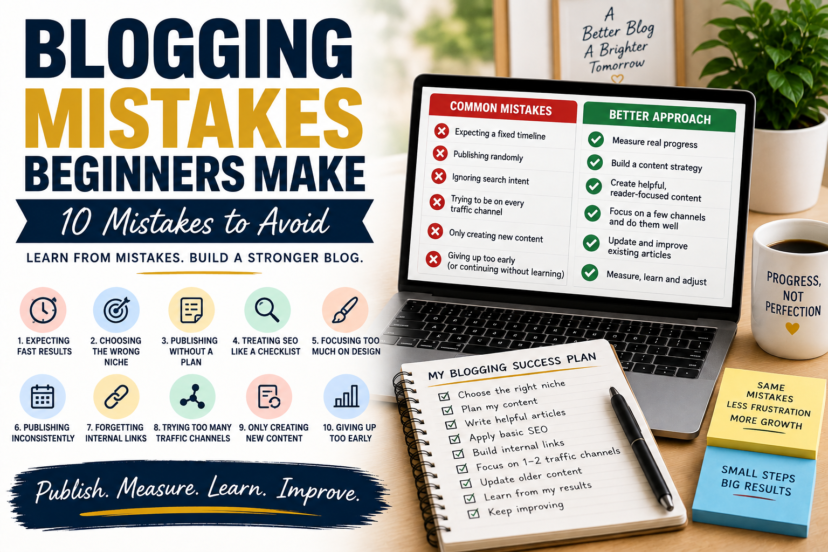
Blogging Mistakes Beginners Make: 10 Mistakes to Avoid
Starting a blog is exciting.
You choose a niche, set up your website, publish your first articles—and naturally hope that readers will begin finding them.
Then reality sets in.
Traffic may remain small. Writing takes longer than expected. SEO feels more complicated than it looked in tutorials, and monetization can seem frustratingly distant.
At this point, it is easy to assume that you are doing something fundamentally wrong.
But many of the blogging mistakes beginners make are not dramatic failures. They are smaller strategic decisions that gradually waste time: choosing topics without understanding the audience, publishing without a clear direction, obsessing over design, chasing too many traffic strategies, or expecting results before the underlying system has had a chance to develop.
The good news is that you do not need to blog perfectly.
You need a process that helps you create useful content, learn from what happens, and make better decisions as your website grows.
Here are ten common mistakes worth recognizing early—and what to do instead.
Mistake #1: Expecting the Blog to Grow on a Fixed Timeline
One of the easiest mistakes to make is starting with an invisible deadline.
Perhaps you expect noticeable traffic after three months.
Your first affiliate commissions after six.
A dependable side income after a year.
Those milestones sound reassuring because they make blogging feel predictable.
Unfortunately, it is not.
Two blogs started on the same day can develop very differently depending on their niche, competition, content quality, available time, existing skills, promotion, website history, and monetization strategy.
Even individual articles on the same website can behave differently. One may begin attracting search visitors while another receives almost no organic traffic.
That does not mean timelines are completely useless. They can help you understand that blogging generally requires patience.
The problem begins when an estimate becomes an expectation.
Instead of asking whether your blog is where somebody else’s was after six months, look for evidence of progress within your own website.
Are more pages being discovered?
Are search impressions increasing?
Are people clicking your Pinterest pins?
Is your email list growing?
Are readers moving between related articles?
Have you earned your first affiliate clicks or conversions?
Those signals tell you much more than the number of months since you registered your domain.
If income expectations are becoming frustrating, How Long Does Blogging Take to Make Money? explains why there is no universal blogging income timeline and what progress can look like before meaningful revenue appears.
Mistake #2: Choosing a Niche Mainly Because It Looks Profitable
It is easy to find lists of supposedly profitable blogging niches.
Finance. Software. Health. Business. Technology.
The temptation is obvious:
“If advertisers and affiliate programs pay well in this niche, I should start a blog about it.”
But monetization potential is only one part of the decision.
You also need enough understanding or willingness to learn, an audience you can genuinely help, sufficient content opportunities, and a subject you can realistically continue working with.
The opposite extreme creates problems too.
Choosing a topic solely because you enjoy it does not automatically create a viable blog business.
A useful niche usually sits at the intersection of several factors:
Audience needs + Content opportunities + Your knowledge or interest + Search demand + Monetization potential
You do not need the “perfect” niche.
You need one with enough room to create valuable content and develop over time.
That is why How to Choose a Blog Niche focuses on evaluating the whole opportunity rather than simply finding the subject with the highest potential commissions.
Mistake #3: Publishing Whatever Comes to Mind
A new blogger often has plenty of ideas.
On Monday, you write about SEO.
The next article is about productivity.
Then you discover an interesting affiliate program and create a review.
A week later, Pinterest looks promising, so that becomes the next topic.
You are publishing—but the website is not necessarily becoming more coherent.
A better approach is to think of your blog as a connected library.
What does your audience need to understand first?
Which questions naturally follow?
Which subjects belong together?
Where are the gaps?
For example, someone learning to blog might move naturally from choosing a niche to planning content, writing articles, learning SEO, researching keywords, and building internal links.
Each article solves a separate problem while contributing to a larger learning path.
This does not mean your content calendar can never change.
It means every new article should have a reason to exist.
How to Plan Blog Content shows how to turn individual ideas into topic clusters and a manageable publishing plan.
Mistake #4: Treating SEO Like a Checklist
Beginner SEO advice can quickly become mechanical.
Put the keyword in the title.
Use it in the introduction.
Add it to several headings.
Repeat it a certain number of times.
Put it in your images.
Get all the indicators in your SEO plugin to turn green.
The danger is that you can complete every item on that list and still create an article that does not satisfy the reader.
Modern SEO begins much earlier.
What is the person actually searching for?
What problem are they trying to solve?
What type of answer do they expect?
Can your article provide that answer clearly and accurately?
Keywords, titles, headings, URLs, internal links, images, and technical optimization still matter. But they support the content rather than replace it.
Do not write awkward sentences simply to satisfy an SEO tool.
And do not create separate articles for every slight keyword variation if those searches represent the same underlying need.
If SEO still feels like a collection of rules, SEO for Beginner Bloggers explains a simpler approach based on search intent, helpful content, clear structure, and accessibility.
Mistake #5: Spending Too Much Time Perfecting the Website
Choosing a theme can easily turn into changing a theme.
Then the fonts need adjusting.
The buttons could look better.
Perhaps the homepage needs another redesign.
Should the logo be larger?
Would a different shade of green look more professional?
Weeks can disappear this way.
Design matters. Your website should be readable, usable on mobile devices, reasonably fast, and visually trustworthy.
But there is a point where additional design work produces very little benefit.
A visitor arriving through Google primarily wants the answer to a question.
Someone clicking a Pinterest pin expects useful content.
They are unlikely to care whether you spent three hours comparing two almost identical font sizes.
Get the important basics right, then publish.
Your website can evolve alongside your content.
In fact, you will often make better design decisions later because you have real pages, readers, and goals to design around.
Mistake #6: Confusing Consistency With a Rigid Publishing Schedule
“Be consistent” is common blogging advice.
Unfortunately, beginners sometimes interpret it as:
“I must publish every Tuesday forever.”
Or:
“A serious blogger needs at least two new articles every week.”
There is no universal publishing frequency that guarantees traffic or income.
Someone working full-time may be able to create one strong article every week or two. Another blogger may have enough resources to publish more frequently.
Both approaches can work.
Consistency means developing a process you can realistically maintain.
It also means doing more than publishing new posts.
A sustainable blogging routine may include writing, updating older articles, creating Pinterest pins, checking search performance, improving internal links, and working on your email list.
Publishing ten rushed articles in one month and disappearing for the next three is unlikely to be a useful system.
But forcing yourself to publish every week when quality is suffering is not the solution either.
And there is no magical number of posts you need to reach before a blog becomes successful. How Many Articles Do You Need? explains why the usefulness and strategic role of your content matter more than reaching an arbitrary article count.
Mistake #7: Treating Every Article as an Isolated Page
Publishing does not end when you press the button.
Your new article becomes part of a larger website.
It may provide background for something you wrote six months ago. An older article may now have a natural reason to send readers toward this new resource.
This is where internal linking matters.
Suppose you publish a detailed keyword research guide.
Your existing SEO article already introduces keyword research briefly. Returning to that older page and adding a contextual link gives interested readers somewhere useful to continue.
The connection works in both directions.
Your new article can reference relevant existing content, while selected older pages can point toward the new guide.
Over time, these relationships turn individual posts into topic clusters and learning paths.
The mistake is not simply “forgetting to add enough links.”
It is failing to think about how your content works together.
Internal Linking Explained shows how to create those connections without turning every paragraph into a collection of links.
Mistake #8: Trying to Master Every Traffic Channel at Once
You publish your first articles and immediately realize you need visitors.
So you learn SEO.
Then someone says Pinterest is faster.
You create a Pinterest account.
Another expert says email is essential.
Now you need a lead magnet and welcome sequence.
Then you hear about Instagram, Facebook, YouTube, LinkedIn, TikTok, and perhaps another platform that launched last Tuesday.
Suddenly, you are managing seven marketing channels and barely have time to create the content they are supposed to promote.
This is particularly dangerous for bloggers building a website alongside a job.
Your time is limited.
It is usually more manageable to establish a small number of traffic and audience-building systems before adding more.
For Realistic Side Income, for example, a combination of useful blog content, SEO, Pinterest, and email can form a coherent system:
Content → Discovery → Website → Email Subscriber → Return Visitor → Monetization Opportunity
That does not mean every blogger needs exactly those channels.
The principle is to avoid spreading your limited time so thinly that none of them receives enough attention to develop.
Mistake #9: Publishing New Content but Never Improving Old Articles
New articles feel productive.
They increase the number in your WordPress dashboard and give you something fresh to promote.
But as your skills improve, older content can become one of your most valuable opportunities.
Perhaps an article written a year ago has outdated information.
Maybe the structure is weak.
The introduction no longer matches the search intent.
You have since published three related guides that could now be linked internally.
An old screenshot is no longer accurate.
Or Search Console shows that the page appears for queries you did not originally consider.
Updating the article may be more useful than adding another new post.
This is particularly true once your website has developed a substantial content library.
Blogging gradually shifts from:
Create → Publish → Create → Publish
toward:
Create → Publish → Measure → Update → Connect → Improve
Your older articles are not finished products stored in an archive.
They are assets that can evolve with your website.
Mistake #10: Either Giving Up Too Early—or Continuing Without Learning
“Don’t give up” sounds encouraging, but it is incomplete advice.
Persistence matters.
Blogging often develops slowly, and abandoning a project simply because the first few months produced little traffic may mean stopping before you have learned enough to judge the strategy properly.
But blindly repeating the same actions for years is not a strategy either.
Suppose you have published dozens of articles and organic visibility is barely changing.
The answer is not automatically:
“Just publish another 50.”
Investigate.
Are you choosing topics with realistic search opportunities?
Does the content satisfy search intent?
Can search engines access and index the pages?
Is the website focused enough?
Are articles competing with one another for essentially the same searches?
Do you have meaningful internal links?
Are people reaching the site through other channels?
Is your monetization appropriate for the audience you are attracting?
Persistence becomes valuable when it is combined with feedback.
A better cycle is:
Publish → Measure → Learn → Adjust → Continue
Patience does not mean doing the same thing indefinitely.
It means giving a thoughtful strategy enough time while remaining willing to improve it.
Bonus Mistake: Focusing on Monetization Before Building Enough Value
Making money may be one of the reasons you started the blog.
There is nothing wrong with that.
Realistic Side Income is, after all, about building additional income.
The problem begins when monetization becomes more visible than usefulness.
An article filled with affiliate links but very little helpful information gives readers little reason to trust the recommendations.
Likewise, publishing only product reviews and “best tools” articles can create a site that feels more like a catalogue than a useful resource.
You do not have to wait until you reach a particular traffic number before monetizing.
A relevant affiliate link can make sense from the beginning if it genuinely helps the reader.
But the principle should remain:
Help first. Recommend second.
Build content worth discovering.
Earn attention.
Create trust.
Then let monetization become a natural part of the reader journey rather than the entire purpose of every page.
What Should Beginner Bloggers Focus On Instead?
Avoiding mistakes does not require remembering another enormous checklist.
Most of the improvements come back to a few principles.
Know who you want to help and understand the problems they are trying to solve.
Create connected content rather than isolated posts.
Learn enough SEO to make that content discoverable without allowing optimization to ruin the writing.
Choose a publishing rhythm that fits your real life.
Build one or two traffic systems properly before chasing the next strategy.
Revisit older content as your knowledge grows.
And measure enough to know whether your decisions are moving the website forward.
That is a much more sustainable foundation than trying to blog perfectly from Day 1.
Progress Is More Useful Than Perfection
You will make mistakes.
Every blogger does.
An article you are proud of today may look surprisingly weak two years from now.
That is not necessarily a bad thing.
It means your standards and skills have improved.
You may eventually rewrite introductions, change your content structure, replace images, remove weak recommendations, update internal links, or completely rethink an article.
The goal is not to create a flawless website from the beginning.
It is to build one that gets better as you get better.
That is a much more realistic expectation for a long-term blogging project.
Final Thoughts
The most damaging blogging mistakes beginners make rarely come from not knowing an advanced SEO technique or using the wrong WordPress setting.
They usually come from strategy.
Expecting a fixed timeline.
Choosing topics mainly for money.
Publishing without direction.
Treating SEO mechanically.
Spending more time designing than creating.
Following an unsustainable schedule.
Ignoring existing content.
Trying to be everywhere at once.
Or confusing persistence with blindly continuing a strategy that is not working.
You do not need to avoid every mistake.
You need to notice them early enough to learn from them.
Build useful content. Connect it. Give people ways to discover it. Pay attention to what happens. Improve what needs improving.
Then repeat the process.
If you want to continue through the complete blogging learning path, the Blogging Hub brings together our guides on niche selection, content planning, writing, SEO, keyword research, internal linking, traffic, and long-term blog growth.
A successful blogging strategy is not one where nothing ever goes wrong.
It is one that becomes more informed with every article you publish and every lesson you learn.
FAQs
1. What is the biggest mistake beginner bloggers make?
There is no single mistake that applies to everyone, but unrealistic expectations can create many other problems. When beginners expect fast traffic or income, they may rush content, change strategies too quickly, over-monetize, or abandon the project before they have enough information to evaluate it properly.
2. How often should a beginner publish blog posts?
There is no ideal publishing frequency. Choose a schedule that allows you to create useful content consistently without sacrificing quality or neglecting other important work such as promotion, internal linking, email marketing, and content updates.
3. Do beginner bloggers need SEO?
Understanding basic SEO is valuable if organic search is part of your traffic strategy. Beginners should focus first on search intent, useful content, clear structure, internal links, and making sure their website is accessible to search engines rather than trying to master advanced optimization immediately.
4. Should beginners focus on website design or content first?
Your site should be readable, mobile-friendly, reasonably fast, and easy to navigate. Once those basics are in place, creating useful content is generally a better use of limited blogging time than repeatedly making minor visual changes.
5. When should I stop or change a blogging strategy?
There is no universal deadline. Instead of changing direction simply because growth feels slow, look at your data and the quality of the underlying strategy. If traffic, search visibility, engagement, or other meaningful indicators are not developing, investigate the reasons and adjust what is not working.