
When to Monetize Your Email List: A Realistic Beginner’s Guide
Introduction
Building an email list eventually raises an obvious question:
When should you start making money from it?
Search for an answer and you may find subscriber milestones, recommended waiting periods, or formulas telling you how many helpful emails should come before the first promotion.
Those rules sound reassuring because they give you a clear moment to aim for.
But email monetization does not work on a universal schedule.
You do not automatically become ready when your list reaches 500 subscribers. Waiting three months does not guarantee that an offer will suddenly make sense. And sending a particular number of educational emails does not create a point at which subscribers are now “ready to buy.”
A better question is:
Does this offer make sense in the context of why these subscribers are hearing from me?
That question changes the way you approach monetization.
Instead of treating your list as an audience that eventually needs to be converted into revenue, you begin with the relationship that already exists. Why did people subscribe? What are they trying to accomplish? What have you promised to send them? Is there a product, service, or resource that genuinely fits that context?
Sometimes the answer may lead to an offer surprisingly early.
At other times, the right commercial opportunity may not be clear yet.
Both are perfectly reasonable.
In this guide, we’ll look at how to recognize those differences, choose appropriate ways to monetize, and learn from the response without turning every subscriber interaction into a sales opportunity.
There Is No Monetization Milestone
Subscriber count is one of the easiest numbers to use as a milestone.
You might tell yourself:
I’ll start monetizing at 500 subscribers.
Or perhaps:
I need 1,000 people before anyone will buy.
The problem is that list size tells you almost nothing about whether a particular offer belongs in your emails.
A small list built around one clearly defined subject may give you considerable context about why people joined. A much larger audience assembled through unrelated lead magnets, topics, and traffic sources may contain people with very different interests.
Neither list is automatically better.
They are simply different.
The same applies to time.
A subscriber who joined yesterday through a highly specific resource may encounter a relevant product sooner than someone who has received your emails for six months but has shown no apparent interest in that subject.
That is why neither subscriber count nor time on the list provides a reliable answer to when to monetize your email list.
They describe the audience.
They do not decide whether the offer fits.
Start With Subscriber Context, Not List Size
Every subscription begins somewhere.
Perhaps someone found a Pinterest article through Google and downloaded a Pinterest keyword worksheet. Another person may have joined through your Side Hustle Roadmap. Someone else could have subscribed after reading about affiliate marketing.
Those entry points provide useful context.
They do not tell you everything about a person, but they help explain what was relevant at the moment of signup.
That matters when you begin considering commercial offers.
A reader who requested a Pinterest planning resource has given you some reason to believe that Pinterest is currently relevant to them. A person who downloaded a broad guide to side-income ideas has provided much less information about which business model or tool they might eventually need.
The question therefore becomes:
What would make sense as a continuation of this particular context?
Sometimes the answer is another free article.
It could be a worksheet, tutorial, or comparison.
In other situations, a paid tool, your own product, or a service may genuinely be useful.
The important point is that monetization begins with the subscriber’s situation rather than your desire to introduce revenue.
If you are still building that foundation, Why Every Side Hustle Needs an Email List explains why email works best as permission to continue communicating rather than simply a collection of addresses.
Monetization Is Part of the Relationship, Not a Separate Phase
One of the most common ways to think about email marketing is:
First provide value. Then build trust. Then monetize.
There is some useful intuition behind that sequence. A stranger who knows nothing about you may have little reason to pay attention to an unrelated recommendation.
But the model becomes misleading when those ideas are treated as fixed stages.
Helpful communication does not suddenly end when money becomes involved.
And monetization does not have to begin only after an invisible trust threshold has been crossed.
Imagine you write an email explaining how to choose an email marketing platform. You discuss the features a beginner may need, explain which capabilities are probably unnecessary at first, and mention the platform you use.
If you have an affiliate relationship with that company, the email can be both useful and commercial at the same time.
Likewise, a subscriber might ask whether you provide a particular service. Offering that service is monetization, but it would make little sense to refuse simply because your list has not reached an arbitrary size.
The distinction that matters is not:
Value or monetization?
It is:
Does the commercial element contribute something relevant to the communication, or has it been inserted mainly because you want the subscriber to buy?
That is a much more useful boundary.
You Do Not Need to Wait for Perfect Trust
Trust matters when people evaluate recommendations.
But it is easy to turn that idea into another formula:
Send useful emails → build enough trust → make an offer.
Trust does not work like a balance that gradually fills until monetization becomes safe.
As we discussed in How to Build Trust Through Email, you can communicate in ways that give subscribers reasons to consider you reliable, transparent, and useful. Whether they actually trust your advice remains their judgment.
That principle continues when money enters the relationship.
A recommendation does not become trustworthy because you waited long enough to make it.
The recommendation itself still needs to deserve consideration.
Is the product relevant?
Have you represented it accurately?
Have you explained important limitations?
Are you clear about your financial interest?
Do subscribers have enough information to decide whether the offer makes sense for them?
Those questions remain important whether someone has received two emails from you or twenty.
Do not wait for trust to become “complete.” Make commercial communication worthy of the same standards as everything that came before it.
A Small List Can Be Enough
You do not need thousands of subscribers before testing whether email can contribute to revenue.
A smaller audience may be perfectly capable of producing a sale, client inquiry, affiliate commission, or product purchase.
It may also produce none of those things.
Both outcomes are possible.
That is why claims about how much money a list of a particular size “should” generate are not particularly helpful.
Revenue depends on far more than subscriber count.
The subject of the list matters. So does the offer, price, subscriber context, purchasing need, communication, landing page, timing, and many other factors.
A list of 150 people interested in solving a specific business problem may create an opportunity that a broad list of several thousand people does not.
The opposite can also be true.
Instead of asking whether your list is large enough, ask whether you understand enough about the situation to make a relevant offer and learn from what happens next.
Different Audiences Create Different Monetization Opportunities
Not every email list should make money in the same way.
A freelancer may use email primarily to generate client inquiries.
A blogger could recommend relevant affiliate products.
Someone with a specialized skill might sell templates or consulting.
Another business may eventually create a course, membership, or digital product.
This is why there is no necessary progression from:
Affiliate Marketing → Own Product → Sponsorships
Your business model determines which options make sense.
Even within the same website, different subscriber groups may create different opportunities.
A reader interested in Pinterest traffic may eventually find a Pinterest tool or template useful. Someone exploring blogging may need hosting, an email platform, or educational resources. A subscriber interested in side-hustle ideas may not yet need any particular business software at all.
Email monetization becomes more natural when the offer grows from the subject rather than being imposed on it.
Affiliate Recommendations Can Fit Naturally
Affiliate marketing is one possible way to monetize without creating your own product.
You recommend a product or service, and if someone makes a qualifying purchase through your link, you may receive a commission.
The simplicity is attractive, but joining an affiliate program does not automatically create something worth recommending.
Start with the problem.
Suppose you are explaining how to start an email list. A particular email platform may be relevant because the reader needs software to perform the task.
Now the recommendation has a reason to appear.
You can explain what the platform does, which features you find useful, what it costs, where its limitations matter, and who may not need it.
If your knowledge comes from personal use, say so when that context is useful.
If your recommendation is based primarily on research, do not imply that you have personally used the product.
The objective is not to make the product sound universally attractive.
It is to give the reader enough context to decide whether it fits their situation.
Our guide to How to Start Affiliate Marketing as a Beginner explores the broader relationship between useful content, relevant recommendations, and affiliate revenue.
Do Not Let the Commission Determine the Recommendation
Affiliate programs create an obvious incentive.
One product may pay significantly more than another.
That information matters to your business, but it should not replace the question of fit.
A high commission does not make an unsuitable product useful.
Nor does a low commission make a good recommendation unimportant.
Instead, consider the product from the subscriber’s side.
What problem does it solve?
Who is likely to benefit?
What does it cost?
Are there meaningful disadvantages or restrictions?
Does the subscriber need this level of solution yet?
Are there reasonable alternatives?
Those questions make the recommendation more informative even when the reader decides not to buy.
And that is important.
A useful recommendation should still help someone evaluate the decision when the final answer is no.
Your Own Product Does Not Have to Come Later
You may eventually discover that subscribers repeatedly struggle with a problem that your existing content does not solve particularly well.
Perhaps people have difficulty organizing a side hustle around a full-time job.
That could inspire a planner, workbook, template, or another focused resource.
But repeated questions are not proof that people will pay for a product.
They are evidence of a problem worth investigating.
You might explore the subject through emails, ask follow-up questions, publish an article, create a simple resource, or speak with readers before deciding what to build.
If a paid product eventually makes sense, it does not need to be enormous.
A focused template can be more useful than a large course when the problem itself is narrow.
Price should reflect the product, audience, market, and value offered rather than a rule about what a beginner product is supposed to cost.
The important shift is this:
Do not begin with “What can I sell?”
Begin with:
“What problem appears important enough to solve more completely?”
Services Can Make Sense With a Very Small Audience
Services are easy to overlook in discussions about email monetization because they are less scalable than digital products.
But scalability is not always the first problem a beginner needs to solve.
If you provide freelance writing, Pinterest management, design, virtual assistance, consulting, website support, or another service, one appropriate client may matter more financially than many small product sales.
An email can demonstrate how you think about the problem your service addresses.
Later, when a subscriber needs help they do not want to handle themselves, your service may become relevant.
That does not require thousands of people on a list.
It requires the right problem, the right person, and an offer that makes sense in the situation.
The tradeoff is capacity. Services generally exchange more of your time for revenue than scalable products do.
That is a business-model consideration—not a reason to treat services as an inferior form of monetization.
Sponsorships Are Another Model, Not the Final Stage
Sponsorships may become relevant when a company wants access to an audience you have built.
Audience size can matter here, but so can subject focus, reader characteristics, engagement, geographic reach, and the sponsor’s goals.
For some publishers, sponsorship becomes an important revenue stream.
For others, it never fits particularly well.
There is no requirement to progress toward sponsored emails simply because your list grows.
If you do accept sponsorships, the same principles that apply to other commercial communication remain relevant: the relationship should be transparent, and the sponsor should make sense for the audience receiving the message.
Monetization options are choices.
They are not levels you need to unlock.
Do Not Force an Offer Because You Want to Monetize
This may be one of the most useful decisions a beginner can make:
Sometimes there is nothing appropriate to sell yet.
Perhaps you understand the audience reasonably well but have not found a product you feel comfortable recommending.
Maybe you are still investigating what readers actually need.
Or your current affiliate options solve problems that are too advanced for the people joining your list.
You do not need to fill that gap with a random offer.
Continue communicating.
Pay attention to questions.
Develop useful content.
Explore products and business models.
An offer becomes much easier to explain when you know why it belongs there.
No suitable offer is better than an irrelevant offer created only because the list is supposed to make money.
Your Lead Magnet Influences What Comes Next
A lead magnet does more than generate a subscription.
It establishes context for the communication that follows.
Someone downloading a Pinterest Keyword Worksheet has expressed a relatively specific immediate interest.
A subscriber choosing a broad Side Hustle Starter Guide has revealed something different.
This does not lock either person permanently into one topic.
Interests can expand and change.
But the signup context gives you a useful starting point.
That is why lead magnets should not be evaluated only by how many email addresses they collect.
Consider what kind of relationship they begin.
Does the resource connect naturally with the subjects you intend to cover?
Are there logical next resources?
Could a relevant commercial solution eventually belong in that journey?
Our Lead Magnet Ideas for Beginners guide explains how to choose a resource around what the reader needs rather than selecting a format simply because it is supposed to convert well.
Welcome Emails Can Include Offers When They Belong There
You do not need a rule saying:
Never sell in your first five emails.
You also do not need one saying:
Email five should contain your first offer.
Both ignore context.
Suppose someone signs up for a comparison guide because they are actively trying to choose an email marketing platform.
A relevant recommendation could make sense very early because it addresses the reason they subscribed.
Compare that with someone downloading a broad guide about finding time for a side hustle.
Immediately recommending expensive business software may have little connection to the problem that brought them onto the list.
The sequence number does not determine relevance.
The subscriber’s situation does.
Your first responsibility remains the same: deliver what you promised at signup and make the relationship understandable.
After that, a commercial recommendation can appear whenever it genuinely contributes to the subject being discussed.
The Perfect Welcome Email Sequence develops this flexible approach without prescribing a mandatory number or order of messages.
There Is No Required Value-to-Promotion Ratio
You may encounter rules such as:
Send three educational emails for every promotional email.
Or:
Keep your content 80% value and 20% sales.
Ratios can remind an overly promotional business that subscribers need reasons to remain interested.
But they do not solve the underlying question.
What counts as “value”?
A promotional email can be extremely useful when it helps someone make a difficult purchasing decision.
An educational email can be nearly worthless when it repeats generic advice the subscriber already knows.
Instead of classifying every message as either value or sales, examine what the reader receives from it.
A commercial email could explain:
- what problem the product addresses
- how it works
- what it costs
- who may benefit
- who probably does not need it
- important limitations
- relevant alternatives
A subscriber can learn something useful from that explanation without purchasing anything.
That is a much stronger standard than meeting a predetermined ratio.
Recommendations Need Context, Not Hype
The moment money becomes involved, exaggeration can become especially tempting.
You want the reader to click.
You want the promotion to convert.
Perhaps a commission or product launch depends on the result.
But commercial pressure does not make an unsupported claim more accurate.
Avoid turning ordinary tools into “game changers” simply because an affiliate link follows.
Do not imply that a product will create income when the outcome depends on many other factors.
And be cautious about urgency unless the deadline or limitation genuinely exists.
Instead, explain the recommendation.
What does the product help with?
Why are you mentioning it here?
What experience or research informs your view?
Where might it fall short?
Who should probably consider another option?
This approach may sound less dramatic than conventional sales copy.
It also gives the reader more useful information with which to make a decision.
Be Clear About Financial Relationships
When you benefit financially from a recommendation, that relationship should not be hidden.
In the United States, for example, the Federal Trade Commission says material connections that consumers may not expect should be disclosed clearly and conspicuously. Its affiliate guidance also notes that the closer the disclosure is to the recommendation, the better, and that wording such as “affiliate link” alone may not adequately explain that you can receive compensation.
A straightforward disclosure could say:
“If you purchase through this link, I may earn a commission at no additional cost to you.”
That gives the reader meaningful information about your relationship with the recommendation.
Requirements vary by jurisdiction, business model, and circumstances, so this is not legal advice.
The broader principle is simpler:
Subscribers should be able to understand when your recommendation can financially benefit you.
Transparency does not make a useful recommendation less useful.
It gives readers additional context for evaluating it.
Selling Does Not Automatically Damage the Relationship
Many beginners feel uncomfortable when they first introduce an offer.
Providing free information feels helpful.
Asking for money can suddenly feel different.
But a commercial exchange is not inherently opposed to helping someone.
If a product solves a problem, a service saves the client time, or a tool makes a task easier, introducing that solution can be entirely appropriate.
The issue is not whether money changes hands.
The issue is whether the communication remains accurate, relevant, and transparent when it does.
Subscribers are also free to decline.
They may read the recommendation and decide the free information is enough.
They might prefer another product.
Perhaps the timing is wrong.
None of those responses means you should never make another offer.
A healthy commercial relationship leaves room for no.
One Offer Does Not Have to Be the Only Link
Another common piece of advice says every promotional email should contain:
One problem. One solution. One CTA.
Simplicity can certainly help.
But it should not become another rule.
Sometimes a single clear recommendation is exactly what the email needs.
In another situation, comparing two alternatives may be more useful because different subscribers have different requirements.
You might also link to a supporting article alongside the product recommendation.
The better question is whether each option helps the reader understand or act on the message.
Too many unrelated choices can create confusion.
But removing useful context simply to reach an arbitrary CTA count is not an improvement either.
Clarity matters more than the number of links.
Use Email Metrics to Investigate What Happens
Once you introduce commercial offers, analytics can help you understand the response.
They cannot tell you exactly what subscribers think.
Suppose a recommendation receives many clicks but few purchases.
That suggests something different from an offer that receives almost no clicks at all.
If few people follow the link, you might investigate the relevance of the product, the way it was introduced, or whether the audience currently cares about that problem.
If subscribers click but do not convert, the important questions may shift beyond the email.
Does the landing page match what the message led people to expect?
Is the price appropriate for the audience?
Does the product page answer important questions?
Is checkout working properly?
You may not control all of those elements when promoting an affiliate product.
That is useful information too.
Our Email Marketing Metrics Explained guide develops the broader principle:
Metrics are signals that help you investigate. They are not automatic explanations.
Recorded Opens Do Not Determine Monetization Readiness
The original version of this article treated people opening emails as one of the signs that a list may be ready to monetize.
That gives the metric too much responsibility.
Open tracking has important technical limitations. Privacy features such as Apple Mail Privacy Protection can prevent senders from reliably determining whether a protected recipient actively opened a message.
More importantly, even a perfectly measured open would not tell you whether someone wants a particular product.
A recorded open can provide some directional information about email activity.
It cannot establish:
This subscriber is ready to buy.
Clicks, replies, and other behaviors also require context.
Use analytics to understand patterns in your communication rather than trying to convert engagement metrics into a monetization permission slip.
No Sales Does Not Automatically Mean the Email Failed
Imagine you recommend a product for the first time and nobody buys.
The easiest conclusion is:
This didn’t work.
But what exactly did not work?
Perhaps very few subscribers followed the link.
Maybe many clicked and then left the product page.
The offer could have been relevant but too expensive for the audience.
Subscribers might need a feature the product does not provide.
Or the audience may simply not have enough need for the solution right now.
It is also possible that the email itself was unclear.
The point is not to invent a reassuring explanation for zero sales.
It is to avoid pretending that the result identifies the cause.
Look at what you can observe.
Then decide what deserves further investigation.
A promotion is an opportunity to learn about the relationship between audience, problem, offer, and communication—not a final verdict on your ability to monetize.
Unsubscribes After a Promotion Need Context
Some subscribers may leave after receiving a commercial email.
That can feel uncomfortable, particularly the first time you promote something.
But an unsubscribe does not automatically mean that selling was a mistake.
People leave lists for many reasons. Their interests change. They may no longer need the topic. Perhaps they joined for one resource and never intended to remain long term.
What matters more is whether a pattern emerges.
If promotional emails consistently produce a noticeably different response from comparable messages, investigate why.
Is the offer relevant to the reason people subscribed?
Does the tone suddenly become much more aggressive?
Are you sending promotions people were not reasonably expecting?
Has the frequency changed?
Do subject lines represent the message accurately?
Spam complaints deserve particular attention because they can affect sender reputation and deliverability. Gmail’s current sender guidance emphasizes consent, easy unsubscribe, authentication, and low spam complaint rates; requirements become more extensive for high-volume senders.
The goal is not to prevent every person from leaving.
It is to make staying voluntary and the communication worth choosing.
Automation Can Support Monetization Without Deciding What to Sell
Automation can make email monetization more sustainable.
A welcome sequence may deliver a promised resource, introduce useful articles, explain important concepts, and include relevant commercial recommendations.
That can reduce the need to manually send the same information to every new subscriber.
But automation does not make the recommendation appropriate.
You still decide what belongs in the sequence.
Imagine a subscriber joins through a blogging resource and later receives an automated email explaining website hosting.
That connection may be perfectly sensible.
Now imagine the same sequence suddenly recommends an unrelated product simply because it has a profitable affiliate program.
Automation makes both emails equally easy to send.
It does not make them equally useful.
Automate delivery where it helps. Keep human judgment in charge of relevance.
Let Subscriber Questions Inform Product Ideas
Email gives you something analytics alone cannot provide:
direct language from subscribers.
Pay attention when people ask questions, describe obstacles, or explain why existing solutions are not working for them.
Repeated themes can reveal areas worth investigating.
Suppose several subscribers mention difficulty planning side-hustle work around a full-time job.
That does not prove demand for a paid planner.
But it tells you that the underlying problem deserves attention.
You could explore it through an article, ask subscribers additional questions, test a worksheet, research existing solutions, or eventually develop a product.
The audience is not handing you a guaranteed business idea.
It is helping you see problems more clearly.
That is a much stronger starting point than inventing a product in isolation and hoping someone wants it.
Revenue Is One Outcome, Not the Purpose of Every Email
Once you earn your first commission or product sale, revenue becomes another measurable outcome.
That can be exciting.
It can also distort the way you evaluate your emails if you are not careful.
A message explaining an important concept may generate no immediate income.
Another may invite useful replies.
A third could send readers to a free resource.
Later, a commercial email may produce revenue partly because those earlier interactions created the context in which the recommendation made sense.
This does not mean you should assign invisible monetary value to every educational email.
It means that different messages have different purposes.
Evaluate them accordingly.
The fact that your business needs revenue does not require every individual email to produce it.
A Better First Monetization Experiment
Your first attempt at email monetization does not need to be a launch.
Treat it as a focused question.
Perhaps subscribers regularly show interest in a particular problem and you know of a product that appears to address it well.
Your question might be:
Does this recommendation make sense to subscribers interested in this problem?
Write the email around the problem rather than the commission.
Explain the issue clearly. Introduce the product where it becomes relevant. Describe why you are mentioning it, provide important context, disclose the financial relationship when applicable, and make the next step understandable.
Then observe what happens.
Did people follow the link?
Did anyone reply with questions?
Did purchases occur?
Was there an unusual change in unsubscribes or complaints?
What happened after the click?
You may discover that the offer fits well.
You may learn that subscribers are interested in the problem but not this particular solution.
Or the response may be too limited to support a confident conclusion.
All three outcomes give you information.
Do Not Scale Before You Understand What You Are Scaling
Suppose an affiliate recommendation generates several sales.
It is tempting to conclude:
Great. I need more affiliate products.
But first examine what happened.
Was the recommendation closely aligned with the lead magnet?
Did subscribers already know they needed that type of product?
Was the price relatively accessible?
Did the product solve an unusually specific problem?
Were sales concentrated in a particular subscriber segment?
You may not be able to identify one definitive explanation.
That is fine.
The objective is to understand enough about the result that your next decision is deliberate rather than simply more.
Adding ten unrelated offers because one worked replaces learning with volume.
You Do Not Need a Monetization Ladder
Online-business advice often presents monetization as a progression:
Build Audience → Build Trust → Add Affiliate Links → Create Products → Add Sponsorships → Scale
Real businesses are rarely that tidy.
A freelancer might sell a service before having an email list at all.
A blogger could use affiliate links from the beginning because the content naturally discusses tools.
A creator may develop a small product before ever joining an affiliate program.
Another business might never use sponsorships.
Instead of climbing a predefined ladder, use a framework that works across different models:
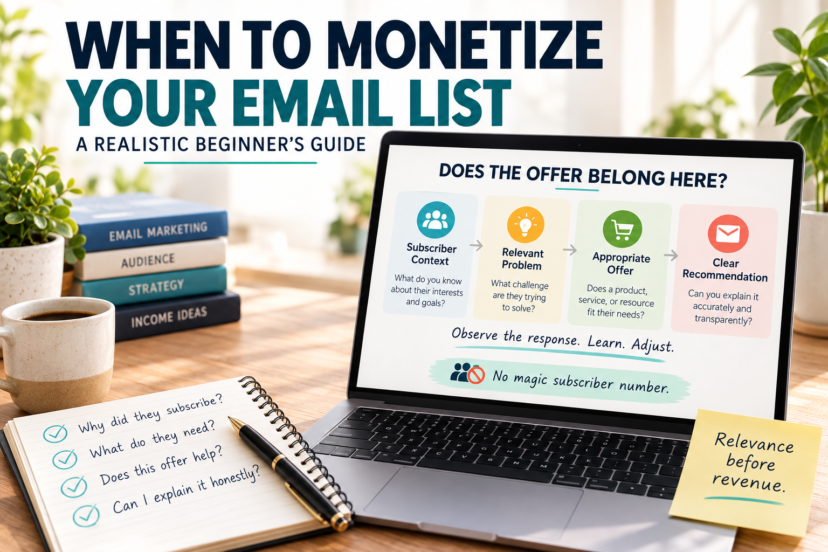
Subscriber Context → Relevant Problem → Appropriate Offer → Clear Recommendation → Observable Response → Learning
Subscriber Context
Why is this person hearing from you, and what do you reasonably know about their interests?
Relevant Problem
What problem or goal makes the commercial option worth discussing?
Appropriate Offer
Does the product, service, or resource genuinely fit that situation?
Clear Recommendation
Can you explain the offer accurately, including relevant limitations and financial relationships?
Observable Response
What happened that you can actually measure or learn from?
Learning
What does the evidence suggest you should investigate, keep, change, or leave alone?
Then the process continues.
There is no final stage at which monetization becomes solved.
Audience needs change.
Products change.
Affiliate programs change.
Your business changes.
The system should be able to change with them.
What Successful Email Monetization Looks Like
There is no single picture of a successfully monetized email list.
For one business, success may mean a small number of high-value service inquiries.
Another might earn regular affiliate commissions from highly relevant software recommendations.
Someone else may sell inexpensive digital resources to a larger audience.
The revenue models are different, so the metrics and economics will be different too.
What they can share is a coherent relationship between:
what the audience needs
what the business offers
and
how the offer is communicated
That relationship matters more than whether you began monetizing at subscriber 100 or subscriber 10,000.
A Better Question Than “Am I Ready to Monetize?”
The phrase ready to monetize can make it sound as though your list has to pass a test.
Perhaps you need enough subscribers.
Enough recorded opens.
Enough replies.
Enough months of free content.
Then you finally receive permission to sell.
There is no such threshold.
Instead, ask:
“Do I have a commercial offer that belongs in this communication, and can I explain why it may be useful?”
If the answer is yes, you can consider introducing it.
If the answer is no, waiting is not a failure.
It simply means the commercial connection is not clear yet.
That distinction removes much of the unnecessary anxiety from early email monetization.
Final Thoughts
So, when should you monetize your email list?
Not when you reach a predetermined subscriber count.
Not after a fixed number of welcome emails.
Not when an open-rate dashboard supposedly proves that people trust you.
And not simply because you have been publishing free content for long enough.
Start when you have a reason for the offer to belong in the communication.
That reason begins with context.
Why did people subscribe?
What are they trying to accomplish?
What problem are you discussing?
Does the product or service genuinely contribute to solving it?
Can you explain the recommendation accurately and disclose your financial interest clearly?
If those pieces fit, monetization can be a natural part of useful email communication rather than an abrupt transition from “helping” to “selling.”
Your first attempt may generate revenue.
It may generate useful questions.
It may show that the offer is poorly matched.
Or the evidence may remain inconclusive.
That is part of building the system.
Observe what happens, investigate before drawing conclusions, and improve the connection between audience, problem, offer, and communication.
Most importantly, do not look at an email address and ask:
“How much can this subscriber be worth?”
Ask:
“What can I offer that is genuinely worth considering?”
Revenue matters. A side hustle that is intended to become a business eventually needs a way to earn money.
But sustainable monetization does not require turning every interaction into a transaction.
You do not need permission from a subscriber count to monetize. You need a reason for the offer to belong in the relationship.
Your Next Step
Understanding when an offer belongs in your emails is only part of the process. Once you begin testing monetization, the next challenge is interpreting what happens without jumping to conclusions.
Return to Email Marketing Metrics Explained to distinguish between recorded opens, clicks, replies, conversions, unsubscribes, complaints, and the outcomes that occur after someone leaves the inbox.
If the offer itself feels premature because you still do not understand what subscribers need, How to Build Trust Through Email can help you focus on clearer expectations and useful communication.
And when the problem is attracting people whose interests align with the wider direction of your website, revisit Lead Magnet Ideas for Beginners and How to Increase Opt-In Rates.
The objective is not to rush toward the first possible sale.
It is to build a system in which useful content, subscriber needs, and appropriate commercial offers can work together.
FAQ
1. How many subscribers do I need before monetizing my email list?
There is no universal minimum. Subscriber count alone does not determine whether an offer is appropriate. A small list can create a meaningful commercial opportunity when the audience, problem, and offer are closely aligned, while a much larger list may contain subscribers with very different interests.
2. Can I monetize an email list with 100 subscribers?
You can introduce a relevant commercial offer to a small list, but revenue is never guaranteed. The more useful question is whether the product or service fits the reason those subscribers joined and whether you can explain the recommendation accurately.
3. Should I sell something in my welcome sequence?
An offer can appear in a welcome sequence when it naturally relates to the subscriber’s signup context. There is no required email number for the first promotion. Deliver what you promised first, make the relationship clear, and introduce commercial recommendations where they genuinely contribute to the subject.
4. What is the easiest way to monetize an email list?
There is no single easiest method for every business. Affiliate recommendations may suit content that naturally discusses products or tools. Services can work well for skill-based businesses, while your own digital products may make sense when you identify a problem worth solving directly.
5. How often should I send promotional emails?
There is no universal promotional ratio. Instead of trying to maintain an arbitrary balance between “value” and “sales,” consider whether each message remains relevant to the audience and provides enough information for subscribers to understand the offer.
6. Will subscribers unsubscribe when I start selling?
Some may, but an unsubscribe does not automatically mean the promotion was inappropriate. Look for patterns across comparable messages and investigate whether the offer, frequency, tone, or subscriber expectations changed significantly.
7. What should I do if my first promotion makes no sales?
Look at the available evidence before deciding what went wrong. If few people clicked, investigate relevance and communication. If people clicked but did not purchase, the important questions may involve the product, price, landing page, or checkout. Zero sales alone does not identify the cause.
8. Should I use affiliate marketing before creating my own product?
Not necessarily. There is no required order. Affiliate marketing, services, and your own products solve different business problems. Choose the model that fits your audience, skills, resources, and the problems you are equipped to address.
9. Do I need to disclose affiliate links in emails?
Applicable requirements depend on your jurisdiction and circumstances. In the United States, FTC guidance says material connections that consumers may not expect should be disclosed clearly and conspicuously, with disclosure close to the recommendation. A clear statement that you may earn a commission can communicate the relationship more effectively than simply labeling something an “affiliate link.”
10. When is it too early to monetize an email list?
It may be too early for a particular offer when you cannot explain why it is relevant to the subscribers receiving it, do not understand the problem it is supposed to address, or cannot represent the recommendation accurately. In that situation, learn more about the audience and problem rather than forcing a commercial connection.